


NS students embark on a year of learning in Ottawa
“The adaptation that they’re doing is amazing”
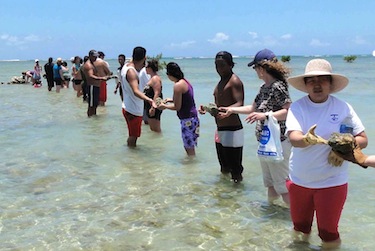
Students at Nunavut Sivuniksavut in Ottawa also learn about other indigenous cultures during their one-year program. On their 2011 cultural exchange tour to Hawaii, NS students spent an afternoon learning about the Mokauea Island Fisherman’s Association and their struggles to maintain traditions. The students pitched in to help transfer dead coral that is being used to protect the island from erosion. (FILE PHOTO)
Before last week, 17-year-old Valerie Amarualik of Resolute Bay, who described herself a “true Northerner,” had never been further south than Nunavut’s Rankin Inlet.
Today, she’s studying in Ottawa at Nunavut Sivuniksavut — the training program started in 1985 to prepare Nunavut youth for the implementation of the Nunavut land claims agreement— along with 31 other young Nunavummiut.
And now home isn’t a familiar dwelling in a High Arctic community of 250 but a city apartment, shared with two other students near downtown Ottawa, where they’re responsible for doing everything from buying and preparing their own food to getting to school every day for classes.
There’s a lot to get used to when students from Nunavut, mostly recent high school graduates still in their teens, come to study at Nunavut Sivuniksavut, — such as hot temperatures and the noise and bustle of city life (which caused one new arrival to already say on Facebook that she doesn’t like big cities).
“The adaptation that they’re doing is amazing, getting used to all these things that we take for granted here,” said NS co-ordinator Morley Hanson.
This also includes everyday things like remembering to take along door keys — in a pinch they can call NS staff for help — and learning how to budget on $1,000 a month.

“Everything looks so cheap to them down here. The value of money looks for different, so it’s easy to go through money,” Hanson said.
During the week after Labour Day, the newly-arrived NS students went to Harris Farm, an idyllic country getaway outside Ottawa, for their orientation.
Hanson described them as “pretty representative of what we’ve come to expect,” but perhaps a little more comfortable with themselves and more technologically savvy.
At Harris Farm, the students, 25 young women and seven young men, got to know each other and learned more about what they would be studying at NS.
“What they’re doing when they come, they’re taking a leap of faith, because they don’t really know what they’re getting into to,” Hanson said. “It’s this obscure kind of program — basically they come because other people tell the it’s a good experience. So it’s mostly a leap of faith [to come], but it’s good for them.”
Of the 36 admitted to NS this year, 17 from Nunavut’s Baffin region, 10 from the Kivalliq region and eight from the Kitikmeot, 32 decided to come to NS — and only two are yet to arrive in Ottawa.

This week, students were already hunkering down to work at NS’s new building at 450 Rideau St, starting with English classes and an overview of the Nunavut Land Claims Agreement.
NS classes start about 9:00 a.m. and last until 4:00 p.m., but after that students often can be found late into the night at the building, socializing and using the computers there to prepare their homework.
It’s their place, Hanson said, and after 5:30 pm, there’s no official supervision, although sometimes former NS students drop by.
This year there are nine NS students in their second year of study, which includes university courses, offered by Carleton University instructors at NS.
These students will complete courses in subjects such as research, political science and public administration for credit — a great stepping stone to continuing on with their university studies, Hanson said.

Still many are not ready to tackle university on their own after one year of NS, he said.
With all this going on, Hansom said he’s pleased with NS’s new spacious facility which will allow NS to grow.
“What we’re aiming for is some magic critical mass here that would pull people unto the education cycle, and today we’re getting close,” he said.
(0) Comments