


Nunavut airline struggles with weather, staffing changes
“It’s not been a great week for travel into Iqaluit, that’s for sure”
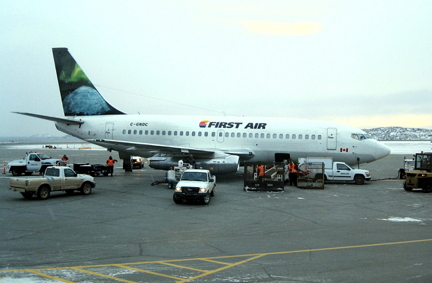
Twenty First Air layoffs in the Kivalliq region will be offset by 28 new jobs in Ottawa and Iqaluit, says company vice president Bert van der Stege. And all but two Kivalliq staff took jobs with codeshare partners Calm Air or Canadian North, he added, or accepted redeployment elsewhere in the company. (FILE PHOTO)
Bad weather, runway construction and staffing changes all added up to a challenging few days for First Air last week.
But the airline’s vice president of commercial affairs, Bert van der Stege, said late Friday afternoon, July 10, that the company is taking it all in stride.
He confirmed that 20 First Air staff in the central Arctic were laid off recently as a result of the new codeshare agreements with Calm Air and Canadian North.
But all those employees, in Winnipeg and Rankin Inlet, were offered jobs with First Air in other locations or local positions with the codeshare partner airlines, he said. And only two declined to take those job offers.
“We worked on a transition plan for the affected employees with our partners,” van der Stege said.
“The redeployment of those employees, and other mitigation options, are always our priority whenever we have a layoff situation like this, in order to minimize negative impact.”

He was quick to add that new partnerships, like the one with Cargojet, offer the potential for new job opportunities as well.
First Air is currently recruiting 28 new staff in Iqaluit and Ottawa, van der Stege said, in areas such as ground handling and maintenance.
“It’s not always about job losses,” said van der Stege. “We’re creating jobs in Iqaluit and Ottawa and that’s also a direct result of partnerships.”
But the weather? Well, you can’t come up with a transition strategy for that.
Van der Stege said cloud cover and precipitation — perhaps exacerbated by excessive ice in Frobisher Bay — hampered a number of landings and takeoffs at the Iqaluit airport last week.
He didn’t have an exact figure, but said it was in the “double digits.”

A couple of southern flights into Iqaluit had to be diverted to Kuujjuaq and then sent back south, he said, because of weather.
“Obviously if it’s not safe to land, we’re not going to land,” said van der Stege.
Normally, clouds and rain don’t cause so much havoc.
But the Iqaluit runway is under renovation as part of a huge $400-million-plus airport construction project.
“We’ve been negatively affected this week by the bad weather, but unfortunately, the runway construction work is also affecting the ability to land and take off,” van der Stege said.

Pilots must contend with a runway that is shorter and narrower than usual right now, he said. And they are currently operating under visual flight rules. So low clouds tend to be a problem in that situation.
“We cannot rely on instruments for landing so that makes the ability to land or take off in weather like we’ve seen over the past couple of days very difficult,” van der Stege said.
“’We’ve had to cancel a few flights. We’ve had to divert to other airports,” he said. “It’s not been a great week for travel into Iqaluit, that’s for sure.”
Runway repaving began the first week of July as promised, he said, and, despite the weather, is still expected to be completed by the first week of August.
(0) Comments