


Nunavut capital grapples with big water system breakdown
Large section of Iqaluit has gone without water since Aug. 8

The Snack restaurant has remained open throughout the water shortage, but manager Lorraine Hébert says “it’s been murder.” (PHOTO BY THOMAS ROHNER)
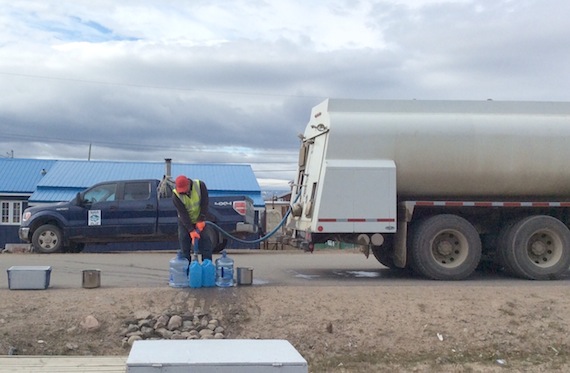
City of Iqaluit staff fill buckets of water for residents Aug. 8 in the area affected by the emergency utilidor shutdown. (PHOTO COURTESY OF JANET ARMSTRONG)
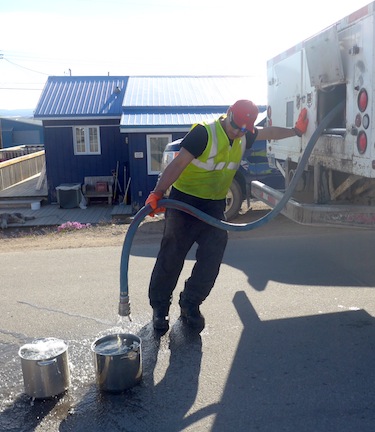
Need water? In Iqaluit you can leave your containers by the side of the road to be filled by City of Iqaluit workers if you’re still in the area without water since Aug. 8. (PHOTO COURTESY OF JANET ARMSTRONG)
Many Iqaluit residents say they are frustrated and even angry over the City of Iqaluit’s handling of the continuing water crisis that has recently left a large swath of neighbourhoods close to downtown without water for days.
“There are health and safety implications when people don’t have water for days,” one resident, who wished to remain unidentified for this story, told Nunatsiaq News Aug. 10.
“If toilets aren’t flushing and are backing up, and if hands are not being washed, and if dishes are piling up and food is not being washed properly before it’s eaten — these are all basic precautions that everyone is educated to follow to avoid outbreaks of disease.

“That’s all out the window.”
The city and the Government of Nunavut have also issued a boil water advisory for the affected areas, especially when water service resumes.
Even more concerning, this resident said, is how families with small children are coping, especially considering Iqaluit’s chronic problem with overcrowded homes.
“All the laundry and cleaning that goes on with these overcrowded homes with lots of children — their problem would only be compounded.”
Iqaluit’s water woes began in the early morning of Aug. 8.
An Iqaluit taxi driver told Nunatsiaq News that while driving a passenger home around 2 a.m. Aug. 8, he saw water “gushing” out of a hole dug recently by Iqaluit city staff across from the Nunavut Employees Union building.

Residents in buildings numbered in the 100s, 200s and 300s, as well as those living in the Qammaq elders centre and the Creekside Valley townhouses and apartments, woke up Aug. 8 to find themselves without water.
The City of Iqaluit issued a public service announcement on Facebook and on its website later that day, saying an emergency shutdown was necessary because multiple breaks had been found in the utilidor, Iqaluit’s utility corridor which carries drinking water in and grey water and sewage out.
The PSA said residents could fill water jugs at the Arctic Winter Games arena complex, where showers were also available.
City water trucks drove around the affected neighbourhoods on Aug. 9 and Aug. 10, honking their horns to let residents know water jugs could be filled up by the truck.
On Aug. 10, the municipality restored water to some residents, but as of Aug. 11 the emergency water shutdown still continued for some on Nipisa St., between Queen Elizabeth Way and Kuugalaaq St.

The buildings in the affected area includes businesses like the Quickstop and the Snack restaurant.
Clerks at the Quick Stop told Nunatsiaq News Aug. 10 that they haven’t been able to operate the in-store Pizza Hut and KFC restaurants since the shutdown began.
Lorraine Hébert, who runs the Snack, said Aug. 11 that businesses shouldn’t have to close during water outages.
“Having to close business when people are trying hard to earn a living? Come on, it’s not right,” Hébert said.
Hébert said municipal officials should have found a way to avoid that.
“As a business, you turn around and make it work. The City should’ve found a way to make it work.”
Hébert has kept the Snack open throughout the water shortage, but she said “it’s been murder.”
Her staff has been running back and forth, “day and night”, between the restaurant and a staff house in the West 40 area to boil water for use at the Snack, Hébert said.
“There was no stopping, and it only worked because I have the greatest staff. I really commend them.”
The risk of a fire was a particular concern, Hébert said, because memories of the 2007 fire that consumed the restaurant are still fresh enough in her mind.
And while her restaurant has fire extinguishers, “there’s a point where you can only do so much with a fire extinguisher,” she said.
But Hébert said she is grateful for the municipal staff who showed her what to do to keep the restaurant open during the crisis, and who are working “tirelessly” to fix the issue.
“There are some people who really helped out, who at least tried.”
The City of Iqaluit’s PSAs are not getting to all residents, however, as Hébert didn’t know an emergency water station had been set up at the Arctic Winter Games complex — because she’s not on Facebook and because she was busy keeping her restaurant open.
Some who spoke to Nunatsiaq News said they didn’t know trucks were delivering water to the affected neighbourhoods, adding that the city should’ve issued suggestions on how to remedy the potential health risks, and provided more information.
“They could have acknowledged the problem was a priority, and that best efforts are being made to remedy the circumstance. And if there are some particular challenges they are willing to disclose, that would help.”
None of the municipal PSAs have offered any details beside “multiple breaks” or an idea of when the break in service will be fixed.
(0) Comments