


Nunavut power utility braces for soaring plant replacement, upgrade costs
QEC boss reveals $12 million cost over-run on Iqaluit plant upgrade
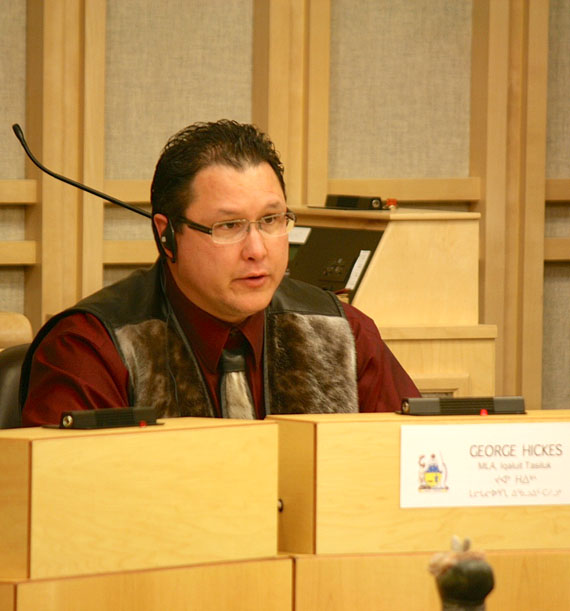
George Hickes, MLA for Iqaluit-Tasiluk and chair of the Legislative Assembly’s standing committee on oversight of government operations, puts a question to the president of Qulliq Energy Corp. at a Sept. 23 hearing. (PHOTO BY PETER VARGA)
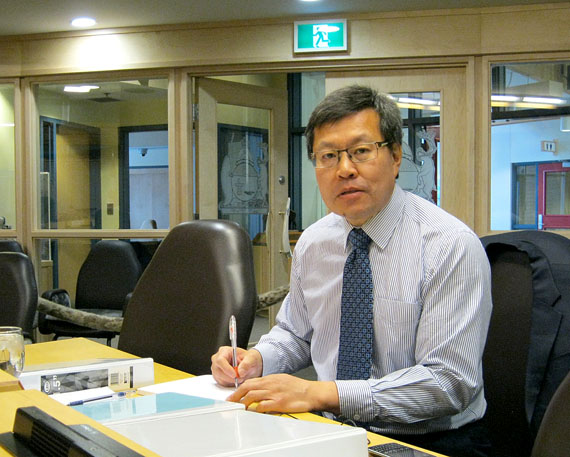
Peter Ma, president and CEO of Qulliq Energy Corp., gets set to answer questions from the Legislative Assembly of Nunavut’s standing committee on oversight of government operations, Sept. 23. (PHOTO BY PETER VARGA)
Upgrading Nunavut’s aging fleet of power plants will likely come at a much higher price than originally estimated, Peter Ma, the president and CEO of the Qulliq Energy Corp., told MLAs this week.
That includes the recent expansion of Iqaluit’s power plant, which has run more than 40 per cent over budget.
Almost 10 months into his job as head of the QEC, Ma faced a standing committee of the legislative assembly, Sept. 23, to explain the budget over-runs.
Chaired by George Hickes, MLA for Iqaluit-Tasiluk, the meeting represents the first time that MLAs have brought QEC officials before a legislative committee to account for their actions.

Ma took up the challenge of turning the troubled corporation around this past November, after the territorial government fired Ma’s successor, Peter Mackey.
His tenure has also been marked by the appointment of a new board of directors.
“One of the things that concerns me is the age of the infrastructure,” Ma said of Nunavut’s power plants. “Getting our infrastructure replaced. And of course the challenge is financing.”
QEC owns and operates the territory’s 26 plants in 25 communities. All of them, with the exception of Iqaluit’s, were built well before Nunavut’s creation in 1999.
Many date back more than 30 years, when the Northern Canada Power Commission, a federal Crown corporation, operated plants throughout the Northwest Territories, Yukon and northern regions of the provinces.
In the late 1980s, Ottawa devolved NCPC’s operations in the NWT to the Government of the NWT — leading to the Northwest Territories Power Corp.

In the years prior to Nunavut’s creation, planners intended that the NTPC would remain in one piece, and that Nunavut and the NWT would share ownership and control.
But the two sides couldn’t agree on a deal and the QEC emerged as a standalone Nunavut Crown corporation in 2001.
Late into the day-long hearing, Ma revealed that the QEC’s $28 million project to expand Iqaluit’s power plant, completed this summer, cost $40 million, far more than the $28 million that was originally budgeted.
“It’s a $12 million overage — just under 50 per cent. So it is significant,” he said.
Ma blamed poor planning and design work that “wasn’t done on time” for the cost overrun.

“This is why I’m focused on doing a better capital-management planning process and better reporting process,” Ma said.
Poor budgeting extends to other projects. Cost estimates on new power plants lined up for Qikiqtarjuaq and Taloyoak are now $15.4 million and $14.7 million, respectively.
Each community’s revised construction costs are $4 to $6 million more than QEC’s first estimates, drafted in 2011.
The corporation plans to continue to build new plants in other communities after 2015, once Qikiqtarjuaq and Taloyoak’s are up and running. Next in line will be Cape Dorset, Ma said.
A three-year capital expansion program for 2013 to 2015 will cover these projects, Ma said, as well as upgrades to diesel plants in Sanikiluaq and Kimmirut.
A CIBC loan of $74 million, guaranteed by the Government of Nunavut, is financing the program.
“This is the first of its kind for the corporation,” Ma reported to MLAs of the standing committee on oversight of government operations.
“We’re on-target at this point in time. We’re not overly over-budget. I mean, it’s always going to move up and down.”
QEC’s most costly project, the proposed construction of hydro plants for Iqaluit, is still on the corporation’s list, despite failure to advance past public opposition in September 2013.
Ma maintained that hydropower was the best alternative to diesel for Iqaluit’s future electricity needs.
He said poor communication was to blame for the lack of pubic support for the two-stage hydro project.
The corporation’s hydro plan calls for construction of two dams and power plants southwest of Iqaluit, opposite Frobisher Bay, at a cost of up to $450 million.
Construction of the first dam, at Jaynes Inlet, 60 kilometres from Iqaluit, was to go up by 2019. The second installation, at Armshow South, 20 kilometres south of the city, was planned for completion in 2030.
The corporation has already spent some $9.5 million on the project, which went into public consultations and environmental impact studies.
Another $6.5 million is needed to take the plan through an environmental assessment stage, Ma said.
“We obviously have financing constraints. We don’t have a lot of cash on-hand,” Ma said.
Private investors could be included through a private-public “P3-arrangement” as a possible way to meet the high costs, he said, adding that QEC has had “initial conversations” with a mining company and an Inuit organization based in Iqaluit.
Thought Ma didn’t name anyone, that’s likely a reference to a possible P3 deal for a hydro plant that would serve Iqaluit and a potential diamond mine at Peregrine Diamond’s Chidliak property, involving the QEC and a birthright firm such as the Qikiqtaaluk Corp.
“At some point, we have to look at some type of alternative energy, and this seems like a feasible alternative,” Ma told MLAs at the hearing.
“Certainly the capital cost initially is high, but it’s the type of long-life project where you don’t have to replace it for 100 years.”
Ma said QEC would bring the project back to public consultations again, and possibly reconsider the location of the dams.
MLA’s questions about new power plants veered to questions about old ones.
No fewer than five MLAs asked for details on what QEC would do to clear away unused plants and contaminated sites.
The corporation must account for environmental liabilities, Ma said.
It committed to doing so in 2010, with studies of contamination at QEC sites in four communities: Resolute Bay, Arctic Bay, Grise Fiord and Baker Lake.
“I would say most of them have some form of environmental liability,” the QEC president said.
Clean-up costs range from “a few hundred thousand dollars” to larger amounts of up to $7 million.
The corporation’s commitment to clean-up will help it meet new federal standards, which took effect in April.
“Government entities are now required to assess in more detail their environmental liabilities, and to put some numbers behind that,” Ma reported to MLAs.
QEC is well-placed to meet the standards, Ma said, although he could not put a dollar value on the costs of clean-up just yet.
“The value of the potential environmental liability is probably significant,” he said, “and most governments are probably not ready for that.”
MLAs noted that most of the territory’s power plants were built before Nunavut came into being, under the QEC’s distant ancestor – the Northern Canada Power Commission.
This could mean the federal government, and not QEC or the Government of Nunavut, may be responsible for a certain share of the clean-up under the “polluter pays principle,” Ma said.
“As everybody knows, a lot of our facilities are upwards of 40 years-plus, and probably have environmental liabilities from the past,” Ma said.
“There’s a potential environmental liability, and you have to recognize that in your financial statements.”
(0) Comments