


Nunavut students get schooled in the world of politics
Many first-time voters will mail ballots from Ottawa
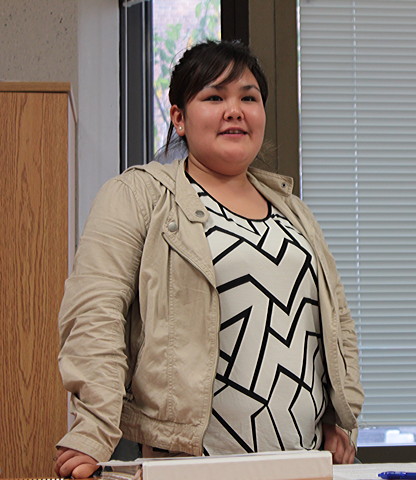
Lila Evic of Pangnirtung tells fellow Nunavut Sivuniksavut students this week she found the candidates in her home riding very similar after completing an assignment for her Contemporary Issues class. “I didn’t see a big light in any of them,” she said. “I wasn’t able to choose.” (PHOTO BY LISA GREGOIRE)
Students at Nunavut Sivuniksavut discovered a few things about aspiring and veteran politicians this week: they talk fast, they often push their own agenda instead of answering your questions, and many just ignore your calls.
But they also learned what’s involved in running for political office, what kinds of issues are important to them and which candidates impressed them most.
In fact, they had to tell their fellow students exactly that during presentations this week for a Contemporary Issues class at the Ottawa-based college program.
“We’re slowly losing our culture back home and I like the fact that that’s one of his goals, to preserve our language and culture,” said Jutai Toonoo, of South Baffin candidate David Joanasie.
Toonoo said he also appreciated Joanasie’s views on the importance of education and integrity in government and the legislative assembly.
Instructor Daniel Guay said later that these are the kinds of insights he was hoping to get from students, some of whom will be voting for the first time in Nunavut’s Oct. 28 territorial election.

That’s one of NS’s greatest strengths, he said: the ability to take real-time events in Nunavut and turn them into assignments.
“It’s often just a matter of making it a big deal,” said Guay. “It’s our job to get students engaged. Students here really care about their home communities and they want to make a difference.
“If you can have political literacy, suddenly you’re on the inside of the discussion, instead of the outside.”
Students joined the discussion by finding out who’s running in their home constituencies, calling candidates, and asking them a series of questions concerning their suitability for the job of MLA.
In some cases, the students may have been a bit biased.
“My uncle is 67 and is still running. It’s impressive. It’s inspiring,” said Sanikiluaq’s Mick Appaqaq of Hudson Bay candidate Moses Appaqaq.

“He’s very caring. He’s the lay minister for our [Anglican] church.”
Appaqaq, 21, worked as an office assistant for Hudson Bay incumbent Allan Rumbolt before starting school in Ottawa in September.
He said he used to be reluctant about supporting one candidate over another at election time because he’s from a small community, knows all the people, and finds it difficult to take sides.
But the NS course has encouraged him to take the election more seriously, to delve into candidates’ views on local issues and to decide who would best represent his constituency.
Appaqaq has never voted but he plans to vote this year with a special mail-in ballot that Chief Returning Officer Sandy Kusugak dropped off for students and staff during a recent visit to the school.
Students had a wide range of experiences when trying to contact their home-town candidates.
Seasoned politicians, such as Paul Quassa and Jack Anawak, made time to take phone calls, but many students had to resort to blogs, Facebook and candidate websites to find out what candidates’ priorities were.
That’s significant, Guay said. If a candidate takes your call, or returns your message, that might say something about their ability to respond to the needs of constituents.
Iqalummiut Natasha Allakariallak, Sapatie Stokes and Marley Dunkers took on the hotly contested seat of Iqaluit-Niaqunnguu, where six candidates are running for MLA.
“I had no idea who was running. I didn’t even know what constituency I was in,” said Stokes. “I’ve never voted, so this was really good for me.”
The three students agreed Anne Crawford and Pat Angnakak impressed them most.
Guay asked students to explore the reasons why a voter would choose one candidate over another.
He then asked them to consider whether voters should, by law, be obliged to educate themselves about all the candidates before being eligible to vote.
Some students said yes, that people shouldn’t be allowed to vote for someone for frivolous reasons — such as how they look or the flashiness of their campaign.
“Hey, that’s politics,” said Terrie Kusugak. In a democracy, people have the right to vote for whoever they want, she said, no matter what their reasons are.
Kusugak is the daughter of Lorne Kusugak, the incumbent MLA for Rankin Inlet South, who is hoping to win re-election Oct. 28.
Guay also talked about voter apathy and how in some communities, only half of eligible voters bothered to cast ballots in the last territorial election.
Because youth make up such a huge proportion of Nunavut’s population, young voters could control the local agenda by insisting candidates address youth issues and by voting as a block, he said.
He also prompted an interesting discussion around candidate eligibility by asking whether students knew if a criminal record prevented someone from running for MLA.
He promised to give a prize the following day to the first person with the correct answer.
(0) Comments