


Nunavut teens take hits, keep skating, at elite hockey camp
“I told one of my buddies, keep practicing, this could be you”
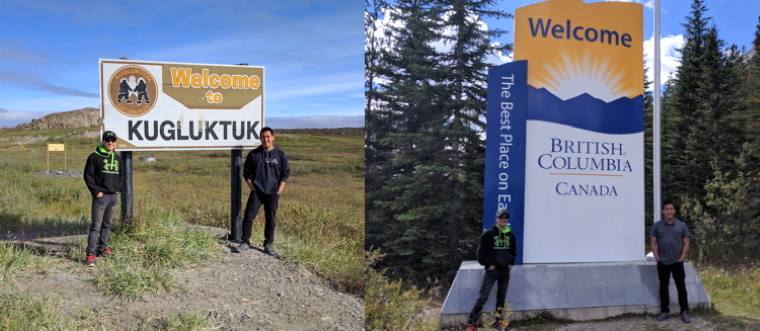
From Kugluktuk to B.C. and back: Dustin Aleekuk, left, and Keiran Panioyak, stand beside their hometown sign, and the sign to British Columbia in late August during a trip to Invermere, B.C. for an elite hockey training camp and tryout. They didn’t make the Columbia Valley Rockies junior team but both say it was worthwhile to get a taste of high calibre hockey. (PHOTOS BY JARED OTTENHOF)
Dustin Aleekuk has been playing hockey since he was about eight years old and most would agree the young defenseman knows his way around the hash marks on his hometown rink in Kugluktuk.
But the 18-year-old skater recently learned what southern style junior hockey feels like at an elite training camp and tryout held annually by the Columbia Valley Rockies in Invermere, B.C.
It’s fast. It’s rough. And it’s exhausting.
“I was excited to get back on the ice,” said Aleekuk from his home in Kugluktuk. “I took a couple of head shots. It was heart-pounding.”
Aleekuk and Keiran Panioyak, 17, also from Kugluktuk, both graduated from high school this year and a week after graduation, at the end of August, they attended the B.C. hockey camp for five days, billeting with families in Invermere to cut costs.
The Rockies have a policy of encouraging participation from Aboriginal players and Kugluktuk RCMP Const. Tim Harper, formerly of the Columbia Valley detachment, knew that. He’d been on the lookout for Inuit prospects for a while, said Jared Ottenhof.
Ottenhof, who works for the Kitikmeot Inuit Association in Kugluktuk, is a friend of Harper’s and joined the RCMP officer in Invermere as a chaperone when the boys flew south.
Both Harper and Ottenhof, who are involved with senior hockey in the western Kitikmeot town, had noticed the skill and prowess of Aleekuk and Panioyak since the teenagers started playing in the men’s league.
“They’re very hard to play against. They skate circles around the older guys, with experience,” said Ottenhof.
“Dustin is a pretty quick and smart defenseman. He’s a smaller size but he holds his own in front of the net. Kieran is definitely a real presence as a forward. These guys, they stand out when you watch them play.”
Ottenhof and Harper figured the two boys would really benefit from exposure to higher calibre hockey where players play year-round.
In Kugluktuk, the only ice maker is Mother Nature: When the weather gets cold enough, they open the doors and make ice which means hockey players only get three, maybe four months per year of on-ice action.

Not only that, there’s no body-checking in the men’s league in Kugluktuk so getting used to a physical game took guts and effort, Ottenhof said. Both boys took some hits and were sometimes slow to get up but stuck it out, with encouragement from the other players, he added.
Neither of the young recruits were drafted to the Rockies but they have no regrets about going.
“I’m happy I went. I got to learn a few new drills and see what it’s like to play fast-paced hockey. I got to meet some new people. My billets were really nice. It felt like home in their house,” said Aleekuk, a Sidney Crosby fan.
“I didn’t picture myself in January trying out for a hockey team. I told one of my buddies, keep practicing. This could be you.”
Aleekuk also got to go wake surfing and fishing and do a bit of sightseeing in and around Invermere, a gorgeous town about double the size of Kugluktuk nestled between the Rocky and Purcell Mountains in southern British Columbia.

Darryl Egotak, Aleekuk’s proud dad, told Nunatsiaq News there’s plenty of raw talent in Nunavut communities, the athletes just lack the practice time and experience of playing serious hockey.
Egotak, who plays and coaches hockey in Kugluktuk, said organized sports help teach youth leadership, cooperation and discipline, all of which help them become mentors to other youth in town.
But a lack of facilities and resources in small communities make sports such as hockey difficult to offer.
“I look at the kids who aren’t involved in sports, and the kids I coach? There’s a big difference,” Egotak said.
“The ones who are into organized sports, like hockey, they’re good kids. They have a good attitude. Because they have something to do. They’re not just going out, causing mischief. When we coach them, we tell they have to have schooling also.”
When the Stanley Cup came through Kugluktuk this past spring, Project North and their sponsors donated two dozen new sets of hockey equipment, Egotak said, so that will go a long way toward encouraging new players to sign up.
Egotak, whose three sons all play hockey, said he now has a baby girl. When asked if she would play too, he said it was too early to tell but she does like playing hockey with brothers in the halls at home.
The boys’ airfare and room and board were paid for by the Tahikyoak Heritage Fund, Ottenhof said, money that flows through the hamlet from Inuit benefit agreements with local mining companies.
(0) Comments