


Nunavut welcomes new Franklin expedition painting to collection
As collection moves out of storage, GN sees uptick in donations
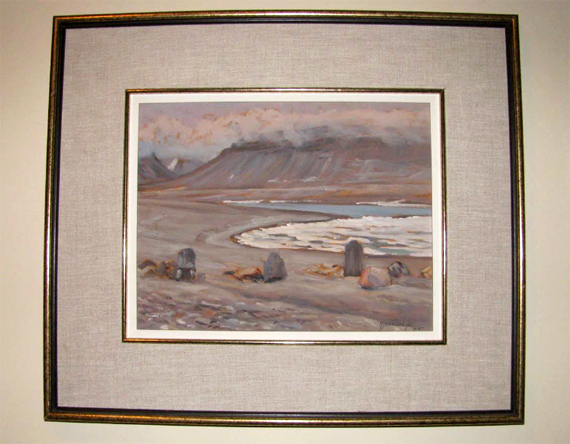
The 1975 painting The Three Franklin Expedition Graves was recently donated to the GN, where it hangs in an Iqaluit office. The painting will join the GN’s fine art collection at the Winnipeg Art Gallery. (PHOTO COURTESY OF THE GN)

The back of Maurice Haycock’s Franklin Expedition graves painting includes details of his 1975 visit to Beechey Island, where he painted the grave markers just before they were removed for conservation. (PHOTO COURTESY OF THE GN)
The Government of Nunavut’s art collection has welcomed a new painting into its fold; a depiction of grave markers for three seamen who died during Sir John Franklin’s last expedition to Beechey Island in 1846.
Dr. Maurice Haycock painted “The Three Franklin Expedition Graves” during a 1975 summer visit to Beechey Island, just before the grave markers were removed.
The pastel-coloured oil painting, dated July 24, 1975, shows the three markers along an ice-choked shoreline, with the island’s sweeping flat-topped mountain and clouds as a backdrop.
“At the time of the painting the grave markers were subsequently removed for conservation, and it is the last painting done of the site prior to the grave markers’ removal,” George Kuksuk, Nunavut’s minister of culture and heritage, told the legislative assembly March 9.

“In light of recent developments in the Franklin expedition, the painting is relevant to the GN museum and archaeology collections and complements the collection as a whole.”
Nunavut’s culture and heritage department is working to place the painting into the GN’s fine art collection, which is currently housed at the Winnipeg Art Gallery for a five-year period.
The GN’s goal is eventually to build a facility in the territory to house the estimated 7,000 art pieces.
But given the recent discovery of both of Franklin’s expedition ships—the HMS Erebus in 2014 and the HMS Terror in 2016—the new painting is already a popular addition to the GN’s collection, Kuksuk said.
That collection also includes another Maurice Haycock painting: it depicts “Kellet’s Store House at Dealy Island,” a cairn built to store provisions for sailors and used in the British admiralty’s final attempt to find the Franklin expedition.
The “Three Franklin Expedition Graves” was donated by its most recent owner, Arlie Hobson, on behalf of her late husband, George Hobson, who died in 2015.

The Ottawa-based geophysicist served as a director of the Polar Continental Shelf Project during the 1970s and 1980s. Hobson was a self-described “Franklin fanatic,” who took part in a number of research missions to Beechey Island, including the 1975 visit with Haycock.
“Eight of us visited Beechey Island in 1975 to investigate the grave area, to see what had not been documented to that time, to conduct certain surveys, etc,” Hobson wrote of the 1975 trip.
“Maurice painted this piece and stated that it was not for sale but would go into his permanent collection. A few days after our return to Ottawa he came into my office and said, ‘Arlie may have this one,’” Hobson wrote, referring to his wife.
With the GN’s art collection moving to WAG and its heritage collection heading for safekeeping at the Canadian Museum of Nature, the territorial government said it’s received an increased number of donations over the last year.
Alex Stubbing, director of culture and heritage, said that’s likely due to the exposure the collections will get, given the chance of finally being exhibited in a major museum and gallery.

Since the GN announced the collections were coming out of storage, Stubbing said the WAG has hosted the successful “Our Land” exhibit.
And this year, some of Nunavut’s Franklin artifacts will go on exhibit this year at the National Maritime Museum of History in Greenwich, U.K., before returning for display at the Canadian Museum of Nature.
“A major next step we want to achieve with our collections is to develop traveling exhibits that can tour communities in Nunavut so that more Nunavummiut get the opportunity to see [them],” Stubbing said.

Government of Nunavut heritage officer Krista Zawadski holds up a soapstone carving in the vault of the Winnipeg Art Gallery. It’s one of thousands of pieces that make up the GN’s art collection, which recently came out of storage and is currently housed at the WAG as part of a five-year agreement. Over that period, the GN hopes to train Nunavummiut to work with the collection to promote education and exhibit programming. (PHOTO BY LEIF NORMAN/GN)
(0) Comments