


Polar bear conservation meeting ends with nod to traditional knowledge
“Science, traditional ecological knowledge” will guide future circumpolar action plan
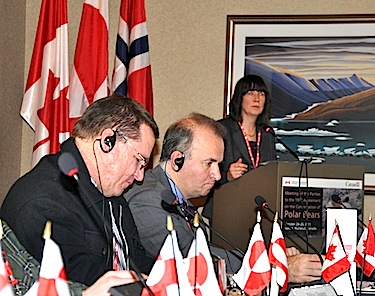
Virginia Poter, far right, the director of the Canadian Wildlife Service, shares the summary of this week’s international meeting on polar bear conservation in Iqaluit on Oct. 26, with members of the Canadian delegation to the left. (PHOTO BY SARAH ROGERS)
(updated at 2:50 p.m.)
Canada, the United States, Greenland, Russia and Norway will develop a joint circumpolar action plan to guide polar bear conservation efforts, said delegates to this week’s international meeting on polar bear conservation in Iqaluit.
This circumpolar action plan will be international in scope — covering the entire circumpolar range of polar bears.
And it will complement the national action plans on polar bear management, which Canada, the United States, Denmark (Greenland), Russia and Norway are already working on.
The action plan “will be informed by science, traditional ecological knowledge and will focus on opportunities for collaboration across the range of the polar bear,” said Virginia Poter, the director general of Canadian Wildlife Service, who chaired the Iqaluit meeting of representatives from the five countries which signed the Agreement on the Conservation of Polar Bears in 1973.
Poter said the national delegations at the Iqaluit meeting agreed that polar bears play an important role for people living in northern regions, and that the “pace of change in the Arctic requires action locally, nationally and internationally.”
A draft of the circumpolar action plan, which will be presented at their next meeting, will:
• balance polar bear conservation requirements with the needs of local communities;
• include adaptive management strategies, to take into the account the changes in the Arctic climate;
• ensure indigenous populations are engaged in process;
• consider the “best available science and increased consideration of traditional ecological knowledge.”
The inclusion of traditional knowledge in the circumpolar action plan, also referred to as a “range state plan,” will be welcomed by some members of the Canadian delegation.

Gabriel Nirlungayuk, Nunavut Tunngavik’s director of wildlife, said earlier this week that traditional knowledge doesn’t play a large enough role in polar bear management decision-making.
NTI vice-president James Eetoolook said in an Oct. 26 NTI news release that he was encouraged by the acknowledgement of traditional knowledge’s importance in polar bear management.
“Inuit have long been concerned about the effects of scientific research on polar bears. The Government of Nunavut is now conducting their research using less intrusive methods,” said Eetoolook, who also called on other jurisdictions to use less intrusive polar bear research methods.
To develop the circumpolar action plan for polar bears, Canada will work collaboratively with Canadian provinces and territories, wildlife management boards and aboriginal groups, as well as with the other signatories of the 1973 agreement, Poter told Nunatsiaq News in an email communication from Environment Canada.
Canada has already taken a number of actions to protect polar bears, she said.

This past July, the federal environment minister recommended that the polar bear be added to Schedule 1 of the Species At Risk Act as a species of special concern, Poter said.
Following “careful analysis of comments received,” the final decision as to whether polar bear will be listed under the SARA should be made next month, she said.
Canada’s delegation to the meeting, which wrapped up Oct. 26, included officials from Environment Canada and the GN as well as representatives from Inuit organizations.
The date and location of the next meeting of the parties to the international agreement on polar bear conservation were not announced, but members of the Polar Bear Specialist Group, research scientists who provide technical and scientific advice on polar bears, will be invited.
(0) Comments