

Taissumani, April 6
Inuit and the Titanic
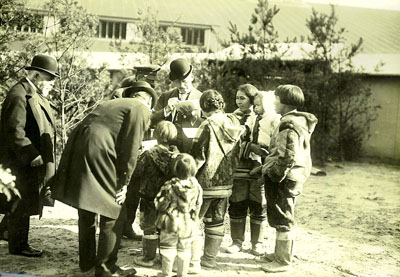
Inuit visiting Berlin in the fall of 1911. (PHOTO TAKEN BY CONRAD HUNICH)
Next week marks the 100th anniversary of the sinking of the Titanic.
Much will be made of it on radio and television. Documentary programs will tell of the loss of 1,514 lives in the frigid waters of the North Atlantic. Nothing will be mentioned of the Arctic, except as the place of origin of the iceberg that inflicted the fatal damage on the doomed ship in the dark hour just before midnight on April 14.
There will be no mention of Inuit, for none were aboard the ship on this, its maiden and only voyage.
But two elderly people in California, the descendants of Inuit from Labrador, may take a few minutes to pause and remember the stroke of fate that led to their parents not being aboard the ill-starred ship, for one Inuit family came very close to sailing on the Titanic.
I’ve written before about the remarkable lives of Nancy Columbia and her mother Esther Eneutseak. Esther was from Zoar, a Moravian mission station in Labrador and went, with a large group of Inuit from the Labrador coast, to Chicago in 1892 to appear the following year at the Chicago World’s Fair. Nancy Columbia was born there.
When the other Inuit straggled back to Labrador in the following few years, Esther and her family remained in the United States. They managed to make a living in show business – working in circuses, ethnographic shows, fairs, exhibitions, and later as actors in early silent movies.

In 1901 Esther married their promoter, John Smith, and over the next decade she bore two sons and a daughter, half-siblings for Nancy. These children too would become participants in the “Eskimo shows” that became the family’s lifeblood. Two other Inuit, Simon Aputik and Zacharias Zad, who were relatives of Esther, travelled with the family for many years.
In 1911 they took their show across the Atlantic to Europe. They had been recruited by Carl Hagenbech, a German promoter who operated a private zoo but dabbled as well in ethnographic shows.
In September of that year, they appeared at a show called “The Northland” in Berlin, Germany. They wore sealskin clothing, lived in a skin tent, and demonstrated Inuit skills to the paying public. The men were adept at the use of the whip, which always impressed the public. By January, their show was in Stuttgart. They may have appeared in other German cities too, before they moved on to the Palais d’Été in Brussels. Esther gave birth to another son, Sidney, there in late January 1912.
The shows in Belgium were not successful. The group was reduced to appearing at a show called “Pole Nord” at an ice skating rink. John Smith decided that his prospects were better back in America and he determined to get his family back there as soon as possible.
He booked passage on the Titanic. Abandoning Aputik and Zad in Belgium, he and Esther, their four young children, and Nancy who was by now 20 years of age, travelled to England where they would board the ship in Southampton.
But fate intervened. The Titanic was behind schedule. Her sailing date from Southampton had originally been planned to be March 20. But she was late. Launched in Belfast, her sea trails and departure for England only took place on April 2, and she would not be ready to leave Southampton for New York until April 10.

John Smith was impatient. He had employment arranged for himself in Seattle. And so he cancelled the family’s booking on the Titanic and rebooked on the Mauritania.
That ship left Liverpool on March 23 and steamed uneventfully across the Atlantic. Perhaps the family sighted icebergs on the crossing. Perhaps Esther used the occasion to tell her children about her childhood on the Labrador coast, where icebergs, so foreign to her children, were a common sight.
They reached Ellis Island, New York on the 29th of the month and left almost immediately for Seattle. The Titanic had still not left England. When it did, it would sail for four and a half days before its famous collision. A few hours later, in the early morning of April 15th, it was at the bottom of the sea, and 710 survivors were bobbing in lifeboats in the frigid waters of the Atlantic.
Had it not been for the impatience of John Smith, he and his Inuit family would have been aboard the doomed ship. Would they have been among the survivors or the victims?
They would almost certainly have been third-class passengers, the class from which most of the victims came. The odds are high that they would not have survived.

Nancy’s daughter Sue, and her sister Florence’s son Paul, living today in California, may take a moment next week to remember their family’s good fortune.
Taissumani recounts a specific event of historic interest. Kenn Harper is a historian, writer and linguist who lives in Iqaluit. Feedback? Send your comments and questions to kennharper@hotmail.com.
(0) Comments