


A tale of two communities: “Creenuks” in Nunavik
“Why do I have to choose to be an Inuk or Cree when I’m both?”
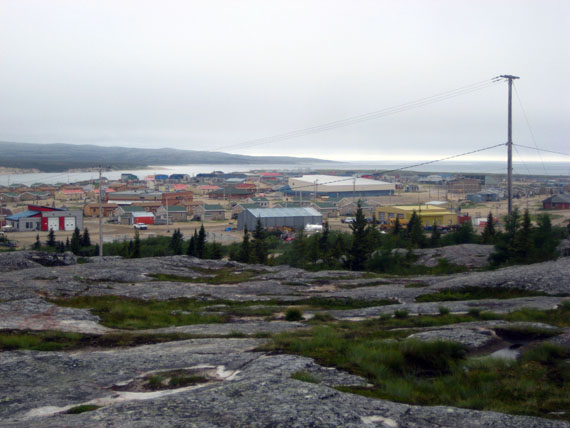
A view over the twin communities of Whapmagoostui-Kuujjuaraapik where Inuit and Cree have cohabited for more than half a century. (PHOTO BY MARIE-HÉLÈNE LAREAULT/WIKICOMMONS)
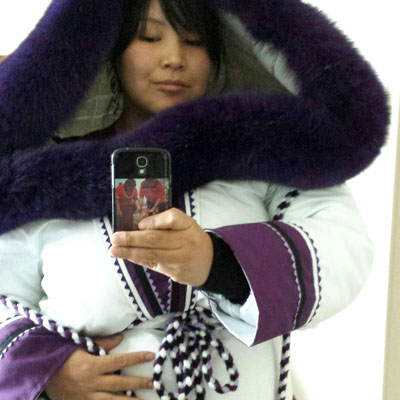
Pasha Abraham, a Creenuk living in Whapmagoostui, poses for a photo in her amautik. Abraham speaks Inuktitut and wants to participate more in her Inuit culture, but feels limited as a Cree beneficiary. (HANDOUT PHOTO)
Two communities sit at the mouth of the Great Whale River; two nations, each one straddling a side of the waterway that flows into Hudson Bay.
Inuit and Cree have occupied the coast and the region’s interior for almost 3,000 years, living side-by-side in the twin communities of Kuujjuaraapik and Whapmagoostui for more than a half century.
Kuujjuaraapik, the southernmost community in Nunavik, is home to about 800 Inuit, while Whapmagoostui is the northernmost village in the Eeyou Itschee, or James Bay Cree, region, which is home to about 900 Cree.
Over the years, the communities’ proximity to one another has produced a blending of culture, a number of mixed families and a hybrid identity for some people.
But some community members of mixed Cree-Inuit heritage say the land claim agreement signed by both communities in 1975 has created a rupture, which makes it difficult to live and celebrate both cultures.
Pasha Abraham calls herself “Creenuk.” The 30-year-old special needs educator was born and raised in Whapmagoostui by a Cree mother and an Inuk father.
Her father, Jobie Abraham, came from his hometown of Kuujjuaq to Kuujjuaraapik for training some 30 years ago, when he met Pasha’s mother, Lydia Kawapit.
“My dad spoke to me in Inuktitut and I went to school on the Inuit side until secondary one (high school),” Abraham said.
“My mother spoke to me in Cree, but I was raised in both cultures. It was normal for me.”
Cree and Inuit in northern Quebec are both signatories to the James Bay and Northern Quebec Agreement, but enjoy separate sets of benefits under the agreement.
And those who are born into both cultures must choose one—beneficiaries of the treaty are eligible for only one set of benefits, which includes access to education, health, housing and other cultural support and programming.

In Abraham’s case, her mother registered her as Cree as a child. She transferred her status for a period while she was still in school, but transferred back as a Cree beneficiary once she had children.
Today, Abraham lives with her Cree spouse and their blended family of seven children, with a baby on the way.
With her children registered as Cree beneficiaries, she feels like the only option is to remain a Cree beneficiary with them.
“If my children had to be medevaced and I wasn’t a Cree beneficiary, I wouldn’t be able to go with them,” Abraham said.
The requirement to choose sides has always troubled Abraham, and other Creenuks like her.
Although she lives in a Cree family, she speaks Inuktitut and would like to practice her Inuit culture more often.
“It’s not really about the benefits,” Abraham said. “Why do I have to choose to be an Inuk or Cree when I’m both? I just want to be known as both.”
Abraham gives an example: attending any event or activity in Kuujjuaraapik might be restricted to Inuit beneficiaries. She said she can’t take part in the Christmas games hosted in Kuujjuaraapik because prizes are limited to Inuit beneficiaries of the JBNQA.
“It makes me feel discriminated against,” she said.
Abraham is quick to say that both Cree and Inuit in the twin communities have traditionally been accepting of each other—it’s just been the reality for so long and mixed marriages are common.
Cree and Inuit even attended school together before the signing of the JBNQA in 1975.
But Abraham said she’s spoken to elders in the communities and they recall the signing of the JBNQA as being a turning point in the relationship between Inuit and Cree.
“It separated them,” she said. “New rules applied and now it’s affecting us.”
“Acknowledge that we exist and belong”
Minnie O’Connor, an administrator with the Eeyou Eenou Police Force in Whapmagoostui, tells a similar story, though as an Inuit beneficiary.
O’Connor grew up in the Cree communities of Waskaganish and Eastmain, raised by an Inuk mother and an Irish father. But her beneficiary status always limited her education and job opportunities, she said—even the type of health care services she could access.
When she married her Cree husband and had children, O’Connor moved her family to Whapmagoostui/Kuujjuaraapik, to re-establish her own Inuit beneficiary status, but also so her Creenuk children could experience both cultures.
The experience has been a good one, O’Connor said, but she still feels mixed-heritage Cree and Inuit face a number of restrictions.
“Before moving here, I envisioned a well blended happy stew,” O’Connor said. “What I’ve come to learn is there is much more of a divide than I had thought. I wouldn’t necessarily say it’s a bad divide, just it’s clear who belongs where and then there’s the grey patch of mixed families.
“I’ve heard stories, that before the agreement, people lived in harmony and there was one of everything.”
O’Connor would like to see Makivik Corp. and the Grand Council of the Crees sit down and re-evaluate how they treat beneficiaries on either side.
“[To] acknowledge that we exist and belong,” she said.
Andy Moorhouse, Makivik’s vice-president economic development, also oversees enrollment, a department that processes the approved applications for Inuit beneficiary status—anywhere between a handful and 20 each year—or mediates issues with denied applications.
Applicants must answer a series of questions to show their knowledge of Inuit culture and tradition, which go to the local landholding association or band council for review.
But Moorhouse said that many Cree and Inuit in the communities do in fact have access to each others’ services just out of necessity, like in the case of mixed families.
“It’s kind of tricky,” he said. “Some Inuit beneficiaries do access Cree services and vice-versa.”
The lines become blurred in the Cree community of Chisasibi, Moorhouse said, where the small Inuit population of fewer than 100 often relies on local services that are geared towards Cree beneficiaries, though he’s heard instances of Inuit denied certain services.
One thing is clear though—Makivik has no plans to revisit the agreement and redefine how mixed Inuit-Cree Quebec residents receive benefits.
“They have to understand that the benefits that are provided through the JBNQA are clearly defined,” Moorhouse said.
“In a situation of a [mixed] couple, how they process their kids is up to them, weighing the benefits of one or the other.”
(0) Comments