


Technology, poor planning exclude Inuit youth from PM’s council, says leader
“It’s so much more than bandwidth connection—it’s about social and economic inequities”
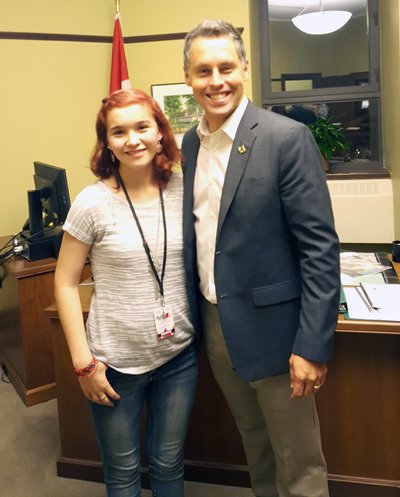
Rachel Smale of Pond Inlet, left, pictured with Peter Schiefke, Parliamentary Secretary to the Prime Minister for youth. Smale was selected to sit on the PM’s new youth advisory youth council. (PHOTO COURTESY OF R. SMALE)
The good news: two of the 15 newly-elected members of the Prime Minister’s Youth Council are from Nunavut.
The bad news: a number of other Nunavummiut youth may have missed out on the chance to take part because of slow bandwidth across the territory.
Prime Minister Justin Trudeau launched calls for participation in the council this past summer in an effort to assemble a body of young Canadians to provide non-partisan advice on national issues from education and employment to climate change.
From the first wave of applications, the Prime Minister’s office selected Nigerian-born, Iqaluit-raised Nmesomachukwu Umenwofor-Nweze, who is currently studying at Pearson College in Victoria, B.C., along with 19-year-old Rachel Smale from Pond Inlet.
“I chose to apply for the youth council because it was finally an opportunity for my voice to be heard,” Smale said, “and not just looked at as an ‘everyday issue for the younger generation.’ It would be looked at in a way all issues should be looked at, equally.”
Smale, a recent high school graduate, has helped set up after-school activities for elementary school-age children in Pond Inlet and is considered a youth mentor in the community of 1,600.
But while Smale said she’s pleased to have been selected, she said the application process itself was a challenge.
“I had a hard time trying to explain my ideas in the interview, wishing I could [have] said it in Inuktitut which to me would [have] been more powerful,” Smale said.
Slow bandwidth in her north Baffin community also made it difficult for Smale to download the questions the Prime Minister’s office provided to applicants ahead of their interviews, which were set up over teleconference—technology that is limited in Nunavut.
Smale wasn’t alone; National Inuit Youth Council President Maatalii Okalik said she heard from a number of youth across Nunavut who were unable to make it through the application process because of slow internet.
In one case, Okalik forwarded one applicant’s complaint to the Prime Minister’s office in email.
“I told them, the concerns I raised and told you to take mitigating steps to prevent, are happening,” Okalik said.

“They connected that particular youth to someone… who organized a phone interview for her. But that was only at my request.”
That’s months after Okalik tweeted her concerns to Trudeau about Nunavut communities’ limited access to internet and videoconferencing, following the call-out for applications.
We'll be working with organizations like yours, Maatalii, to make sure we connect with everyone. #pmyouthcouncil https://t.co/vv4CyGoXCL
— Justin Trudeau (@JustinTrudeau) July 19, 2016

The Prime Minister’s office said any applicants who had problems with internet access were given the chance to do their interviews by phone.
“We are conscious of the challenges concerning access and are working with our partners to ensure that the application process takes these into account,” the PMO told Nunatsiaq News in a Sept. 30 email.
But Okalik fears the damage is already done; that faced with an inequitable process in the first place, youth won’t bother to apply.
“It’s very difficult for me to see this process as inclusive,” she said. “It’s so much more than bandwidth connection—it’s about social and economic inequities.”
And without the voices of Nunavummiut youth around the table, how will those inequities be addressed? she asked.
Moving forward, Okalik has asked the Prime Minister’s office to ensure their budget reflects the cost of ensuring there is the right technology in place or the cost of travel for Nunavummiut representatives.
A second wave of 15 applicants will be selected to fill out the 30-member council, which is expected to meet with Trudeau for the first time in 2017.
Youth between the ages of 16 and 24 have until Oct. 7 to apply to sit on the council.
(0) Comments