


PQ leader brings her message to Nunavik
“We want to do more”
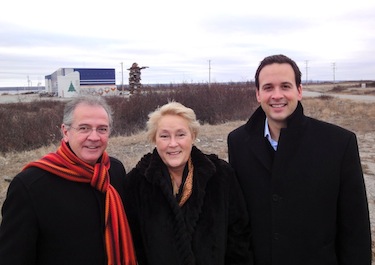
Pauline Marois, leader of the Parti Québécois, visited Kuujjuaq Nov. 7 to learn more about Nunavik. Luc Ferland, who represents the riding of Ungava in Quebec’s National Assembly, (on the left) and by Alexandre Cloutier, MNA for Lac St-Jean and the PQ’s native affairs critic (on the right), accompanied Marois on her visit to the community. (PHOTO BY JANE GEORGE)
KUUJJUAQ — Pauline Marois, the leader of the Parti Québécois, says that if elected premier of Quebec, she would immediately work on finding solutions to Nunavik’s most pressing problems.
On top of that list is Nunavik’s housing crisis, Marois said.
Marois, leader of the opposition in the Quebec national assembly, arrived in Kuujjuaq Nov. 7 for a 24-hour visit to Nunavik.
Recent opinion polls suggest that if an election were held now in Quebec, Marois and her Péquistes would defeat Jean Charest’s unpopular Liberals and likely form the next government.
Quebec could and should make Ottawa help pay for the estimated 1,000 houses that Nunavik needs to ease overcrowding, Marois said, speaking over an early morning coffee at the Kuujjuaq Inn.
There’s “no need to wait” for the federal government to chip in before the Charest’s Liberal government moves on improving social conditions in Nunavik, she said.

Marois, a former provincial minister responsible for family issues and a social worker, has combed the recent reports of Quebec’s human rights and youth commission that cite numerous failures in the youth protection and justice system in Quebec.
It’s clear that a “population in good health is a population that takes care of its children,” she said, vowing her party would focus on improving social conditions.
Encouraged by the willingness of Nunavik communities to work together and by some concrete signs of progress, Marois said that a PQ government would do everything necessary to reduce the constant turnover in health and social workers and to improve the delivery of services and training.
“We want to do more,” Marois said.
As for the Plan Nord — the blueprint for development now promoted by Charest’s government, Marois opened a thick briefing book and pointed to a 2001 PQ plan that also dealt with northern development — but with much more focus on social issues.
That would be her future government’s starting point, she said.
Marois was to spend her morning in Kuujjuaq behind closed doors listening to presentations about housing, youth and the high cost of living in Nunavik.
And she also planned to visit a local store to see the prices of retail goods and to peek into one of Kuujjuaq’s two childcare centres.
Although Marois is not a well-known figure in Nunavik, she was behind the establishment of low-cost universal child care in Quebec which has led to the network of new child care centres around Nunavik which now employ about 200 people.
On her trip to Kuujjuaq, Marois was accompanied by Luc Ferland, who represents the riding of Ungava in Quebec’s National Assembly, and by Alexandre Cloutier, MNA for Lac St-Jean and the PQ’s native affairs critic.
Cloutier, on his first trip to Nunavik, said that if Quebecers in the south realized how bad housing conditions are here they would be shocked and support prompt action to improve the situation.

If Quebec doesn’t act quickly on housing, none of the other issues will progress, said Ferland, who easily won re-election in 2008 by taking 4,118 votes, 47.3 per cent of total ballots cast.
Ferland said he continues to support the creation of a separate riding for Nunavik — although Charest recently suspended the revision process of Quebec’s electoral boundaries and scrapped his government’s bill 92, which would have opened the door to a separate riding for Nunavik.
In Kuujjuaq, the PQ politicians also underlined their support for the United Nations Declaration on Indigenous Peoples, which was adopted by the United Nations General Assembly in September 2007, and calls for governments and corporations to obtain the “free, prior and informed consent of the indigenous communities” for use of their lands and resources.
The declaration also says indigenous people must be equal partners in all negotiations on self-determination, lands and resources, culture, identity, language, employment, health, education and other issues.
Canada and the United States have not yet endorsed the declaration.
And neither has Charest’s government, Marois said.
But Marois said she was not looking for more votes for the PQ during her visit to Kuujjuaq.
“We would like for them to support us, but more for everyone to vote, even if they don’t vote for us,” she said.
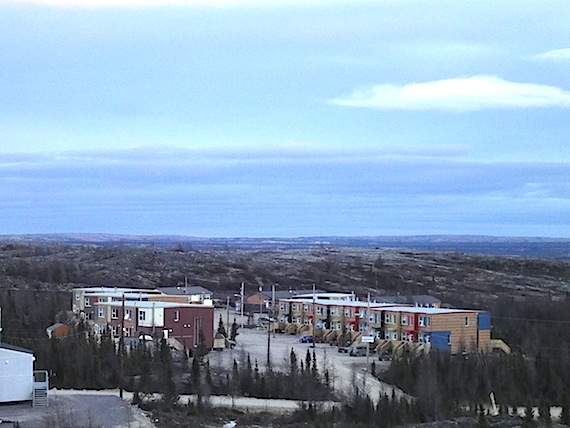
The number one problem in Kuujjuaq? The lack of social housing. Much of the good housing in Kuujjuaq is staff housing, like the recently-built units shown here. (PHOTO BY JANE GEORGE)
(0) Comments