


Nunavik cops make daily booze-drug seizures
Criminal incidents outnumber residents in some villages
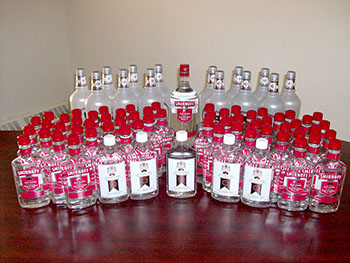
These bottles of vodka and high-proof Quebec “alcool” are only some of the shipments seized during the week of Nov. 23 by the members of the Kativik Regional Police Force and investigators with the new combined squad of provincial police and KRPF investigators. (PHOTO COURTESY OF THE KRPF)
KUUJJUAQ —Small and large bottles of vodka and 95-proof “alcool” are piling up at the Kativik Regional Police Force, which has seized more than 600 mickeys and about 50 large-sized bottles of spirits, cash, a kilo of marijuana, two grams of crack cocaine, some hashish and many bottles of beer since the beginning of October.
The seized booze, bound for Nunavik bootleggers, included a record 86 mickeys and 24 cans of beer nabbed Nov. 23 in Salluit.
The near-daily seizures of booze and drugs are part of a new police-led strategy to attack the growing levels of substance abuse and crime in Nunavik.
The seizures account for only “part of the tip of the iceberg” of the alcohol and drugs flowing into the region, admits interim police chief Aileen MacKinnon.
But there will be more seizures in the future, she said, thanks to the increasing amount of information received from the public and a beefed-up team of police investigators.
This team includes two investigators with the KRPF as well as several with the new joint team with the Surêté du Québec provincial police in Kuujjuaq.
Over the short-term, MacKinnon said Nunavimmiut are likely to see the cost of bootlegged booze rise to more than the $200 now charged for a 375-millilitre bottle of “alcool” because there will be less available in the communities.
Over the long-term, MacKinnon hopes Nunavimmiut will see many positive changes.
She was at the Kativik Regional Government regional council meeting in Kuujjuaq Nov. 26 to boost council backing for the police-promoted alcohol and drug strategy.
This would see Nunavik’s regional organizations, the SQ, and the provincial government working together with the KRPF to mobilize the population on measures to control the influx of alcohol and drugs into Nunavik and prevent and heal the damage they cause.
Something needs to be done because crime in Nunavik is rising, MacKinnon said in her report to the council.
Most of this crime is related to alcohol and drug consumption.

Criminal incidents are up from 7,009 in 2008 to 8,511 so far in 2009, she said.
That’s out of a total population of 11,000 in Nunavik — most of whom are children.
In two Nunavik communities, statistics show the number of criminal incidents exceeds the number of residents.
Aupaluk, population 199, has recorded 199 criminal incidents to date this year, while Puvirnituq, population 1,496, has already recorded 2,041 criminal incidents in 2009.
When seeking support from the regional council, MacKinnon didn’t promise police would stop arresting offenders.

But, after the strategy to fight drugs and alcohol is launched early in 2010, she says Nunavimmiut will have more support dealing with the addictions and violence plaguing communities.
For example, the strategy would see more treatment facilities, so that people who are publicly drunk, for example, will end up in a place where they can get some help, rather than waking up in a cold cell the next morning with a ticket.
The KRPF also has developed programs on school bus safety, drinking and driving, criminality and youth and drug awareness, which are ready to be presented to schools or the members of the public.
To carry out this strategy, the KRPF has a two-year funding agreement with Ottawa and Quebec, which includes more money for investigators and infrastructure.
This deal is worth $15 million for 2009-2010 and $13.4 million next year, along with another $3.5 million from Quebec in 2010-2011.
A new collective agreement with members of the Nunavik Police Association union was also reached last month. The deal applies retroactively to 2006 for members still with the KRPF and remains in force until the end of 2012.
(0) Comments