


Worst TB outbreak since 1999 hits Nunavut
Most new cases are young people between 15 and 24
Nunavut is now suffering the worst single tuberculosis outbreak since the territory’s creation on April 1, 1999.
Since January 2010, Government of Nunavut medical staff have diagnosed 81 cases of active TB in Nunavut, mostly in Iqaluit and Cape Dorset.
The number of cases this year already breaks the last annual record of 58, set in 2008.
Tests of samples from Iqaluit and Cape Dorset have shown the two outbreaks are unrelated, so each outbreak is independent of the other.
Most of the new cases involved young people between the ages of 15 and 24, said Geraldine Osborne, deputy chief medical officer of health for Nunavut.
However, at that age, patients are more likely to put off going to the health centre when they are feeling ill, which puts everyone around them at risk of infection, she said.
Osborne said the number of TB cases in Nunavut has been on the rise since 2003, especially among young people.

“It’s hugely difficult,” said Osborne. “Often by the time someone presents at the health centre it’s [TB] been present for a long time and they’ve already infected someone else.”
Symptoms to watch out for include a persistent cough that lasts three weeks or more, fever for more than a week, weight loss, night sweats, fatigue and a general feeling of being unwell.
The most famous symptom of tuberculosis – coughing up blood – is a sign of an advanced case that requires long treatment.
In such a case, the sick person has probably already infected many others around them for a long period of time.
From a medical standpoint, TB is relatively easy to treat. It’s a bacterium vulnerable to the right antibiotic pills, which are effective treatment when taken correctly.
But on the ground, the disease is a challenge.

“Each case generates an enormous amount of work,” said Elaine Randell, Nunavut’s communicable disease specialist.
A person with a severe case of TB might need to stay on the antibiotic pills for six months to a year.
During that time, staff advise the patient to abstain from alcohol because the combination of booze and antibiotics can be toxic to the liver.
And patients can’t simply get a prescription and take the pills at home because health staff need to witness that the treatment is taking place consistently.
If a patient skips taking their pills, it increases the risk that the germs in their body could become resistant to the antibiotics.
When that happens, other antibiotics are used that might have more serious side-effects, such as liver damage.
And if that happens, and the patient infects someone else, the new infection is also drug-resistant, which puts everyone around that person at risk.
Public health staff do contact-tracing, tracking down a patient’s family members, friends and other acquaintances to screen them for TB infection.
Such contact-tracing reveals most of the cases discovered in Nunavut.
Unfortunately, in some cases the patients may not divulge the names of everyone they have been in contact with, so the department doesn’t get everyone tested and treated if necessary.
Also, some people are reluctant to be tested when public health staff contact them because of the stigma surrounding TB in Nunavut.
“It’s a matter of your health and your family’s health,” Randell said.
Osborne stressed that an active case of tuberculosis does not necessarily mean a person is infectious.
Only five per cent of diagnosed active cases ever develop into a harmful disease and it’s most likely during the first two years after infection.
An active case simply means that lab tests have revealed TB bacteria somewhere in a person’s body.
A person becomes most infectious when they are coughing up phlegm laden with TB germs.
The health department conducts TB screening in places where the disease is a potential concern, such as homeless shelters and prisons.
Such concentrations of people in small confined spaces makes for easier disease transmission.
The department also screens students in kindergarten, Grade 6 and Grade 9 at all schools in Nunavut.
The people most at risk of infection are family members of diagnosed cases, especially in overcrowded homes.
Nunavut has a long history of tuberculosis, and Nunavut’s poor social conditions have created a population that is highly vulnerable.
“There’s a reservoir of infection that dates back years,” Osborne said.
High rates of smoking, poor nutrition and substance abuse all weaken the body enough to allow the disease to take hold in people who otherwise might fight off infection.
Smoking also complicates the issue because a TB cough can be easily mistaken for a regular smoker’s bronchitis.
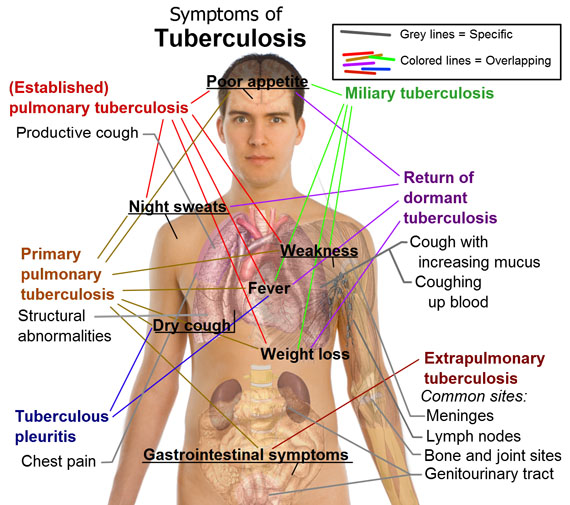
The early symptoms of tuberculosis include coughing, night sweats, fever, weakness and chest pain. Heavy cigarette smokers who cough frequently may not notice the symptoms right away. (ILLUSTRATION HARVESTED FROM WIKEPEDIA)
(0) Comments