


The pissenlits assemble with pompoms held high
Only French school in Nunavut celebrates history with pageant
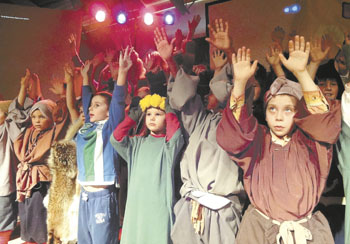
The entire cast waves along with “Fier et Droit,” (Proud and true), the rallying song for the production, and the Ecole des Trois-Soleils’ anthem for the finale of “L’Echo d’un people.”

Students at Ecole des Trois-Soleils recreate the life of Captain Elzéar Bernier, who sailed to the Eastern Arctic from 1912 to 1925, to trade and strengthen Canada’s sovereignty in Arctic during “L’Echo de nos voix: l’écho d’un peuple au Nunavut.” (PHOTO BY JANE GEORGE)

Students at Ecole des Trois-Soleils dress up as dandelions for the “L’Echo de nos voix: l’écho d’un peuple au Nunavut” production at his school.” (PHOTO BY JANE GEORGE)
Here’s a question: why did some students at Iqaluit’s French-language school, the Ecole des Trois-Soleils, wear puffy yellow pompoms and bright green costumes during a recent pageant at their school?
It’s because they were in costume for their roles as dandelions or, in French, “pissenlits,” literally: piss-in-bed, those sturdy, colourful weeds originally from the South, which are now the symbol of the association of Nunavut francophones.
Dandelions were abundant among the 84 performers involved in the school’s March 26 production of “L’Echo de nos voix: l’écho d’un peuple au Nunavut” (The echo of our voices: The echo of a people in Nunavut.)

This ambitious pageant presents the history of French-speaking people in Nunavut — starting from the creation of the world until today, when about 500 French-speakers live in Nunavut.
In Iqaluit, where French-speakers account for about five per cent of the population, they have access to federally-funded services including a community centre, housing the Association des francophones du Nunavut, a radio station, newspaper, a childcare centre, la garderie des petits nanooks, and a 54-student school, l’Ecole des Trois-Soleils, which opened in 2001.
For this small school, mounting “L’Echo de nos voix: l’écho d’un people au Nunavut” was a grand production,
The cast included students from Inuksuk High School’s drumming and throat singing group, as well as teachers and members of the francophone community who were recruited for various roles.
But in little more than 20 hours of rehearsal they carried it off.
Against a French narration, a catchy sound track, and a backdrop of images shown on three screens the production told the history of francophones in Nunavut.
The 45-minute show offered a compressed view of history in 14 scenes, drawing on Inuit and French history.
There’s everything from the creation legend of the raven Tulugak to the arrival of explorer Samuel de Champlain at the St. Lawrence River in 1603 and the “conquest” of Quebec in 1759, when British troops defeated French forces on the Plains of Abraham in Quebec City.
This led to a Canada that would become more English than French, the narrator reminds us, as a student stands at attention dressed as a British soldier in a red jacket.
Perhaps the most successful scene is devoted to the happy story of Capt. Elzéar Bernier, who sailed to the Eastern Arctic between 1912 and 1925 to trade and strengthen Canada’s sovereignty in Arctic.
Known by his Inuktitut nickname, Kapitaikallak, Bernier wore Inuit clothes, relied on Inuit guides for assistance and was known for his habit of handing out great quantities of pilot biscuits, which helped tide Inuit over hard times.

Bernier also left behind barrels of sweet maple syrup for people near Pond Inlet, as well as a tune, Ilititaa putinaviriiri, an Inuktitut version of an old and well-known French sailors’ song “Il était un petit navire,” or “There was a little boat.”
The song, still sung today, provided a jolly musical background to the pageant.
The show also included a scene about the Grey Nuns, who taught at the Joseph Bernier Federal School in Chesterfield Inlet until the residential school there closed in 1969.
The nuns also staffed the former St. Theresa Hospital in Chesterfield Inlet, built in 1931 as the region’s sole hospital and the largest building in the Eastern Arctic.
St. Theresa’s later became a home for the physically and mentally handicapped.
“L’Echo d’un peuple” ends with the more recent history of the Association des francophones du Nunavut, including their successful fight for French-language television and radio service in the 1980s and the visit of former prime minister Jean Chrétien and the former French president Jacques Chirac, in 1999.
For the finale of “L’Echo d’un people,” the entire cast raised their arms and sang “Fier et Droit,” (Proud and true) ,the rallying song for the production.
The song is also the Ecole des Trois-Soleils’ anthem, which describes the school as a place where students work like bees, with French uniting them, “every day of our lives.”
The inspiration for Nunavut’s “l’Echo d’un people” came from a work of the same name that takes place every summer in Casselman, Ont., and relates the history of Franco-Ontarians.
Canadian Heritage came up with the money for the Nunavut version, which may be produced again and taken on tour to other places.
For Ecole des Trois-Soleils teacher Yoan Barriault, who played the role of a voyageur fur trader in a red hat, shirt and woven belt, the Iqaluit production was chance to celebrate his relationship with Nunavut, where he has lived since 2004.
“I’m proud to let people now I am a Franco-Nunavois,” Barriault says, echoing the message that also comes through in faces of the other performers of Nunavut’s “l’Echo d’un people.”
(0) Comments