


Nunavut, Nunavik athletes earn golden moments
“It’s about the kids, not the coaches”

Team Nunavik’s Deseray Cumberbatch, centre, shows off her gold ulu with teammate Sarah Samisack, left, who won bronze. The two competed in the two-foot high kick (open female.) (PHOTO COURTESY OF THE KRG)
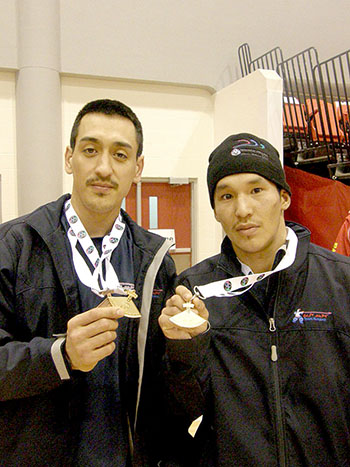
Sean Nipisar, left, of Whale Cove and James Qajaaqjuaq Tautu of Chesterfield Inlet pose with their gold ulus. Nipisar won gold in the two-foot high kick while Tautu took the gold for kneel jump in the open male competition. (PHOTO BY DAVID JOANASIE/CLEY)
The suspense was unbearable.
Team Nunavut’s table tennis coach Attila Csaba could only watch his students from the sidelines at the 2010 Arctic Winter Games.
“I almost couldn’t handle it,” laughed the Kugluktuk high school coach. “But it’s about the kids, not the coaches.”
In the end, he had nothing to worry about — Csaba helped train a team of champions. Nunavut’s table tennis players brought seven ulu medals home from the Games, a gold ulu among them.

Juvenile female double Karla Evaluarjuk and Mine Celebi beat Team Greenland in the final to earn their golden moment. That was padded with four silver and two bronze ulus, a jump from the two bronze ulus won at the 2008 Games.
“We were very happy with the results,” Csaba said. “There was a huge improvement.”
More than 2,000 athletes vied for the golden ulu during the 21st Arctic Winter Games in Grand Prairie, Alberta, which came to a close last Saturday.
The week-long event welcomed nine teams from throughout the Arctic to participate in 21 indoor and outdoor events from badminton to Arctic games.
Team Nunavut picked up 49 medals at the games. Its close rival Team Nunavik took 36 in the games before they wound up March 13.
“Overall, the games were a huge success,” said Kyle Seeley, Team Nunavut’s chef de mission. “The team met its goals and we even had some finishes that were higher than we expected.”
Team Nunavut did not fare as well in Grand Prairie as they did at the 2008 games in Yellowknife, when athletes brought home a haul of 69 medals, but Seeley said the games were a very positive experience for athletes, coaches and fans alike.
“It’s a lot of planning and organizing that goes into it,” Seeley said. “And our athletes didn’t disappoint.”
From the sounds of it, the athletes weren’t disappointed either.
“A lot of the events off the field, like cultural activities and social events were really well co-ordinated,” Seeley said, “and that’s always a really big part of the games.”
Nunavut’s Bantam male hockey team earned a silver medal, when the strong Northwest Territories team won in the final.
One of Team Nunavut’s most savoured moments was the male midget hockey team’s bronze medal, which caused a huge celebration on and off the ice.
Team Nunavut had the loudest fan base in Grand Prairie all week, according to the CBC’s Dan Robson, who wrote about the win in his blog: “Team Nunavut fans have been wild all week long – by far the most powerful force in the stands. As their flag waves for the third place finish, you’d think they just won Olympic gold.”
Team Nunavik led an equally impressive offensive in Grande Prairie.
Inukjuak’s powerhouse siblings Deseray and James Cumberbatch earned nine medals between them in Arctic sports.
Deseray took gold in both the one- and two-foot high kick, sledge jump, triple jump and overall as well as a silver medal in arm pull.
Deseray set a new world record in triple jump at 7.90 metres.
James took top honours in both the one- and two-foot high kick and a silver ulu in overall.
Teammate Sarah Samisack won five bronze medals in Arctic sports, one silver ulu in kneel jump.
By the end of the games, Nunavik’s 48 athletes had won 11 gold, 9 silver and 16 bronze – not bad for a team that only re-entered the competition again in 2000 and which has only visitor status at the event.
Team Alaska easily led the pack of competing regions with 251 medals. The team was also awarded the Hodgson Sportsmanship Trophy at the games’ closing ceremonies.
The Arctic Winter Games began in 1967 when some northern politicians notice the lack of local athletes participating at the national level.
Equally troubling, they noted, was a lack of gyms, swimming pools and ice rinks required to train athletes.
In 1970, Yellowknife hosted the first Arctic Winter Games.
The countries and regions that make up the Games today include Nuanvut, Nunavik, Northwest Territories, Yukon, Northern Alberta, Greeland, Scadinavia and Russia.
The next AWG will be held in Whitehorse, Yukon in 2012.
(0) Comments