


The long goodbye: from Nunavik to Kahnawake
Kuujjuaq woman finds mother’s grave after 59-year search
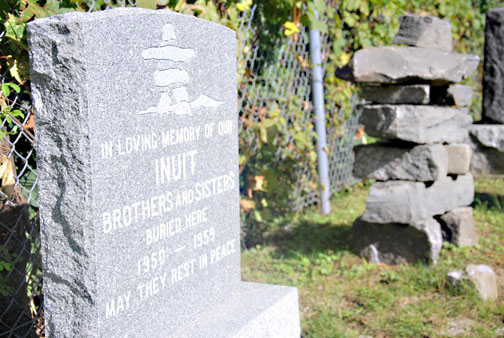
This monument on Mohawk territory in Kahnawake, just south of Montreal, pays tribute to 15 Inuit from what is now Nunavut and Nunavik who died in the 1950s after leaving the north for tuberculosis treatment. Members of the Mohawk community’s United Church unveiled the monument during a ceremony this past Sept. 10. (PHOTO BY JORDAN STANDUP, EASTERN DOOR)
CHRIS CURTIS
Eastern Door
Special to Nunatsiaq News
They were separated 59 years ago, but Mary Kauki can still remember her mother’s face.
“She was beautiful,” said Kauki. “Most of the memories come and go, but I will always remember her beautiful face.”
In 1952, when Kauki was just five years old, her mother Galakkiq Maggie Kauki contracted tuberculosis and was flown from her village in Kuujjuaq to Montreal for treatment.
From Montreal, she was sent to a hospital in Kahnawake, where she died later that year.
Kauki was buried in the town’s Protestant cemetery, where groundskeeper Tom Patton made her a concrete tombstone, marking it with what little information on Kauki was available to him at the time.

For decades, the crudely marked grave faded, and government officials never bothered telling Mary Kauki about the location of her deceased mother’s burial plot.
But thanks to the efforts of a handful of Kahnawa’kehró:non, Mary finally visited her mother’s grave June 1.
The seeds for this long-overdue reunion were sown in September, when Kahnawake’s United Church unveiled a memorial commemorating Kauki and 14 other Inuit who were buried in the cemetery during the 1950s.
At the time little was known about the deceased, most of whom died of tuberculosis, other than a first name and location of birth. Despite this relative lack of information, Kahnawa’kehró:non took the time to pay tribute to the Inuit every year.
“Every September we would gather at the cemetery to commemorate our Inuit brothers and sisters,” said Arlene Horn-Delaronde.
“Two years ago we had an exceptional year of fundraising and we had a little extra money. So I said look why don’t we make a nice little monument. We never thought it would take off like this.”

News of the monument reached the Kauki family, who had been searching for Maggie Kauki’s grave for years.
“I always planned on finding her. That was my mission for years,” said Mary-Joanne Kauki, who accompanied her mother Mary on the nearly 2,000-km trip to Kahnawake. “But she found us.”
The markings on Kauki’s grave eroded long ago, making it impossible to distinguish her tombstone from those of the other 14 Inuit buried there in the 1950s.
But as Mary Kauki stood at the memorial monument, she said she felt a sense of closure.
“I felt proud, I felt something special being there,” said Kauki.

During a tear-filled ceremony held under one of the cemetery’s many oak trees, United Church minister Maureen Scott Kabwe led the Kauki family in prayer and a group of parishioners sang a Mohawk rendition of Amazing Grace.
“Coming to Kahnawake for the first time, there were a lot of question marks” said Mary-Joanne Kauki. “But the welcome we got and the ceremony given to us was amazing.”
Kahnawake resident Selma Delisle was just eight years old when Maggie Kauki was buried, but she could clearly recall that day as she spoke at the ceremony.
“Our principal brought us to the cemetery and the entire school cried for these people,” said an emotional Delisle. “We cried because we imagined losing our own mothers and family members. The Inuit are our brothers and sisters, we’re all part of the same family.”
Minister Scott Kabwe has sent pictures of the monument and information on the deceased to their northern communities. She expects there will be more ceremonies like Wednesday’s in the months and years to come.
But for now, the Kauki family can breather a sigh of relief with the knowledge that one of their kin was treated with such reverence in Kahnawake.
“I tried to picture how it was for my grandmother back then,” said Mary-Joanne Kauki. “I often wondered if she had gotten a cold, impersonal burial but from what I’ve heard and seen today, that question was answered.”
(0) Comments