


Amagoalik controversy rooted in dissolution of health and social services boards
Arctic Matters | Inuit-led health boards hadn’t been abolished in 1999, they might have provided for homecare for Inuit elders by now
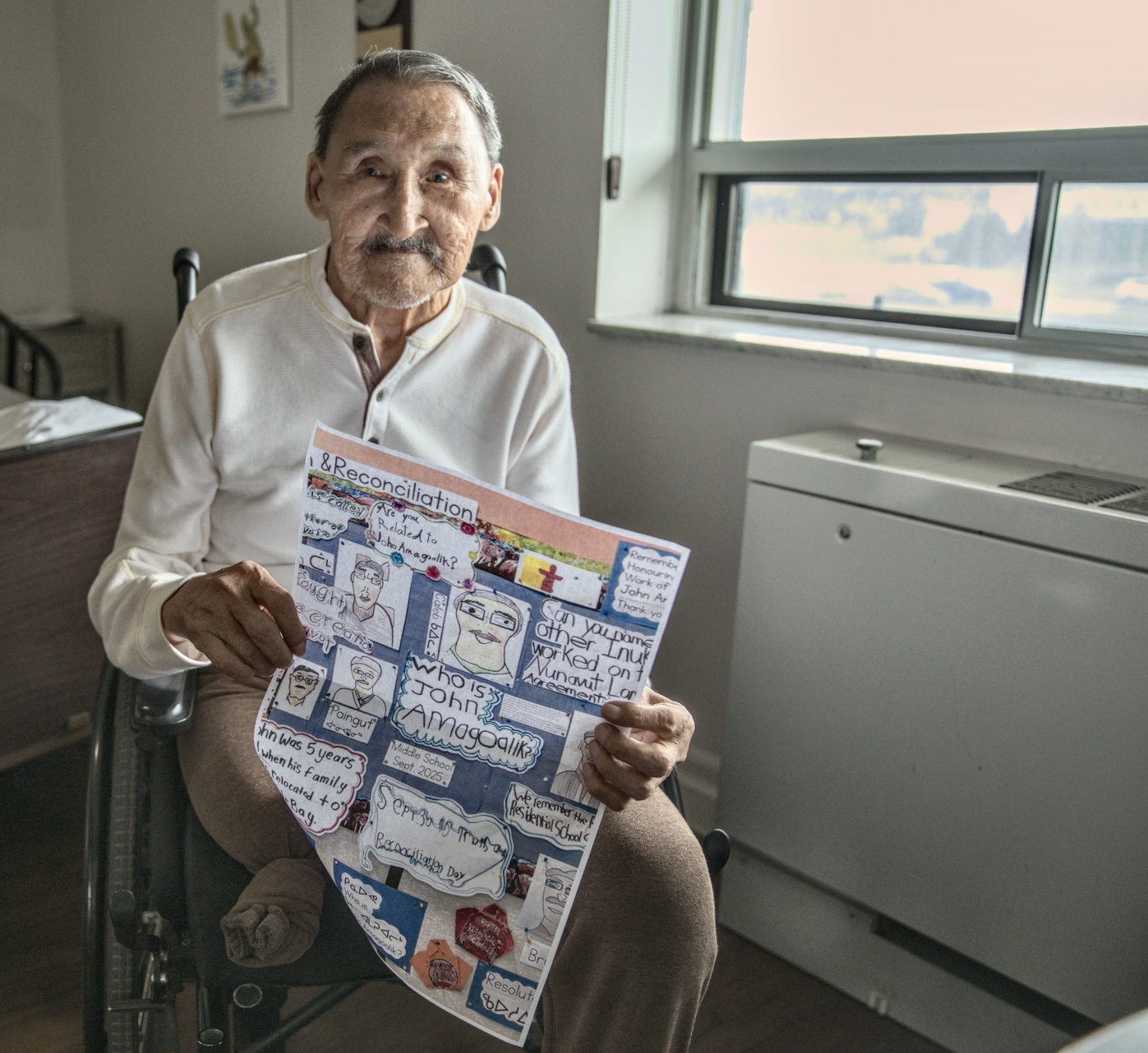
John Amagoalik holds a copy of a display created by Resolute Bay students that honours his role in the creation of Nunavut in this file photo taken in June when he lived at the Embassy West long-term-care facility in Ottawa. His current fight to get financial support to pay for the homecare he needs to live in Iqaluit might have been avoided if the Government of Nunavut had not dissolved Inuit-led boards of health back in 1999, former senator Dennis Patterson writes in his Arctic Matters column. (File photo by Jorge Antunes)
Dennis Patterson
Recent news stories about a beloved Inuit elder John Amagoalik seeking support from the Government of Nunavut to return and remain home in his autumn years drew me back to 1999: the first months of the promising new Nunavut government, in which we all had so much hope.
What happened in 1999 which may have led us to this situation?
Well, the first major law of the new Nunavut government proudly led by Nunavut’s first Inuk lawyer, then-premier Paul Okalik, was the Boards of Management Dissolution Act, which with one stroke, without consultation, dissolved all three existing regional health and social services boards in the brand new territory. (Disclosure: I was Chair of the Baffin board at the time this drastic decision was made — the only non-Inuk member of our 13-person board.)
Those boards were dominated by respected Inuit elders from every community in each of Nunavut’s three regions. We had been well trained in governance — the Carver Model — by the N.W.T. government and had done good work in four previous years under the Government of the Northwest Territories until being abruptly told we were no longer needed by the brand new Nunavut government.
In the Kitikmeot, the board had successfully pushed for a new regional health centre in Cambridge Bay that provided elder care to keep elderly residents in their homeland.
In the Kivalliq, the health board oversaw the first midwifery program to allow women to give birth closer to home, reviving traditional practices.
In the Qikiqtani Region, the health board made the bold decision to move southern medical services from Montreal to Ottawa, removing an additional language barrier for Inuit patients from Nunavut’s largest region. The board also chose the site and functional program which reflected Inuit values — for a new regional hospital, retaining and renovating the old hospital for administrative support.
Health boards run mostly by Inuit helped make those big decisions happen.
So in 1999, soon after the establishment of the shiny new Inuit-led Nunavut government, I remember Inuit board members being incredulous that their new government would do such a thing without even consulting them, instead relying on a quick and dirty desktop study by a now-defunct colonial federal agency — Consulting and Audit Canada — which justified that extreme action as a cost-saving measure, even though we all knew that the vast bulk of the budget was tied up in nurses’ salaries and medevac costs.
That reckless decision to dissolve the health boards also disrespected a condition of the transfers of health services from the federal to the territorial government in 1988. When Health was transferred to the GNWT from the federal government, federal health minister Jake Epp made it a condition of the transfer that the territory had to agree to create health boards to ensure community input.
So when respected Inuit from communities in all three regions of Nunavut heard that their new government no longer required their advice, it was surprising and devastating.
I never understood why the new Nunavut government would deprive itself of the very valuable traditional knowledge of those respected (mostly) Inuit who served on those boards, representing each one of Nunavut’s communities in each region. Instead, the government promised to establish advisory local health committees in every community, which never materialized.

Our duties overseeing the operations and developing policies for health and social services in our regions were then taken over by a well intentioned but utterly overwhelmed Nunavut minister of health and social services, originally from Newfoundland, who was married to an Inuk from Qikiqtani.
Even though he promised to be accessible, being the first one in his office at seven every morning, it was too much even for one workaholic and sincere minister to run those very important and culturally sensitive departments. He was overwhelmed by those huge responsibilities and ended his political career, exhausted, after only two terms.
The negative impact of that inexplicable decision by the government of Paul Okalik is still felt to this day and I believe is reflected in the current uncertain situation of John Amagoalik.
Would an Inuit-led health and social services board have ensured the provision of required homecare for a respected Inuit elder statesman?
If Inuit-led health boards had been allowed to continue instead of being dissolved in 1999, would they by now have revised budgetary priorities and programs and established new policies and programs to support homecare for Inuit elders wherever possible?

The Hon. Dennis Patterson represented Nunavut in the Senate from 2008 to 2023. He was premier of the Northwest Territories from 1987 to 1991, and played a key role in the Nunavut land claim agreement.
Same Problem with Education – 3 Regional education Boards represented by Community Members of the local community oversaw the Educational process giving local representation were abolished and replaced by the Nunavut Board of Education based in Iqaluit
The Majority od Education observers have cam e to same conclusion – local positive initiatives succumbed to centralization authority of the Board and Minister in Iqaluit.
So very true. Look at the disrespectful farce of the so-called consultations on the Language of Instruction held in late 2024/early 2025 in all communities. Led by the most colonial of ADMs and policy staff, the consultations were conducted as lectures with little to no input in many communities including, in more than one community, nobody turning up for the ill-timed evening community consultations. What a massive difference from the board led community consultations of the early 1990s that predated the establishment of Nunavut. Government officials only check the box, period. On to the next item on the to do list. Inuit Qaujimajatuqangit? Oh, we took Tim Horton doughnuts to the community. Checked.
And a few years later the dissolved the Divisional Boards of Education and you see where that got us.
Health and Education Boards were initially formed in 1988.
The problem with John Amagoalik is that he is just a bit too old.
Elder care in Nunavut will only be solved when Okalik’s generation of Inuit leadership ages enough and finds that this issue directly affects them.
Give it a few more years and they will be crying from the rooftops to have elder care addressed.
Dennis Patterson’s memory appears to be failing. The decision to eliminate the boards of health and education was not made by Premier Paul Okalik. The Nunavut Implementation Commission recommended that rather than having three regional health boards and three regional education boards, Nunavut should have one of each. It was Interim Commissioner Jack Anawak who decided to do without health and education boards altogether. By the time Paul Okalik was elected the first Premier the dissolution of the boards was a fait acompli. I believed at the time, and continue to believe, that Anawak’s decision to eliminate the boards was a terrible mistake. It has cost Nunavummiut dearly. That said, there’s no reason the MLAs couldn’t decide to re-establish boards of health and education.
Weird, I coulda sworn it was the Boards of Management Dissolution Act S.Nu 1999 c.3 and the Divisional Education Councils Dissolution Act S.Nu 1999 c.4, passed by the First Legislative Assembly of Nunavut, that dissolved the boards and councils.
Not weird at all. That was the legislation prepared to enact the dissolutions that the Interim Commissioner had decided upon.
That’s an utterly disingenuous claim. “Footprints in the Snow” was issued by NIC in 1995 did indeed recommend dissolution of the regional boards. The chair of the Commission was John Amagoalik. That irony aside, it was the Nunavut Legislature (with Premier Paul Okalik) that passed the Boards of Management Dissolution Act in 1999 that removed the three regional boards as of 2000. Anawak, as Commissioner, assented to it , but claiming it was his decision is like claiming the Governor-General is responsible for an act of Parliament. You should know better.
You’re confused. Anawak was pre-1999 Interim Commissioner with sweeping executive powers. He was a minister in Okalik’s first cabinet (he’d been odds-on favourite for preem) not the Commissioner. Helen Maksagak was Commissioner.
Thank you Dennis. Well written and I learned a lot.
It’s easy to agree that killing off the boards was a mistake. But that’s ancient history. Question is: what to do now?
We can and do tie things into regressive states when following procedures to the T. From my experience with municipal government, elder experenced councils where making goid and sound decisions from their own life experience than younger councils (that depended largely upon bureaucratic advice). It would be fine to allow the lawyers and bureacrats have their own little kingdoms to wile away their hours while the important matters are taken care of by the wiser ones in the communities.
Whether or not a board or committee might have made things different is just gaslighting.
What is needed now is Action.
Not speculation about what could have, should have or might have been.