


Arctic Fresh Projects awarded $35.6M contract for Iqaluit multiplex
Project to become federal employee housing
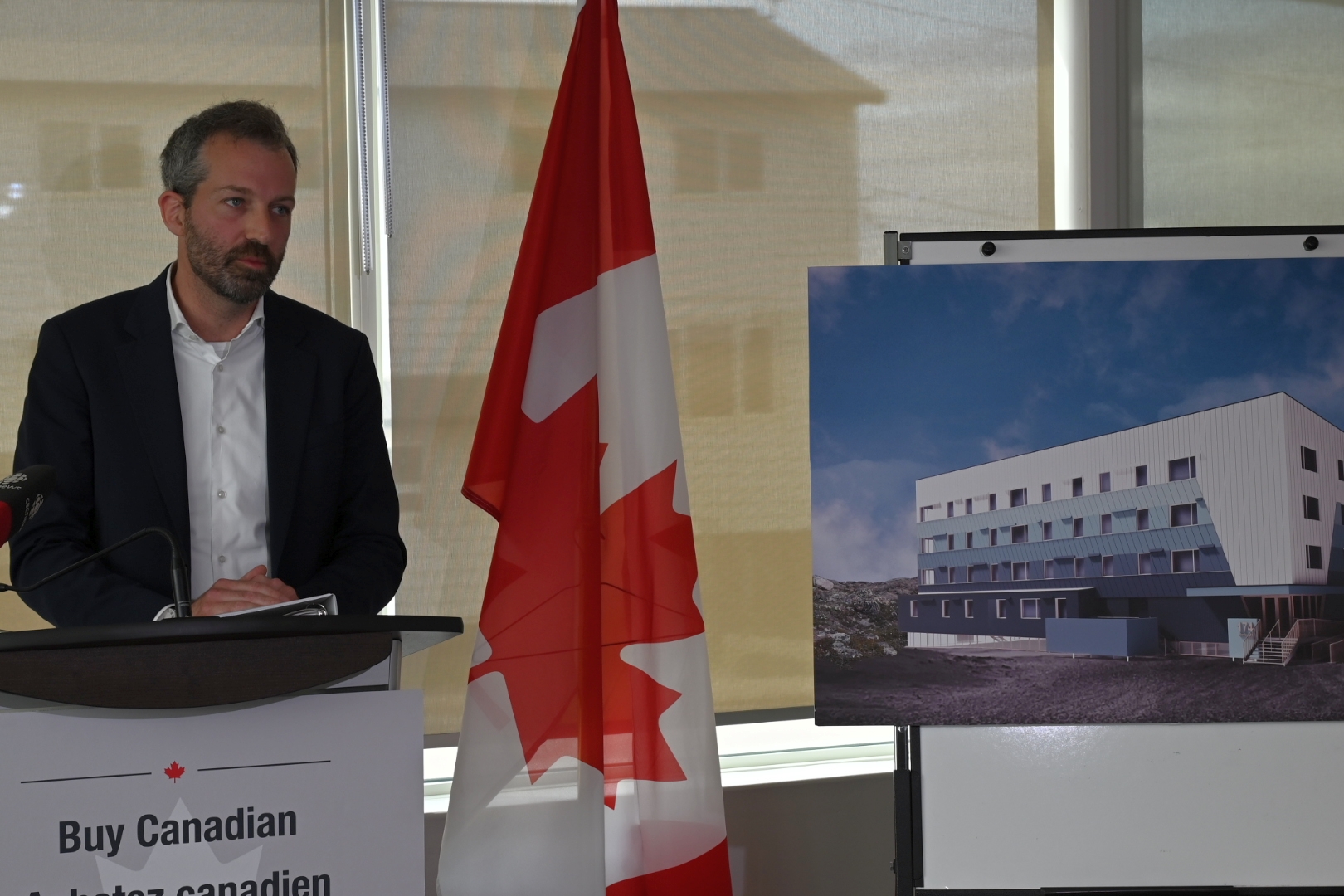
Joël Lightbound, federal minister of public works and procurement, answers questions Tuesday at a news conference announcing Arctic Fresh Projects as the recipient of a $35.6-million contract to build a federal government employee housing complex in Iqaluit. (Photo by Mosha Folger)
Arctic Fresh Projects Inc. has been awarded $35.6 million to build a 23-unit multiplex for federal workers in Iqaluit.
Federal Procurement Minister Joël Lightbound announced the contract Tuesday morning at an Iqaluit news conference.
“We’re moving from three single-family homes that were in a pretty sorry state to now 23 two-to-three-bedroom units,” Lightbound said about the project.
The multiplex will be located on Nikku Lane, east of Nakasuk School.
Construction on the four-storey building is scheduled to be completed in 2028 and is expected to create or sustain 55 to 60 jobs, Lightbound said.
It was contracted through the terms of an Inuit Benefits Plan that commits the federal government to give consideration to Inuit-owned businesses and businesses located in Inuit regions as part of the procurement process.
Arctic Fresh Projects, founded by Rhoda Angutimarik-Recinos of Igloolik, is a registered Inuit company.

“Our human resources department is entirely Inuk,” Evan Schellenberg, Arctic Fresh’s Iqaluit-based general manager, said. “We have training being developed by Inuit for Inuit. We have recruitment being done by Inuit.”
Arctic Fresh was founded in 2017 to bring food to Igloolik at lower costs and has since expanded to include logistics and construction.
“We could bring down the cost of groceries, but people still were having trouble affording them,” Schellenberg said. “A good way to make sure that people can afford the groceries is to give long-term, sustained employment.”
Between 200 and 250 federal government workers are based in Iqaluit.
The cost of the new building equates to about $1.5 million per unit, which is higher than other apartment complexes built in Iqaluit recently. Those have come in closer to $1 million per unit.
Schellenberg says this is due to the project aiming for LEED Gold certification, which is the third of four levels awarded by the Canada Green Building Council for energy efficiency, water conservation, sustainable materials, and indoor air quality.

Kevin Turner is a regional director with Public Services and Procurement Canada, which oversees the northern pool housing program that provides staff housing to federal employees.
“We know that there’s more demand [for housing] than supply right now,” Turner said. “So, this will alleviate some of that pressure, but it won’t alleviate all the pressure.”
The project is also one of the first to be contracted under the federal government’s Buy Canadian policy. The project, awarded to a Canadian company, will use predominantly Canadian steel, aluminum, and lumber, a Public Services and Procurement Canada news release said.
The policy was designed to boost Canadian business, partly in response to international pressures, including the ongoing trade war with the United States.
U.S. President Donald Trump started threatening and imposing tariffs shortly after he was elected in November 2024, and this week announced more tariffs on a range of Canadian goods from hockey equipment to down jackets.

“We’ve been very focused on what we can do to shore up the Canadian economy,” Lightbound said.
“Buy Canadian is very much a part of that…. Free trade with the Americans has been mutually beneficial, and I think a lot of Americans understand that as well. From our perspective, we’re very much focused on what we can do to build resiliency in the Canadian economy.”
Demolition of the three original houses on Nikku Lane was done in fall 2024.
Lets estimate here, say these units are around 1000 square feet on average, at 1.5M per unit that is $1,500 per square foot.
If that is a true cost, and remember this is an apartment building where you gain significant efficiencies in building compared to making a ton of individual units or row units, where each need foundations, roof, etc. those highly expensive items, that means NCC and the Housing Minsters touting their what $650 dollar per square foot NCC3000 building program is either a massive blunder or its all just smoke and that is why we are seeing little to no NCC3000 progress.
Here is the old articles https://nunatsiaq.com/stories/article/major-nunavut-3000-contracts-late-over-budget-and-lack-guarantee/
“Previously, the two parties had agreed on $630 per square foot on average for the first year’s agreement, and $670 per square foot in the second year.”
So prices have now doubled for a building that should be cheaper to make / more efficient than row-plex’s scattered across 25 communities or did NCC enter the worst deal of all time?
Also lets digest $1,500 per square foot for essentially residential property. If you are a prospective homeowner who would like to have a new home built, no one can afford 1.5M for a very small home. Wont matter what homeownership programs NHC puts in, uptake will be exactly zero if that is the new reality.
Nunavut is in serious trouble because the cost needle is moving rapidly.
@Hold on. Your assessment is a fair one. Litres of ink has been spilled by this media outlet, other outlets, on social media and all over the internet regarding Nunavut 3000 and the disastrous sole source contract between NHC & NCCD now NCC 3000 or whatever they are calling themselves this week and the overall failure of this Project to deliver on its promises.
The reality is the numbers never really mattered that were shown by NCCD & NHC. It was all a smoke show. The Premier, Housing Minister, NHC CEO and NCCD Leadership had to have known these numbers could never be achieved. How could they know? Well at the time, both NHC and NCCD were well aware of the going “market cost” and “actual costs” to build in Nunavut. NHC and the GN were also clearly aware as the cost proposed per sq. ft. was half the amount of what NHC and the GN had been receiving in public tender bids they had put to market before announcing Nunavut 3000. The number they put at $600 to $650 per sq. ft. has been clearly proven, to have been wrong, by the few actual cost numbers that have been released to date in the public domain.
The rub and what makes the actual cost per sq. ft. NHC made in their “revised amount” potential far higher; is found in the details that have not been accounted for nor shown to Nunavummiut. The “revised cost” per sq. ft. for the NCCD units has not taken into account numerous other expenses that were paid directly for by NHC and not charged by NCCD/NCC 3000. Cost NOT directly accounted for in their “revised” cost per sq. ft for those NCCD/NCC 3000 units they issued back in June of 2025 (of between $740 & $755 per sq. ft.). Those costs (free lodging, equipment purchases, permits, land value, lack of bonding requirements, etc.. do not show anywhere in NHC documentation released regarding Nunavut 3000. Those costs are dispersed and accounted for elsewhere. Where? The average Nunavummiut won’t ever know unless a full Auditor General investigation was launched. So, in essence what Nunavummiut may well discover in the future is that the units that were supposed to cost $600 to $650 per sq ft. and then told were $740.00 to $755.00 might actually cost around $1000.00 – to $1200 per sq ft. This will never be known unless regular Nunavummiut and some politicians with courage start demanding the facts.
Also of interest is the $30 million Extra paid by NHC to NCCD/NCC 30000 in June of 2025 which has NEVER been properly explained to Nunavummiut. That Extra paid by NHC was at a time where NCCD/NCCD had only delivered 18 out of 316 units required by end of October 2025 and End of December 2025. That means NHC gave NCCD/NCC 3000 $30 million dollars before it had delivered even 5% of the units. Today the majority (more that 50%) still have not been delivered to this date. The question more appropriate here. Is where did all the money go?
Taking all of this into account, Arctic Fresh should know what it costs to build (as should any Contractors in Nunavut). No one likes it but the facts are that it costs in the range of approx $1200.00-$1400.00 per sq. ft. (to others who want to comment please do not throw in the whole Modular issue as that is not what we are talking about here). This “stick build” price can vary as you mentioned based on the type of build (components/material used), foundation types, if they are plex’s, apt, single family, etc… So, is Arctic Fresh price inflated? No on can truly know without seeing the cost breakdown sheets. However, judging by what is described above they are close to the “going” cost range. Also, do not forget that Arctic Fresh is not the Developer of this project, so their profits are written into the ultimate cost per sq. ft. of $1500.00. Which is how it should be.
In the end, as you mentioned and are correct, the cost needle is currently far too high to ever permit someone to purchase a unit in Nunavut regardless of all the packages and programs NHC tries to flog. Remember also that the $1500 is the supposed “cost” per sq. ft. “to build”. That would not be what a developer would “sell” that units for. It would be significantly higher putting the units even further out of reach.
In the end, the reality is Nunavummiut need homes desperately. It is clear that the path that has been chosen is not the one that is or will lead to this objective being achieved. All new units are welcome ones. So hopefully Arctic Fresh will have a successful project.
However, until a full re-analyses, and some investigation into the whole housing fiasco in Nunavut over the last 4 + years. Home ownership will remain out of reach for Nunavummiut and those needing public housing will simply continue to wait.
Note that this does not include design costs, owner project management, demolition of the old units, and all the change orders that will happen (plus more). This will most certainly end up over $2,000 /sf. Why the Feds are trying to cosplay as real estate developers is beyond me.
The lot is empty. no demolition needed.
Colour palette looks nice! I like the blue!
This contract makes no sense. Educated and skilled Inuit (or others) filling those federal government jobs should be helped with financing to build their own homes for less than half this unit cost. The savings could then go toward making up the shortfall in housing for the thousands of Inuit in real need of it.
Can you please direct me to the contractor that is building homes at half the price? Right now even modular homes, the cheapest form of building in NU right now is pushing well over 900 per square foot and they are having some issues. These are homes that are put up within less than 2 months of arrival on sealift and they are still costing that.
There is no viable housing path for people to build new homes right now, even at a subsidized rate the cost and equity you gain in homeownership is not even remotely close to those financial gain you would get from sitting in staff housing and investing that money and making a return since staff housing is typically at a heavily subsidized rate. If you are the person who would have the money for your own home, it is likely you are employed and in demand / in a well paid job meaning you have a skillset where employers will always offer you staff housing and thus it makes zero sense from any financial perspective to build your own home at current building costs in NU, even with the first time home owners plan and other financial incentives. Its not particularly close either when you run the numbers. The only real incentive is qualitative, not being tied to a job, able to customize your own space more, etc. The quant fails though and it fails by such a margin that it will usually override the qualitative reasoning.
Arctic Fresh is simply following the well worn path of all northern contractors. The bigger the organization wanting work done, the more they charge.
Its a sliding scale; Feds top dollar, GN a little less, Hamlets around the same if there is GN money involved, then other Local Businesses and Groups (as long as they are not competition) and lowest for individuals.
People wanting to be homeowners take heart; these companies know how shallow your pockets are, and will accommodate you when government work slows down.
People have to keep in mind that the pricing of northern contractors may have little to do with their costs plus a reasonable margin.
It has more to do with covering their costs at all times, and then soaking whatever customer they are dealing with at the time for as much as they think they can get away with.
The only way that the market can protect itself from this behavior is by encouraging competition.
However, in Nunavut, we hold competition in very low regard, and count it a win when we send business to the same local companies time and again. We allow our local businesses to exist in relatively competition free bubbles contained within Inuit and northern preferential contracting policies.
This is probably exacerbated by the odd gentlemen’s agreement between local contractors to informally divvy up the available work so that everyone gets a share without spoiling things for others.
So, until such time as we are willing to have these construction quotations stand the test of reality by comparing their bids to those of as many other companies as possible, this will go on.
To the Government of Canada and southern Canadian taxpayer: be prepared to be fleeced when spending the billions earmarked for Nunavut on Defense in the coming years.
Avram, are you talking about Iqaluit only, the rest of Nunavut does not have local contractors, the poison of the GN,NTI, has almost driven all local contractors out of business, and thus with the housing 3000 program, it is all southern based contractors, taking 90 percent of all revenue south, look at the tender results, almost every contract awarded are phoney so called jvs, Nunavut is being drained by southern based company’s, local company’s are as endangered as the Caribou.
Wait till you guys see the price on modular homes that are about to be built in Nunavut,it’s ridiculous