


Artists’ resale right sparks debate among Inuit art galleries, advocates
Copyright change would give artists or their estates 5 per cent royalty on resales over $1,000
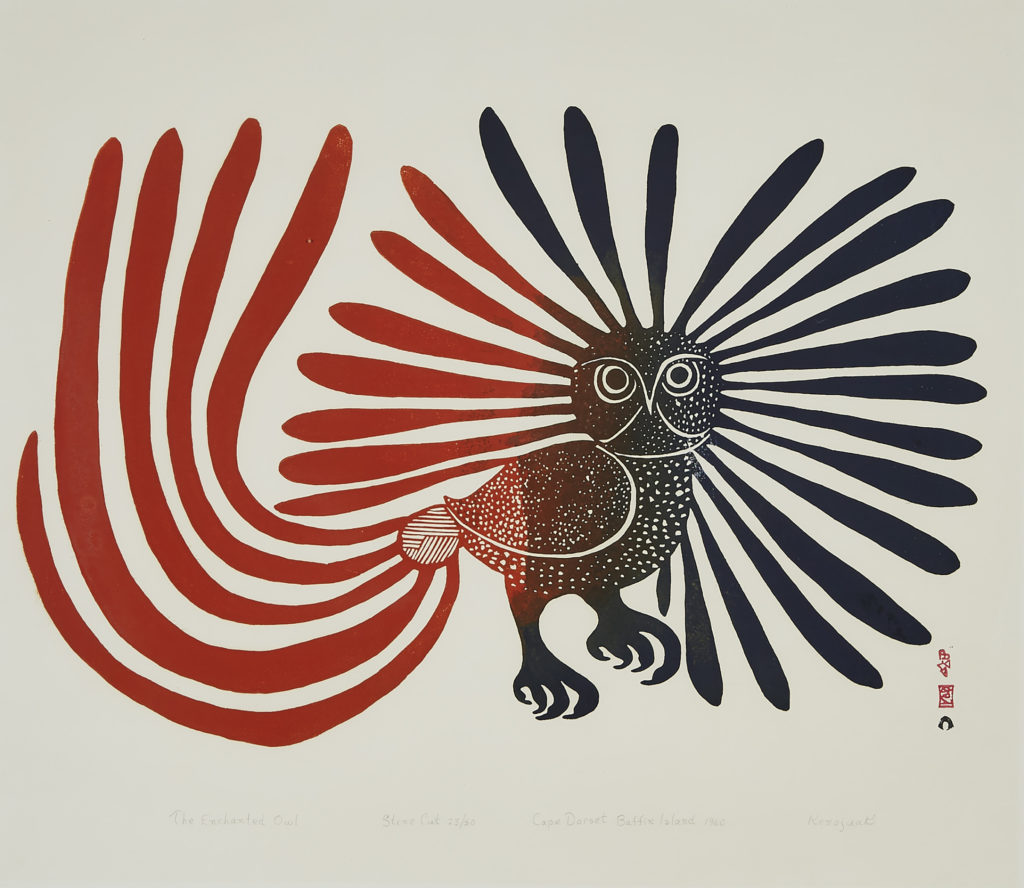
This 1960 stonecut print “The Enchanted Owl” by late Kinngait artist Kenojuak Ashevak sold at Waddingtons Auction House on Nov. 20, 2018, for $216,000. That’s the highest amount ever paid for a print by a Canadian artist at auction, says the Inuit Art Foundation. (Photo courtesy of Waddington’s)

The federal government’s plan to introduce an Artist Resale Right in Canada has drawn both support and criticism, particularly from those in the Inuit art market.
The Artist Resale Right would ensure that when a piece of art is resold through a gallery or auction, the artist or their family receives five per cent of the resale price for artwork worth $1,000 or more.
The provision was announced in the most recent federal budget and still needs amendments to the Copyright Act in order to become official.
Theresie Tungilik, an Inuk artist and past president of the national non-profit Canadian Artists’ Representation/Le Front des Artistes Canadien, said the measure could benefit Inuit artists who rely on their artwork as their primary source of income.
“I only see it as a very positive thing, because many of the artists that have made a name for themselves did so over time as collectors sought their artwork,” Tungilik said.
“This really enhanced the profile of the Inuit artist and the artist community.”
Tungilik used Kenojuak Ashevak’s The Enchanted Owl as an example. In 1960, the first print sold for $75 and Ashevak received approximately $24. In November 2018, a print sold at auction for a record-breaking $216,000, and in December 2024, another print in blue ink sold for $366,000.

“Had she been alive, or had she named an estate or family member to manage her artwork, that money would go to her estate,” Tungilik said.
Some art dealers caution the Artist Resale Right may present practical challenges, especially in the Inuit art market.
John Houston, of Houston North Gallery in Halifax, which specializes in Inuit art, expressed support for it in principle.
“I understand that France has had these resale rights in place for over 100 years. We’re well behind the times on this one,” he said. “And I think this is our opportunity for Canada to walk its talk in terms of reconciliation and reward the genius of Inuit art and their estates.”
But he asked how it would be implemented.
“Who monitors this without creating a huge bureaucracy?” he said.

“Many of these artists have passed on. Who does the payment go to? The estate? But in many cases, identifying that can take a year or more, from my own experience trying to locate families for film rights.”
Houston added that unsigned or illegibly signed pieces are harder to attribute.
Tungilik said if the Artist Resale Right is implemented, Canadian Artists’ Representation/Le Front des Artistes Canadien would appoint a copyright management organization to track and distribute artists’ payments.
She emphasized the importance of artists signing their work to ensure royalties reach them or their estates.
“For many years now, many of the older artists have only been signing their artwork in syllabics. Those are still recognizable, and so that makes it traceable,” Tungilik said.

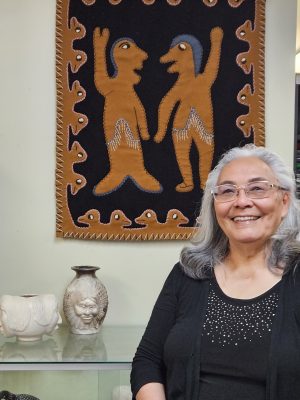
Theresie Tungilik, past president of Canadian Artists’ Representation/Le Front des Artistes Canadien, says galleries benefit from artists’ work. A resale royalty would ensure artists also share in the profits. (Photo by Charlene Panigoniak/courtesy of Theresie Tungilik)
Mark London, a Montreal-based art dealer specializing in Inuit art, shared other concerns.
He said implementing an Artist Resale Right could unintentionally discourage galleries from buying Inuit art because the resale royalty would act as an extra “tax” on these pieces.
“Most art isn’t bought for resale anyway. It’s for enjoyment,” he said. “Resale happens when someone dies or redecorates. The number of works that sell for big profits is very small. You can’t cherry-pick the Enchanted Owl.”
In 2015, about 13,650 Inuit artists produced visual arts and crafts with roughly 4,230 creating works for income. The sector contributed $87.2 million to Canada’s gross domestic product and supported more than 2,700 full-time jobs across visual arts, performing arts and media, according to the National Indigenous Economic Development Board.
Tungilik acknowledged the concerns but said fair compensation for all Canadian artists is the priority.
On its website, Tungilik’s organization states that both the seller and the art market agent would share responsibility for the royalty payment.
She said galleries raise prices to cover their own operating costs, noting “a gallery selling an art piece for $50,000 when the artist received only $500 — and these northern artists still have to pay their own water bills and rent.”
“Artists are businesspeople too, and if there were no artists, would the galleries exist?”
Imagine the amount all these artist over the history of Co-ops selling their art have profited, Crazy! And just look over how many Famous arts we have had across the North, Yukon/NWT/Nunavut/Nunavik/Alaska……and our great grandparents got peanuts from their ART.
Some data on Inuit art revenues & earnings
According to a study reported in 2015, the “Inuit visual arts and crafts economy” across Canada contributed over CA $64 million to GDP.
Crown-Indigenous Relations Canada
+1
In that same study, Inuit artists who were creating art for income (not just as a hobby) earned a total of ≈ CA $33 million net of costs in that year — i.e. after paying for materials, supplies, perhaps shipping, etc.
Crown-Indigenous Relations Canada
The study found that many of those earnings came through direct-to-consumer sales (about 67% of net payments to artists), with the rest through retail or wholesale channels.
Government of Canada Publications
+1
On average across all Inuit visual artists making income from craft/arts, the mean art-income was estimated at CA $7,810/year, while the median was only CA $2,089/year.
Crown-Indigenous Relations Canada
Roughly 10.97% of artists earned more than CA $20,000 in that survey period.
Crown-Indigenous Relations Canada
For one specific co-op, West Baffin Eskimo Cooperative (in what’s called Kinngait / formerly Cape Dorset), estimates suggest the art-production part of its business brought in on the order of CA $2 million in revenue per year, and about half of that went directly to pay artists; other portions went to staffing and operating costs.
My Great-Great Grandmother was Helen Kalvak of Ulukhaktok, NWT (Holman Island).
I asked for info online, and this is what was gathered;
What we do know about Helen Kalvak’s output and global reach
Kalvak was extremely prolific: she produced more than 3,000 drawings in her lifetime.
Many of her drawings were converted into prints and sold internationally — i.e., “sold throughout the world.”
Among these, there were a significant number of “published prints.” Some sources say she had 176 published prints.
Other sources note that between 1962 and 1978 she produced roughly 1,800 to 2,000 drawings.
And between 1965 and 1985, she had around 154 of her drawings made into prints in the annual print editions from her community co-op.
So, we know she created a very large body of work, and a portion — possibly hundreds or more were made into prints and distributed globally.
Exactly like the last paragraph say of this story, our artist saw very little in return compared to modern day artist profits.
Some data on Inuit art revenues & earnings
• According to a study reported in 2015, the “Inuit visual arts and crafts economy” across Canada contributed over CA $64 million to GDP.
• In that same study, Inuit artists who were creating art for income (not just as a hobby) earned a total of ≈ CA $33 million net of costs in that year — i.e. after paying for materials, supplies, perhaps shipping, etc.
• The study found that many of those earnings came through direct-to-consumer sales (about 67% of net payments to artists), with the rest through retail or wholesale channels.
• On average across all Inuit visual artists making income from craft/arts, the mean art-income was estimated at CA $7,810/year, while the median was only CA $2,089/year.
• Roughly 10.97% of artists earned more than CA $20,000 in that survey period.
• For one specific co-op, West Baffin Eskimo Cooperative (in what’s called Kinngait / formerly Cape Dorset), estimates suggest the art-production part of its business brought in on the order of CA $2 million in revenue per year, and about half of that went directly to pay artists; other portions went to staffing and operating costs.
This proposal only applies to galleries or auctions for transactions ≥ $1000 . It does not apply to retail or online sales, personal transactions, etc. It also applies only to Canada, not to transactions in other countries.
Overall, unfortunately it will have little impact for most artists or their estates.
What it may do, however, is shed more light on forgeries such as the infamous Norval Morrisseau case, which are not as big a problem in the arctic as elsewhere in Canada.
Both logic and experience elsewhere shows that the main beneficiaries of resale rights are the already very rich artists and their heirs.
You sell something to somebody, it becomes their property. That should be the end of the story.
Imagine the logistical challenges to this. Does that mean every sale of every piece of art is going to need to be registered and tracked? How would you avoid the black market?
What counts as art? What if a glassblower blows a vase? Is that art? I imagine many people would say yes. What if a stained glass artist creates a beautiful stained glass window for a house? Is that art? Does that have to be included as a resale of a piece of art every time somebody sells that house?