


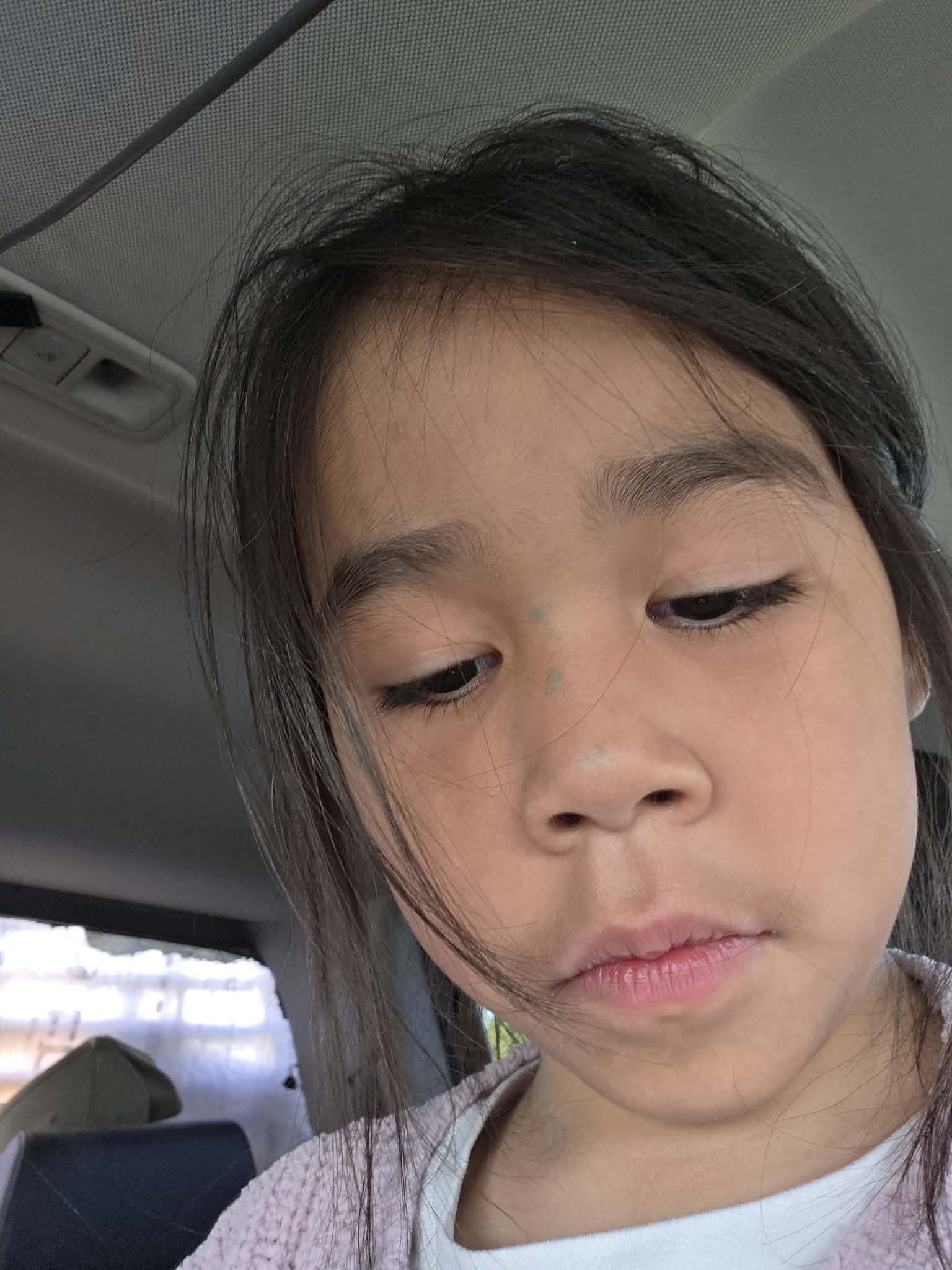
Six-year old Skyla Gordon was attacked by three loose dogs in Aupaluk, Nunavik’s smallest community with a population of about 200 people. Charlie Gordon, the girl’s father, is calling for measures to be implemented to avoid future incidents. (Photo courtesy of Charlie Gordon)
Aupaluk dog attack raises safety concerns
Six-year-old girl recovering after being bitten by three dogs last month
A father in Aupaluk is calling for better animal control after his daughter was attacked by three dogs last month.
Six-year-old Skyla Gordon was walking toward her father Charlie Gordon’s workplace, a vehicle repair garage, in early August when the incident happened.
He said his daughter’s uncle called him on FaceTime to tell him about the attack and that Skyla Gordon ended up at the nursing station to get treatment for multiple bites.
“I think it’s mostly thanks to her thick coat that she was wearing that day. The wounds would have been a lot worse if it wasn’t for her coat,” Charlie Gordon said in an interview.
He is calling on dog owners in the community to keep their dogs tied up to prevent another attack. He also said Aupaluk needs designated facilities for dealing with loose dogs.
Although they were loose at the time, the dogs involved in the attack had owners who eventually claimed them, Charlie Gordon said.
Another girl was attacked by dogs about a week after his daughter’s attack, he added.

Skyla Gordon is recovering well, although she’s still processing what happened, her dad said.
“She’s doing a lot better now. She’s still playing outside with her other friends,” he said. “But I think, mentally, she’s still scared of loose dogs.”
Nunatsiaq News could not reach Aupaluk Mayor Maggie Akpahatak for an interview.
A 2020 study published in BMC Public Health by researchers from the University of Montreal and the Nunavik Regional Board of Health and Social Services found that children were particularly vulnerable to potential rabies exposures in Nunavik.
Children aged 5 to 14 accounted for about one-third of the 320 reported exposures recorded between 2008 and 2017.
Among children under five, 86.6 per cent of reported exposures involved bites, according to the study.

The incident in Aupaluk occurred as Nunavut grapples with “several” dog attacks across the territory, according to the territory’s Department of Health.
An 11-year-old girl in Iqaluit was medevaced late last month after suffering wounds from a dog attack in the city’s downtown core. The department did not elaborate on any of the other incidents, citing privacy, but warned people to be wary around unfamiliar dogs, especially stray dogs, dogs that are eating, and dogs with puppies.
Loose dog everywhere , round up and destroy , or wait till they kill a child.
Um, maybe not if you look at an Edmonton court ruling.
Dogs attacking or killing children seems as if it has become a who cares, across Canada?
In 2024, 2 dogs killed an 11 year old boy. The owner of the dogs found guilty of criminal negligence causing death in an Edmonton court this month.
The dog owner sentenced 2 years house arrest, less a day.
Quebec laws prohibit loose dogs everywhere, especially in the communities, except on private properties, within fences. Why is the law not applied in Nunavik? There’s a difference between killing dogs to keep Inuit in the communities and prevent them from hunting and dogs that bite children or are potentially dangerous for people. If Quebec laws don’t apply in Nunavik, then the KRG should pass laws prohibiting loose dogs in the communities AND make sure they’re enforced.
Yeah, enough of the dangerous dogs running about.
That is a myth. If it were true that it was government policy to keep Inuit in communities, evidence would exist for this unlikely idea.
#1. Fur traders would have lost their supply of furs brought in by Inuit. The first thing they would have done if this happened would be to run to Northern Affairs in Ottawa to complain bitterly about it. The fur traders were powerful influences on government policy at that time. No such thing happened. In fact, the fur traders at the time complained about having to administer relief to Inuit on behalf of the government (until they got reimbursed for it), while also complaining any time an able-bodied Inuk hung around their posts/settlements and was not out trapping and sealing. This went so far as to include criticizing the churches for bringing in Inuit for services. Greed stepped in the way of purposeful dog culls to immobilize Inuit.
#2 Northern Affairs would have been faced with a huge increase in “relief” costs to feed Inuit made destitute by destroying our means of travel. Northern Affairs was infamously and chronically underfunded, and even then, regularly lapsed money because Canada has never been keen on spending money on brown people. They would not willingly accept the new costs resulting in Inuit not being able to feed ourselves.
Clearly, federal documents during this era show instead that Northern Affairs was worried about growing Inuit government dependency and was trying to avoid a repeat of the welfare reliance they had created among “southern” and “northern” Indians. Indeed, they were looking at ways of reducing relief payments such as forcefully shipping Inuit to the high Arctic and new hunting areas, not increasing relief. Paternalistic frugality stepped in the way of purposeful dug culls to immobilize Inuit.
The truth is, when loose dogs got too numerous in places and started attacking and eating kids, or started damaging things in a settlement, or got disease, several notable examples exist of RCMP (not all) being arbitrary, brutal, aggressive and unfair about dealing with those real problems.
Living completely off the land is very hard and arduous. There is no shame in Inuit accepting the medicine and housing that came in fits and starts from southern Canada to ease these hardships.
It is, in fact, not a myth: https://www.rcaanc-cirnac.gc.ca/eng/1732300419996/1732300456676
“On November 23, 2024, the Minister of Crown-Indigenous Relations apologized to Nunavik Inuit for effects of federal policies that resulted in the Nunavik Dog Slaughter from 1950 to the early 1960s.
During this time, Government of Canada actions and inactions led to the disruption of Nunavik Inuit way of life. This included the killing of sled dogs, without whom Inuit could not access the land and could not return to their hunting camps or traps. This led to great economic, cultural, and emotional upheaval which is still felt today.”