

Bangs heard inside plane before forced landing near Rankin Inlet
Transportation Safety Board releases report into 2024 forced landing of Kudlik Aviation aircraft
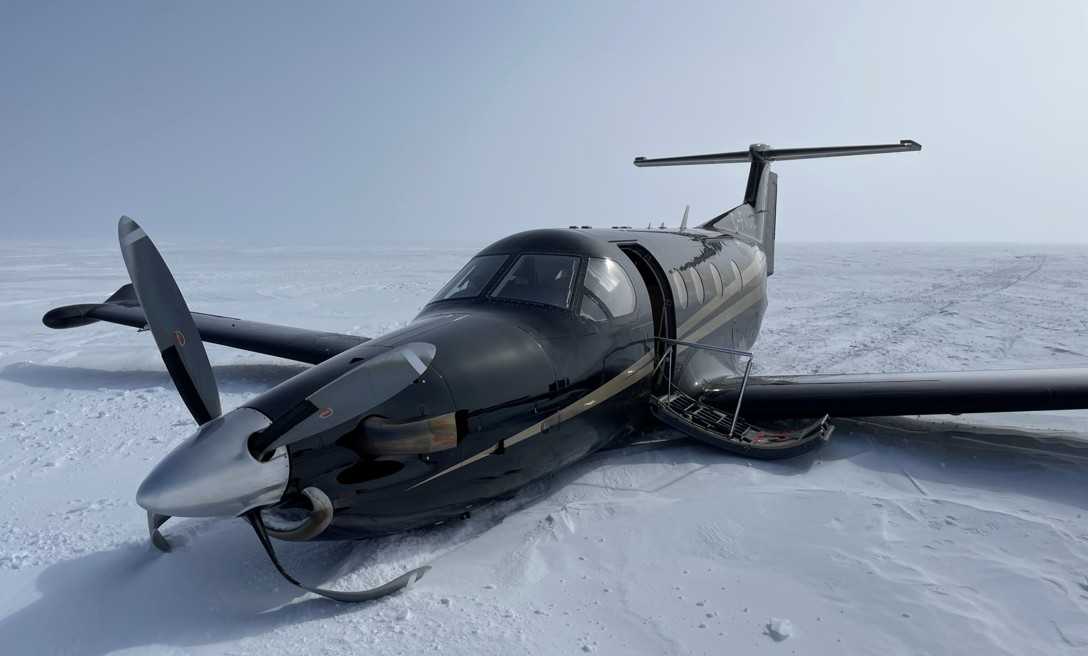
A single-engine Kudlik Aviation plane rests on the sea ice following a forced landing near Rankin Inlet in May 2024. All three people on board were safe, an airline official said. The Transportation Safety Board of Canada released its report on Tuesday. (Photo courtesy of RCMP)
A “series of bangs” was heard inside a Kudlik Aviation plane and flames appeared from its exhaust ducts before a sharp reduction in power forced the pilot to land on sea ice near Rankin Inlet in 2024.
That’s the finding of a Transportation Safety Board of Canada investigation into the May 7, 2024, incident that required pilots to land on the ice about 10 kilometres from the hamlet’s airport. The board’s report was released Tuesday.
The single-engine plane, a Pilatus PC-12/47, was built in 2006 and could hold nine passengers and two crew, the report said.
It was travelling from Chesterfield Inlet to Rankin Inlet on the morning of the incident.
“Tensile overload was the cause of the engine failure. The metallurgical tests were not able to determine a reason for the overload,” Liam MacDonald, a spokesperson with the safety board, said in an email citing the report.
The term “tensile” refers to the metal’s ability to withstand stress.
The lone passenger and two flight crew members exited the plane unharmed, an official with the Quebec-based aviation company said at the time, and no injuries were reported.

The safety board report said that on May 6 — the day before the forced landing — a “bang” was heard inside the plane while it was in flight. It landed safely, and mechanical troubleshooting found the noise was “possibly caused by a momentary bleed-off valve fault,” the report said.
The report describes an uneventful mid-morning flight on May 7, 2024, until pilots reduced power for descent from 4,000 feet above sea level.
“The engine emitted a series of bangs with flames appearing from the exhaust ducts followed by a sharp reduction in power,” the 15-page report said.
The crew’s attempts to regain power failed and they issued a distress signal 10 minutes after takeoff.
The plane landed on its belly on snow-covered sea ice, without deploying its landing gear. The three people on board exited onto the ice through the plane’s main door.
The Rankin Inlet Fire Department and RCMP arrived by snowmobile 80 minutes after the plane came to rest.

The belly of the plane sustained abrasion damage, including a 15-centimetre tear. Several plastic aerodynamic fittings on the edge flaps were cracked or broken, an antenna broke loose, and two propeller blades were bent after hitting snow and ice.
There was no fire or fuel leak after the hard landing, the report said.
The aircraft was taken by a heavy-lift helicopter to the Rankin Inlet airport eight days after the forced landing. There was no environmental contamination, MacDonald said.
Described as a “limited scope” investigation, the investigators’ goal was to learn from the incident to enhance safety, not to establish civil or criminal liability.
A representative from Quebec-based Kudlik Aviation did not respond to requests for an interview.

The Transportation Safety Board of Canada is an independent agency that investigates air, marine, pipeline, and rail transportation incidents.
(0) Comments