


‘Burnout and hardship’: Nunavut teachers struggle with loss of student support workers
Disqualification of education funding requests through Inuit Child First Initiative is a challenge, says teachers association president
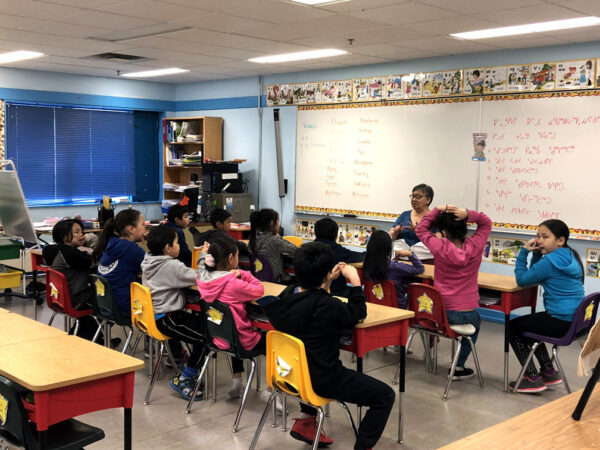
An elder in Kimmirut reads to school children during a literacy event held in fall 2017. (Photo courtesy of the Government of Nunavut)
This story was updated on Monday, Oct. 19, 2026, at 12 p.m. ET.
Teachers in Nunavut have access to fewer student support assistants this year after school-related requests became ineligible for funding under the Inuit Child First Initiative.
The federal funding program, similar to Jordan’s Principle, is designed to ensure Inuit children across Canada have equal access to health, social and educational supports.
In the 2024-25 school year, the Inuit Child First Initiative allowed Nunavut’s 27 district education authorities to pay the salaries of 88 casual student support workers. The staff worked in elementary and high schools, according to figures provided to Nunatsiaq News by Nunavut’s Education Department.
Last year, the department approved 75 casual workers, said department spokesperson Kuthula Matshazi in an email.
He did not provide how many casual support workers are working in Nunavut schools this year by publication time. Instead, he characterized it as a “limited number.”
“When that funding was readily available,” said Nunavut Teachers Association president Justin Matchett in an interview, “there were a lot of schools that were accessing that and getting additional support staff.”

Student support workers join classroom teachers to help deliver curriculum, with a particular focus on students who require accommodations.
In February 2025, Indigenous Services Canada announced that requests for student support assistants would no longer be eligible for funding under the Inuit Child First Initiative, except for in exceptional cases.
Nunavut’s classrooms look very different without that funding, Matchett said.
“There’s a lot of behaviour needs, a lot of medical diagnoses that need and deserve special attention,” he said. “It definitely causes a lot of stress, burnout and hardship on the teachers when they’re trying to manage all of that on top of teaching the curriculum.”
The Nunavut Employees Union, which represents the GN’s permanent student support staff, isn’t opposed to the government hiring fewer casual student support assistants, said president Jason Rochon in an email.
He has been concerned about support staff roles going to non-unionized workers.

“These were casual, lesser paid and non-unionized roles for essentially the same work as unionized [support] positions under our collective agreement with the GN,” said Rochon.
“All [support] positions should be unionized and covered by the NEU’s collective agreement with the Government of Nunavut,” he added. “We encourage the employer to ensure that enough [support workers] are hired across Nunavut schools.”
Indigenous Services Minister Mandy Gull-Masty promised in November 2025 to revamp Inuit Child First Initiative and make it permanent. She announced a $115-million, one-year extension in February.
The $115-million top up ensures “continuity” while the department works on a long-term approach for Inuit Child First Initiative, said Carolane Gratton, spokesperson for the department, in an email to Nunatsiaq News.
In the interim, all funding for school-related needs are reviewed on a case to case basis.

“Although the Inuit Child First Initiative can support child-specific education-related requests, such as psycho educational assessments, technology supports, and tutoring to meet individual student needs, it is not intended to replace existing federal/provincial or territorial universal programs,” Gratton said.
Correction: This story has been updated to provide the correct date for the photo. This story has also been updated to clarify that the Department of Education did not provide current data for student support assistants by publication time.
The idea behind Jordans Principle/Inuit Child First is that the needs of the child come first; not who pays.
If the GN determined, which they did, that the Student Support Workers were needed, they should remain in place and funded by the GN to support the children who need them.
The “who pays” question should then be worked out by the GN and Government of Canada. That is the core of why Jordan’s Principle was first developed; provide the service, figure out what level of government pays after.
Framing this as a disqualification of the Inuit Child First Initiative funding does a disservice to that program, as well as to the needs of the students. The need for the program is there.
It is time for our politicians, at all levels, to step up.
Many of these SSA workers barely have high school degree and there getting paid as much as teachers. That is the problem with nunavut there is zero incentive to reward hard work. Here some of the SSA just go on smoke break all the time and put on movies for kids cause they dont know what to do. No surprise they cut funding for it.
The root of the problem here is, the Federal program had a much, much lower bar for a First Nations child to receive an EA, than any school division, province or territory. Everyone involved learned that quickly and soon “some” jurisdictions started to rely heavily on financial aid from the Federal program to really prop up the number of EAs in a building.
But…. everyone had to know this is temporary! The bar to receive a 1-1 EA is extremely high, unless you’re First Nation. Everyone knew this gravy train was temporary.
I was an Education Assistant (EA) for 2 years, and it was a great experience! Having the right people or Vice-Principal monitor the EA’s performance was good. Also, having a guideline of what duties are expected for EA’s helped because I knew what was expected. There have been write up’s for past EA’s, where teacher’s complained about EA’s non compliant and not engaging with student (s) in assisting his/her classroom work.
Student Support Assistants (SSAs) are absolutely essential to the successful operation of our schools and to ensuring that all students have the opportunity to learn in an inclusive environment.
The reality is that classroom behaviours and student needs are becoming increasingly challenging. Teachers are expected to deliver curriculum, support students with diverse learning needs, manage behaviours, and maintain a safe learning environment, often without enough support.
We are seeing children as young as five entering school with very little understanding of routines, boundaries, or how to function as part of a group. Some students refuse to remain in the classroom, run through the school, hide from staff, or turn being chased into a game. There are even situations where very young children are hitting teachers or other staff members.
When a teacher must leave their instruction to deal with these behaviours, the learning of every other student in the classroom is affected. Teachers cannot be expected to teach an entire class while constantly chasing students through the hallways or managing unsafe behaviours.
This is why SSAs are so important. They provide essential support to students who need additional assistance while allowing teachers to focus on teaching. Inclusion cannot simply mean placing every child in a classroom without providing the necessary resources and staffing to make it successful.
Parents also have an important role to play in preparing their children for school. Early childhood programs, including preschool, provide valuable opportunities for children to learn routines, follow directions, share, take turns, respect boundaries, and understand that they are part of a larger group.
Children need to learn that while their voices and feelings matter, they cannot always be the ones making the decisions. At school, they must understand that teachers and other adults are responsible for establishing expectations, maintaining safety, and guiding learning.
We are seeing increasing challenges with students accepting adult direction, following basic classroom expectations, and understanding that they are not always in charge. These are skills that need to be taught and reinforced both at home and at school.
Of course, some children have disabilities, developmental delays, or other needs that require specialized support and understanding. However, regardless of the reason behind a behaviour, schools must have the staffing and resources necessary to respond appropriately.
Teachers cannot do it all. SSAs are not a luxury; they are a necessity.
If we truly believe in inclusive education, we must provide the people, resources, and support needed to make inclusion work for everyone.
And just as importantly, parents, schools, and communities must work together to teach children that respect, routines, boundaries, and responsibility are essential parts of learning.
Has anyone asked Education what training they provide for SSAs? What ensued with the piloted SSA Certificate Program that ran in three schools in the early ‘00s and the SSA modules piloted in 2012/13? Long-held and never honoured promises of an SSA Certificate program through NAC have never materialized and visions of Inuit recruits laddering through a certificate to a diploma to a degree seem to have become long forgotten though oft reiterated pipe-dreams. SSAs are among the least educated employees in our schools/territory yet they are expected to manage some of the most challenging and challenged children. One properly trained and valued SSA is worth a handful of warm bodies providing a barrier (yes, a ‘take care of him/her barrier’) between a kid and everyone else. Do teachers know how to work with SSAs collaboratively or do they treat them as photocopying assistants? Are SSTs supporting this collaborative relationship? Do they know how to? Are SSAs consistently providing support to kids who need their support or are they being pulled out to substitute teach at the drop of a hat, to run canteens and food programs, to watch the class while the teachers have prep time? Train SSAs to do their job properly and fulfill the functions they should be fulfilling instead of being pulled in all directions. Disallow all non-unionized SSAs and make training mandatory for the sake of the students. Add benefits for training completion and years of experience. The SSA pool should be Nunavut’s strongest recruiting pool but without a pool you’ll never have a sea. So many excuses and no action – it’s absolutely disgraceful. As for the Jordan’s Principle funding for SSAs – that was very largely used to staff PYs to fulfill necessary things in schools but not necessarily to support kids with additional support needs. It was a stop gap measure that gave school staff a fish and did not teach them to fish. Training, training, training that leads to increased competency and efficacy, pay increments and benefits and future Inuit teachers.
Meanwhile the SSA’s at gjoa haven elementary school end up being the casual labour pool for the cleaning staff or other positions. Maybe if the money was spent where it was needed it would still be a benefit.