


Canada, Australia sign $2.5B deal for Arctic radar system
Work begins July 1 on Ontario-based portion of missile defence program
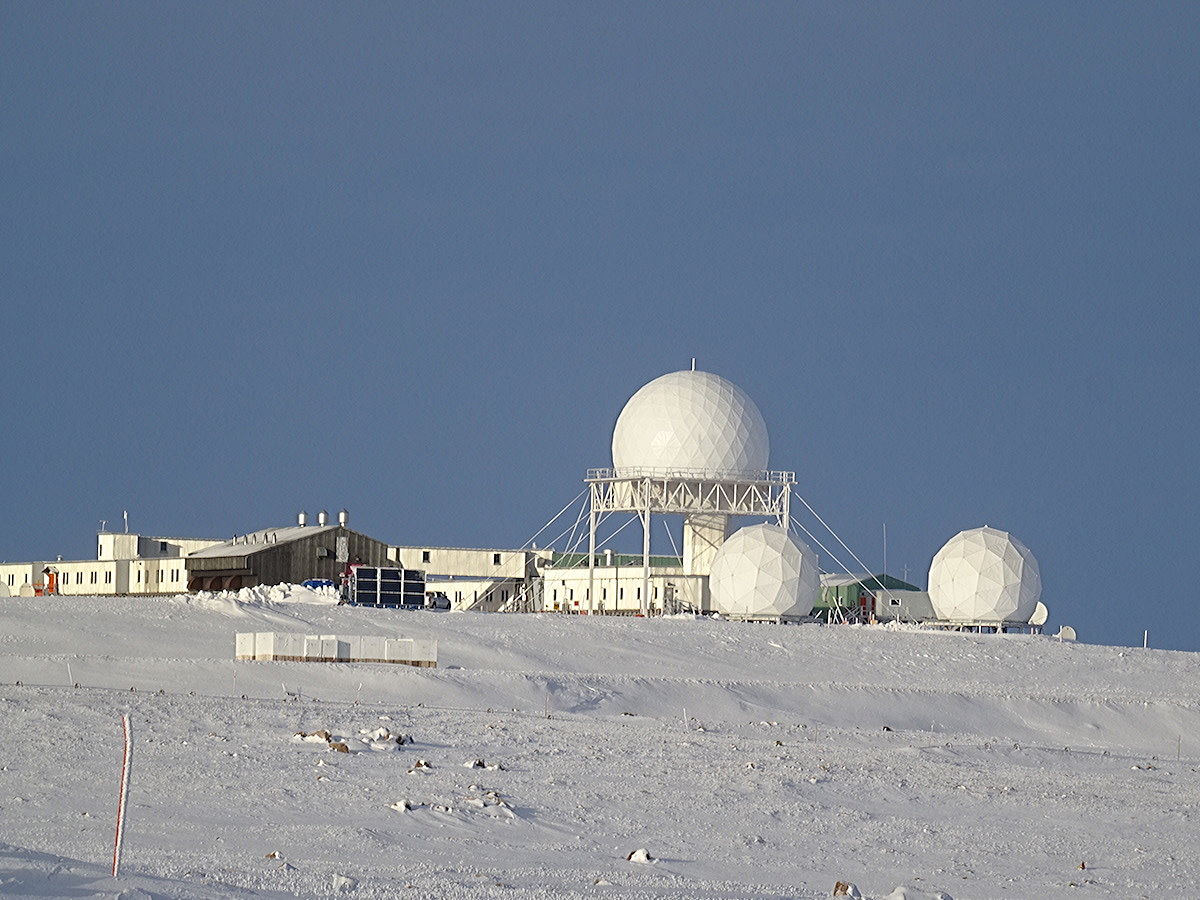
The Cam-Main radar station in Cambridge Bay, Nunavut, is part of Canada’s North Warning System, a network that is being replaced by newer surveillance capabilities. Canada is now working with Australia and defence contractor BAE Systems Australia on an Arctic Over-the-Horizon Radar system designed to provide earlier warning of threats approaching the North. (File photo)

Canada is “waking up” when it comes to strengthening Arctic defence as it moves ahead with a multi-billion dollar Arctic radar system, says one expert in the field.
The federal government announced Monday it has signed four agreements with Australia and defence contractor BAE Systems Australia to deliver an Arctic Over-the-Horizon Radar system that will help safeguard the country from missile and hypersonic weapon attacks.
The $2.5-billion deal will buy the radar system itself. It’s part of a broader Arctic Over the Horizon Radar program, pegged at more than $6 billion, that will include infrastructure, installation, integration and other costs, the Department of National Defence said in a news release.
The deal shows Canada is taking action on Arctic sovereignty, says Alexander Dalziel, senior research fellow with Macdonald Laurier Institute, an Ottawa-based think tank.
“It also [signals] to our NATO allies that, when we say we want to be in Arctic power, we are putting the basic resources in place to do that,” Dalziel said.
Stephen Fuhr, secretary of state for defence procurement, and Richard Marles, Australian deputy prime minister and defence minister, signed the deal in Canberra.
BAE Systems Australia is expected to begin work on the radar system on July 1, and it is expected to be operational by December 2029.

This system is the first of two that will be built in Canada. The second, which will be situated in Canada’s Far North, is planned for completion by 2032.
“About time,” wrote Selkirk—Interlake—Eastman MP James Bezan, Conservative defence critic, in a written statement.
“One signed contract is not enough and does not fulfill [Prime Minister Mark] Carney’s campaign promise to build with ‘speed not seen in generations,'” he said, adding that Conservatives remain skeptical until equipment is delivered and operational for Canadian troops.
This week’s deal covers the first phase of the radar project, which will be built in southern Ontario, with sites selected in the Kawartha Lakes region and Clearview Township, a July 2025 announcement said.
The radar system is part of Canada’s efforts to modernize the North American Aerospace Defence Command, or NORAD, and address gaps in the aging North Warning System, a chain of 47 radar stations from Labrador to Alaska.
The existing systems were not built to detect newer threats such as long-range cruise missiles and hypersonic weapons.
The federal government said the project will create economic benefits for Canada, including an estimated $290 million annually to Canada’s gross domestic product and about 2,270 jobs annually between 2026 and 2033.

Dalziel said northern communities are unlikely to see immediate benefits from this phase of the project, seeing as the work will be done mostly in Ontario.
But future work planned for the Arctic radar system will likely have more direct impacts on the North through infrastructure spending and economic opportunities, he said.
“This week’s deal covers the first phase of the radar project, which will be built in southern Ontario, with sites selected in the Kawartha Lakes region and Clearview Township, a July 2025 announcement said.”
Honestly, as technology gets better, I think you will actually see vastly less investment in the North. Radar sites can be further away meaning they don’t have to be placed along the actual top of the world anymore. There’s been multiple iterations now of how to redo the DEW line essentially and the last one was mostly in the sub-arctic or lower.
Its easier to staff, easier to work on , vastly cheaper maintenance, etc.
Yes we have GBRP being touted as a military project but lets be real, that’s an economic corridor mineral project under the guise of military spending.
To me the future of the North and its military spending remains still very uncertain when it comes to Nunavut. I expect the sub-arctic zones, NWT , Yukon, etc will see investment, but for Nunavut I see scraps coming if that and for very, very select areas.
Hope to be proven wrong since NU can use all the help it can get. I would like to see a full work-plan but imagine we can’t since it will be deemed confidential which is fair enough, but even a basic road-map so us over here in the Central Arctic can see what is in store other than just more upgrades to Rankin Inlets airport which already got upgrades..