


Canada’s courts stacked against Indigenous people, prominent lawyer says
“The criminal justice system has always sentenced Indigenous people differently”
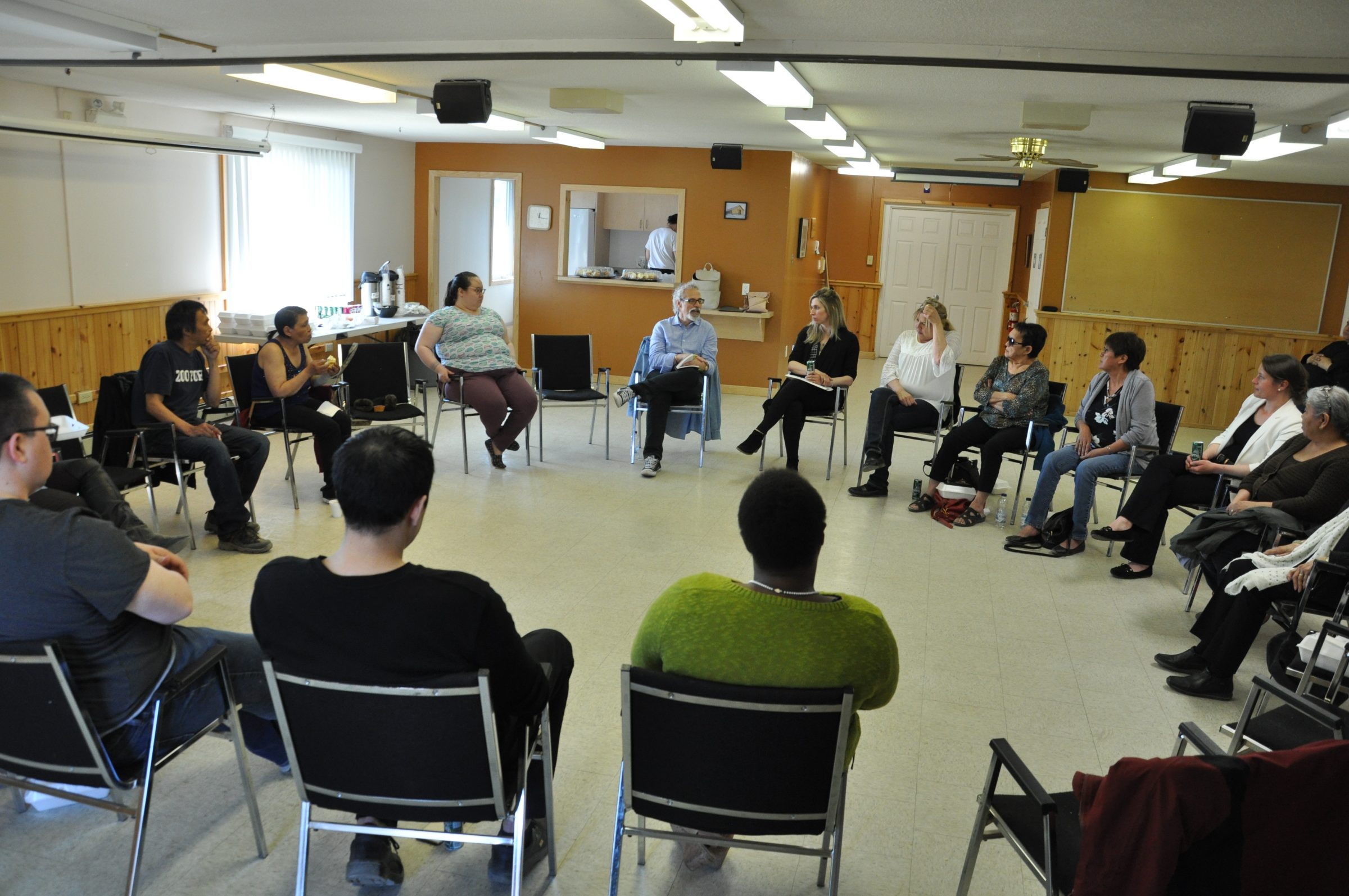
Jonathan Rudin, the program director of Aboriginal Legal Services in Toronto, spoke in Iqaluit on June 27 at an event hosted by the Nunavut Law Society. (Photo by Thomas Rohner)
Jurisdictions like Nunavut do not sentence Indigenous people fairly, because criminal court judges don’t have the whole story of offenders put in front of them before they pass sentence.
That’s according to Jonathan Rudin, a lawyer who is program director of Aboriginal Legal Services in Toronto.
Rudin held a round-circle conversation at the Catholic Parish Hall in Iqaluit June 27. The Nunavut Law Society organized and hosted the public event.
Students from Nunavut’s law program and justice system workers sat around Rudin and listened to his 20-minute speech before asking questions.
“The criminal justice system has always sentenced Indigenous people differently,” Rudin said to start.
As an example, Rudin recounted the trials of Sinnisiak and Uluksuk, Inuit in the Copper River area in the early 20th century. Both Inuit men admitted to killing two priests, historian Kenn Harper wrote.
The prosecution of these “cannibals” and “remote savages,” was about teaching “Eskimos” that “the authority of the Crown” extended to “the furthermost limits of the frozen North,” the jury in those trials heard from prosecutor Charles McCaul.

Since then, the over-representation of Indigenous people in Canada’s criminal justice system has been well documented, Rudin said.
Today, Indigenous people make up nearly five per cent of the Canadian population, yet account for over 30 per cent of all offenders in jail. Rudin said Indigenous youth make up over 40 per cent of all youth in jail, including over 50 per cent of incarcerated female youth.
The Supreme Court of Canada recognized this over-representation as a crisis in 1999 in a famous ruling called Gladue. That decision said sentencing judges must give special consideration to the different life circumstances of many Indigenous offenders.
“Aboriginal people’s history is different because of things like residential schools and government policies to destroy Aboriginal people as people, and judges now have to take that into account,” Rudin said.
But courts are slow to respond to change and a lot of people were hoping the Gladue case would just disappear, said Rudin. That can be seen in the over-representation of Indigenous offenders that continues today.
“We don’t know who prisons do work for, but it doesn’t work for Indigenous people. And that’s because of racism,” he said.

That racism isn’t always intentional, but can be seen in the way prison sentences are handed out and administered.
For example, a core sentencing value is deterrence, Rudin explained. Sentences should provide specific deterrence so the offender does not commit the same crime, and general deterrence so that other community members do not commit the same crime.
But deterrence is not “particularly useful for Indigenous people,” Rudin said.
“If there’s one group in Canada who will know, if you break the law you’ll go to jail, it’s Indigenous people.”
And courts make all sorts of assumptions about offenders.

For example, when offenders break unrealistic court orders—such as no contact with other members of a small community, or a promise to abstain from alcohol when they are alcoholics—the court assumes the offenders intentionally broke those orders.
Therefore the offenders are out of control, don’t respect the court and must be punished further, Rudin said.
“Judges and lawyers come from a different world than the offenders … They don’t get how people get really jammed up by the system.”
In 2001, the Aboriginal Legal Services began writing Gladue reports for offenders, Rudin said. These reports use interviews with offenders, victims, documents and news stories to reconstruct the life story of the offender.
Sentencing judges, then, can rely on these reports to follow the Supreme Court’s instructions in Gladue.
Prosecutors and judges who have received these reports have often echoed a similar refrain, said Rudin: “I didn’t know what I didn’t know.” The impact of the reports is a game-changer at sentencing, he added.
“Why would a judge or a prosecutor know what’s really going on in your life or your community?” asked Rudin. “Maybe they visit 10 times a year, at most.”
Support for Gladue reports continues to rise, with the National Inquiry into Missing and Murdered Indigenous Women and Girls calling on governments “to consider Gladue reports as a right.”
But Rudin said they run up against a familiar problem: money.
The reports fall under the administration of justice, which is up to the provinces and territories to fund, Rudin said. So far a handful of jurisdictions, including Nunavut where the population is about 85 per cent Inuit, have not made Gladue reports mandatory.
Meanwhile there are some, especially Indigenous victims of crime, who come out against Gladue reports.
“Sometimes families get understandably upset. ‘Our family are residential school survivors too. Why should the offender get a lower sentence?’” Rudin said he often hears.
But Rudin said Gladue reports are not about getting offenders lighter sentences. Rather, they’re about how to address a systemic problem within the criminal justice system.
Victims often feel badly treated by the court system, Rudin said.
“In the south, courts basically tell victims: We’re going to tell you about the harm you suffered by the sentence of the offender … All we offer victims is that number.”
That points to another systemic problem within the criminal justice system: there is not enough support for victims of crime either, said Rudin.
Aboriginal Legal Services sought and received funding to run its own programming, for both offenders and victims of crime, Rudin said.
“If things aren’t done differently, things aren’t going to change,” he said.
If this narrative were to be applied successfully to Nunavut it should be accompanied by some statistics and data. Of course indigenous people will out represent others groups here as they are the majority group in this region. In that case using data from Southern Canada is not completely analogous. The common conception here is that Inuit offenders are routinely given sentencing that is much more lenient than elsewhere in the country. This is partly a product of Gladue. So rather than an encore of the romantic anthems and catharsis of nebulous guilt complexes that apparently afflict some of our local writers, let’s take a more critical and holistic look at how Gladue often re-victimizes victims by not deterring or punishing those who have inflicted pain on their communities and families. That’s the kind of bold writing we need, not these painful worn out narratives.
You see it over and over, years of it has been going on. Some white knight appears to save the Inuit from themselves. Look around and see Inuit being saved from alcoholism, drugs, abuses. The white knight has arrived. It’s actually a real syndrome that white knight thing. You see it in judges, doctors, lawyers, ministers, police. There all over the place up here in our north land. One of my friends just rescued a woman from an abusive relationship, so he thought. He’s now alone, and looking for another rescue mission. We have our problems , only to be enhanced, and negatively impact pied by the white knight on his horse.
Solutions. We need solutions.
Describing part of a problem is not a solution. Even saying how you can fix that part of the problem is not a solution. If Nunavut were to make Gladue reports mandatory, which seems to be the gist of the article, then what?
Offenders getting lighter sentences because they have had crappy lives does not make for a more safe, peaceful and healthy society in of itself.
A whole host of other things ranging from the way we educate and raise our boys to how we run our prisons needs to be addressed instead.
Sinnisiak and Uluksuk ate part of the livers of both of the priests they killed in self defense. This was done in keeping with our old beliefs. Calling them cannibals was factual, not racist.
All Gladue aims to do is lighten sentencing for aboriginal offenders. Judges in Nunavut are scared to death of being deemed racist and so they give lesser sentences, a disfavor to victims and aboriginals alike.
Well prominent lawyer, I disagree with you. The problem is there’s not enough indigenous going to jail, and staying there to serve their sentences. In our communities we have ex-convicts who have done some terrible crimes, and caused much pain to our people in our communities, and they get a very light sentence. They serve that sentence, mostly, in many cases, away from the general population of prisoners, who are otherwise getting treatment. I saw it over and over. I’ve been in that system, working. It’s a joke to indigenous society to have theses same offenders going back out in the population, after serving time, not really in jail, but on a holiday, learning new tricks to do worst next time around. I’m not buying your argument, and I’m not alone in that. You or anyone else haven’t got a chance in this world to change my mind. It’s made up with knowledge, and common sense.
“But Rudin said Gladue reports are not about getting offenders lighter sentences. Rather, they’re about how to address a systemic problem within the criminal justice system.”
But they don’t do that, they only thing they do is give people a lighter sentence. Period. Surely you know that Jonathan? The unintended consequences of this of course are as many people have said above. The people who are victims suffer all over again while some self imagined savior sips his cappuccino in Toronto.
With the amount of wife battering , child sexual abuse and violence, they should be getting more time in their sentences.
Why does BCC have not programs for wife batterers?
No programs at all for Child Sexual Abusers?
This has got to stop in Nunavut.