


Creating Nunavut … step by step
Arctic Matters | On Nunavut’s 26th anniversary, former senator reflects on the change to map of Canada
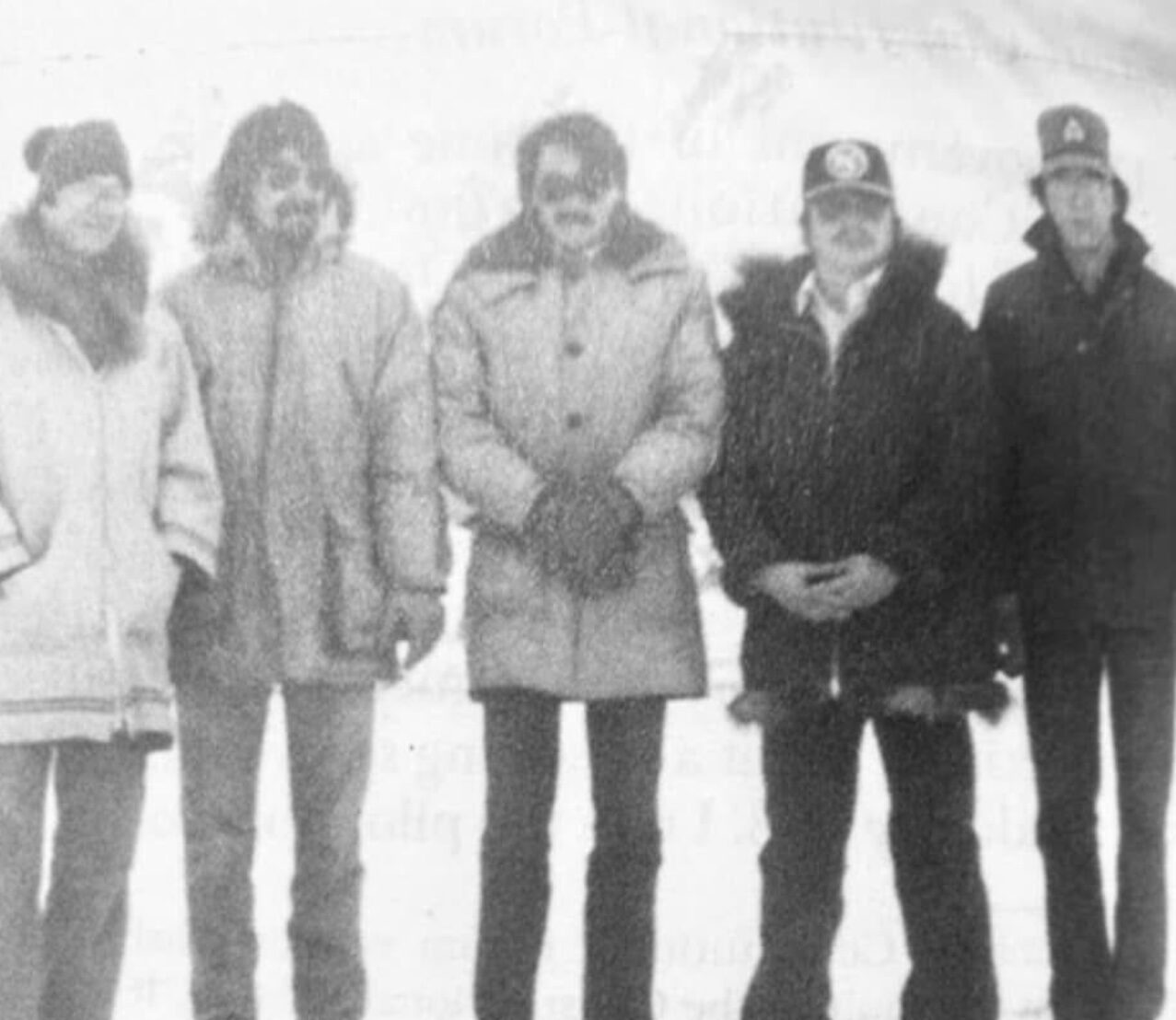
On the anniversary of the creation of Nunavut, former senator Dennis Patterson, left, looks back on many of the northern and Inuit leaders responsible for the new territory’s creation, including Peter Ittinuar, John Amagoalik, Eddie Dillon and Bobby Kadjuk, seen in this undated photograph of a community tour. (Photo courtesy of Dennis Patterson)
Congratulations to the people of Nunavut and the leaders who forged the Nunavut Land Claims Agreement and its companion Nunavut Act, which created the territory on April 1, 1999.
As we celebrate the 26th anniversary, I find myself reflecting on the many steps we took in the long journey which took us to today.
First, Inuit Tapirisat of Canada presented the first formal proposal to establish a new territory of Nunavut in 1976, although the idea had been percolating in Inuit Tapirisat through the visionary mind and work of its first President, Tagak Curley.
Inuit Tapirisat Canada’s initiative was then given a big boost with the election of the first Indigenous-majority legislative assembly in 1979, which included Inuit leaders like Tagak and Nellie Cournoyea. And in the meantime, Tunngavik Federation of Nunavut (now Nunavut Tunngavik Inc.) kept on with intense negotiations with the federal government to finalize the land claim.
In 1982, the Northwest Territories legislative assembly held a plebiscite, asking all residents who had lived in the territory for three years: “Do you support division of the Northwest Territories?”
The result was high turnout voting “yes” in what is now Nunavut and a lower turnout in the western territory, with an overall majority of 56.48 per cent voting yes. That victory, which we celebrated at the Discovery Hotel in Frobisher Bay on April 14, 1982, was a major step towards changing the map of Canada by creating a new territory in the Arctic.
Then the Nunavut Land Claim Agreement in Principle was signed in Igloolik April, 1990.

At the signing of the Nunavut Land Claim Agreement in Principle in Iglooik in 1990 are Mark Evaluardjuk (seated), Dennis Patterson, Paul Quassa and then-Indian and northern affairs minister Tom Siddon, right. (Photo courtesy of Dennis Patterson)
But then, in a dispute over the western boundary for Nunavut, N.W.T. Dene threatened to block progress towards settling the Nunavut land claim. So in July 1991, former commissioner-turned-mediator John Parker recommended a compromise boundary between the N.W.T. and Nunavut — the so-called Parker line — which was reluctantly accepted by Inuit leaders.
In 1992, another territory-wide plebiscite narrowly approved what is now the present boundary between the N.W.T. and Nunavut with a slim 54 per cent yes vote. The western territory voters overall did not support the boundary. Perhaps this was because the N.W.T. ended up with about 40 per cent of the N.W.T., and Nunavut got the other 60 per cent by this roughly tree-line boundary, which unfortunately had to exclude the Inuvialuit of the Western Arctic at the Mackenzie River Delta and Beaufort Sea.
In November 1992, the Nunavut Land Claims Agreement was ratified by 85 per cent of Inuit beneficiaries in Nunavut who voted.
Then another move threatened to block the finalization of the claim in the last year of then-prime minister Brian Mulroney’s government. In 1993, Manitoba Dene went to court to block the Nunavut Agreement. A settlement was reached which allowed for negotiations to resolve the problem, negotiations which are still not concluded (though almost I hope!) to this day.
On May 15, 1993, the final Nunavut Land Claims Agreement was signed in Iqaluit by Mulroney and Inuit and territorial leaders in a joyful celebration at Inuksuk High School.

In December 1995, a public vote was held to choose the capital for Nunavut. Iqaluit received 60 per cent of the vote and Rankin Inlet received 40 per cent.
In May 26, 1997, another vote asked the following question: “Should the first Nunavut Legislative Assembly have equal numbers of men and women MLAs, with one man and one woman elected to represent each electoral district?”
Sadly, in my opinion, only 43 per cent of the electorate supported the proposal. A mere 39 per cent of Nunavut residents actually cast their vote. The proposal to create the first legislature in the world with gender parity was defeated.
The Nunavut Act and Nunavut Land Claim Agreement were adopted by Parliament and became law on July 9, 1993. I was privileged to be an observer in the gallery of the Senate when the two bills were given third reading.
These are the main steps in the almost 50-year journey we took. Today, I think of the people (and I know I will miss some of the many) who have led us and helped us on this amazing story — carving out a new homeland for Inuit and the mother of all modern treaties.
Many of those who devoted their careers and sacrificed time away from home and families are no longer with us and deserve our respect and gratitude.
April 1 is thus a day to celebrate their enormous accomplishment — creating the largest comprehensive land claim in the history of Canada and alongside the implementation of that claim creating a contiguous new territory — a new government for Nunavut’s Inuit majority, but through a public government model providing democratic rights to all residents of Nunavut.
Nunavut and the Nunavut land claim were created by decades of hard, determined work — a miraculous confluence of forces and circumstances — a history which must be learned and respected by newer generations and newer leaders who have replaced those who went before.
It was a staggering accomplishment of a tiny minority within the largest region of Canada, achieved against all odds — reflecting the determination and unity on the part of the leaders from all regions of Nunavut — strong representatives of the Inuit of Nunavut aligned in common cause with their partners representing what are now Nunavut communities in the N.W.T. Legislature.
This was an achievement of leaders — Inuit and non Inuit alike — who sacrificed so much to create this unique government model alongside a modern treaty.
Today on the 26th Anniversary of the establishment of the Nunavut territory and Inuit homeland, I wish to show my respect to Inuit leaders who have gone before us in ITC, TFN (Tagak Curley, Paul Quassa, John Amagoalik, James Arvaluk, David Aglukark, Donat Milortuk, Alan Maghagak and in ITC (founding President Tagak, James Arvaluk, Michael Amarok, Eric Tagoona, John Amagoalik, Rosemarie Kuptana and Mary Simon) on Parliament Hill (Willie Adams, Charlie Watt, Thomas Sulluk, Peter Ittinuar, who crossed the floor for Nunavut and Jack Anawak.
I also wish to especially recognize former MLA colleagues of the Northwest Territories assembly (including Nellie Cournoyea, Joe Arlooktoo, William Noah, Silas Arngn’naaq, Piita Irniq, Ernie Bernhardt, Michael Angutittauruq, Titus Allooloo, Rebecca Mike, James Arreak, Elijah Erkloo, Kenoayoak Pudlat, Moses Appaquq, Charlie Crow and non Inuit like Red Pedersen, Gordon Wray, John Todd and Kelvin Ng), whose unity and support were driving forces in the creation of the new Nunavut territory.
On this anniversary, I remember those who made great sacrifices along the way and are no longer with us: Simon Taipana, Bobby Kadlun, Louis Pilakapsi, Randy Ames, and greatly respected MLAs Ipeelie Kilabuk, Mark Evaluardjuk, Mike Ballantyne, Gordon Wray, John Ningark and George Braden, who worked with me in the Senate for the first seven years of my term and more recently the late Kane Tologanak.
It was a remarkable, historic accomplishment borne of strong unity amongst the Inuit and close and respectful collaboration with the territorial and federal governments of the day.
Let us strive to achieve the same level of close collaboration for the continuing common good of all the people of Nunavut as we move into our next quarter century!
NLCA is a joke to Inuit of NU, only the elected officials are benefiting from it.
Start the land chain and just right into self governed biggest made in Nunavut history.
Nunavut is high jacked bu the outsiders.
These negotiator who were part of NLCA they had no clue what they were up to and coming out of high school.
YES, a variant good