


Five clean energy projects across Nunavut get federal funding
$3 million to support initiatives in Resolute Bay, Chesterfield Inlet, Arviat, Cambridge Bay, Baker Lake and Whale Cove
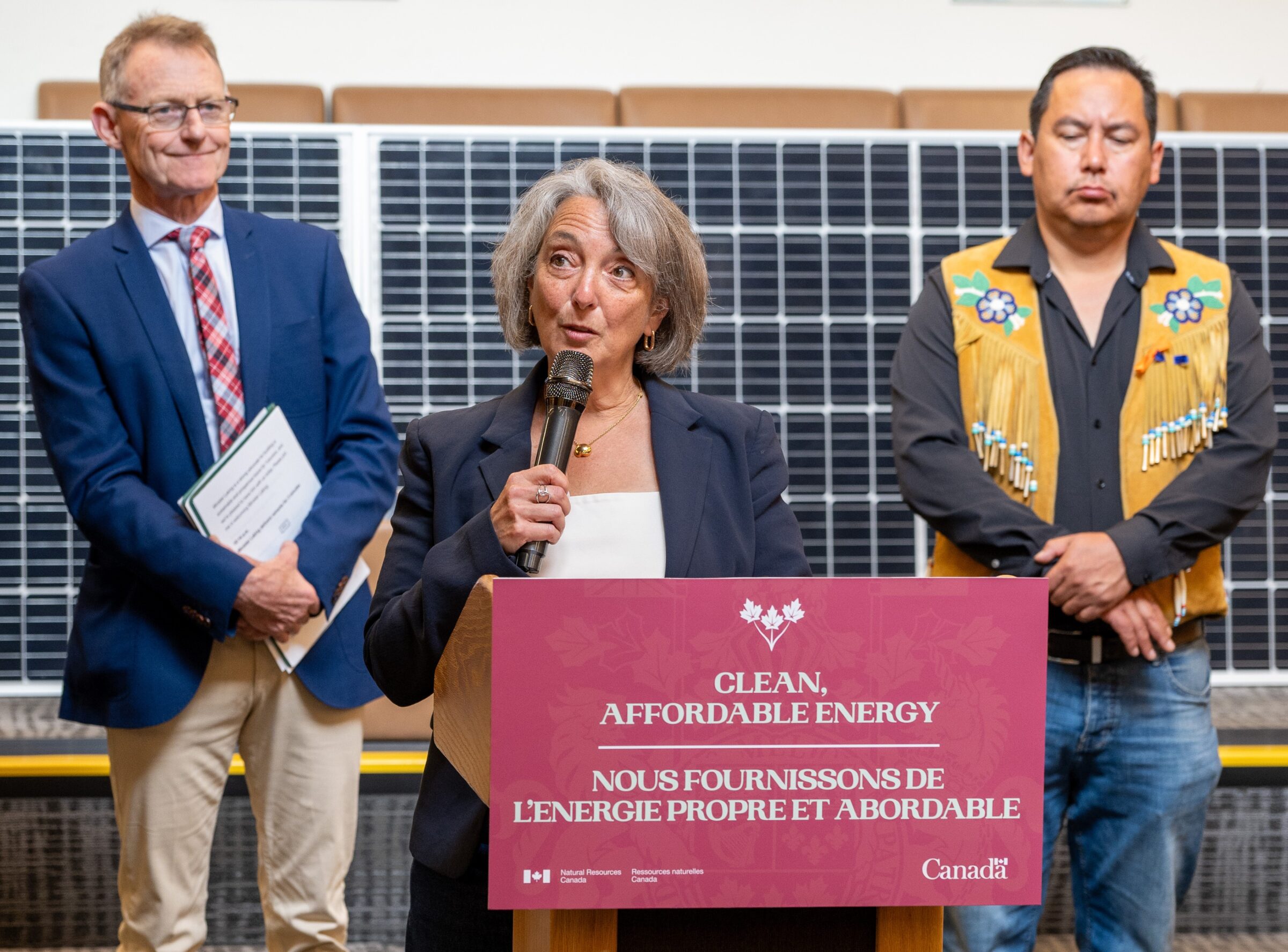
Julie Dabrusin, minister of environment, climate change and nature, speaks to reporters from the podium during a news conference in Whitehorse on July 29. To her left is Yukon MP Brendan Hanley, and to her right is Kwanlin Dün First Nation Chief Sean Smith. (Photo courtesy of Keean Nembhard, Department of Environment)

Five clean energy projects across Nunavut will split $3 million as part of the latest federal funding connected to the National Electricity Strategy announced in the spring.
Federal Environment Minister Julie Dabrusin made the announcement in Whitehorse on July 29.
The announcement was part of a $7-million National Electricity Strategy expenditure, with $3 million each for Nunavut and the Yukon, and more than $765,000 for the Northwest Territories.
“Building a stronger Canada starts with building reliable, affordable and clean electricity systems throughout the country, including the North,” she said in a news release her department issued.
Projects that got funding include the Hamlet of Resolute Bay, which received $260,000 to install a 15-kilowatt solar photovoltaic system on a municipal garage.
The Hamlet of Chesterfield Inlet received close to $730,000 to cover the installation of a 134-kilowatt solar array on the roof of the community centre rink, to reduce the amount of diesel fuel used to generate electricity.
In Arviat, Kivalliq Alternative Energy Ltd. received more than $410,00 to complete an engineering and design study to make a hybrid renewable energy system.
In Cambridge Bay, the Kitikmeot Heritage Society received $100,000 to support carbon analysis for the construction of a new cultural research campus. Called Kuugalak, the facility is dedicated to the documentation, revitalization and mobilization of Inuinnait knowledge.
Nunasi Corp. received the biggest portion of the Nunavut funding, with $1.4 million going toward its Smart Renewables and Electrification Pathways Program, which seeks to improve renewable energy technologies for a sustainable power grid that services Baker Lake, Whale Cove and Chesterfield Inlet.
Most of the funding stems from Natural Resources Canada’s Clean Energy for Rural and Remote Communities Program, which launched in 2018 and aims to reduce reliance on fossil fuels for heat and power.
Prime Minister Mark Carney announced the creation of the National Electricity Strategy in May to double Canada’s power grid’s capacity by 2050 and supply clean energy across the country. The federal government launched consultations with provinces, territories, Indigenous Peoples, utilities and unions over the spring and summer.
(0) Comments