


Gaps persist in information sharing on Nunavut’s youth in care: Hearing
Standing committee hears protocols should be in place to monitor youth outside territory but not all youth are covered
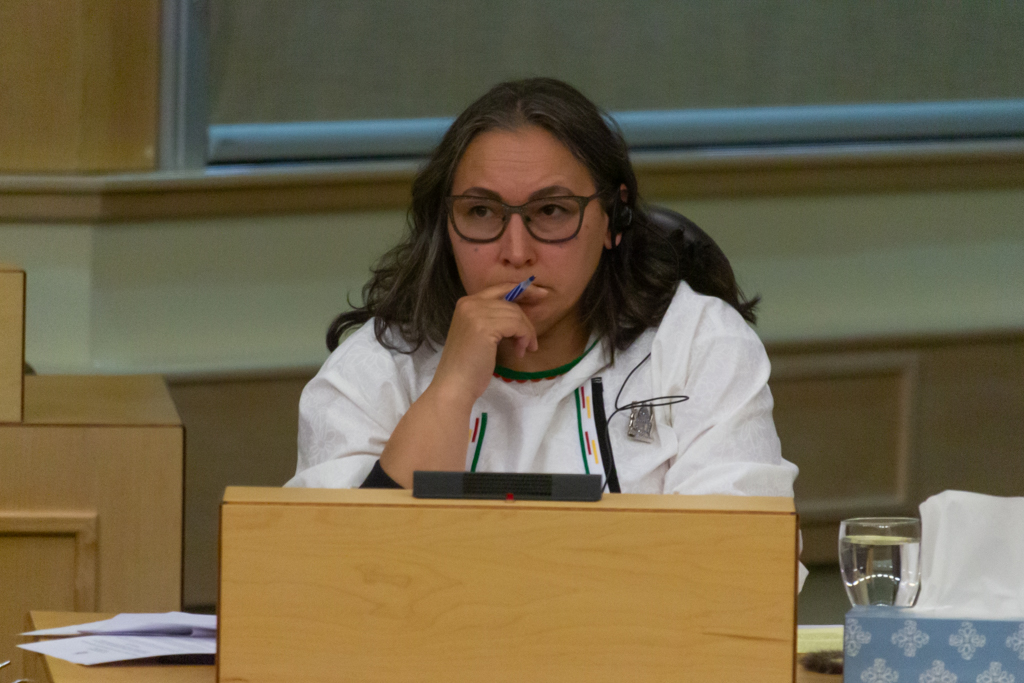
Janet Pitsiulaaq Brewster, MLA for Iqaluit-Sinaa, was not satisfied by the Department of Family Services’ delays in addressing the ongoing crisis in the department at the Legislative Assembly’s Standing Committee on Oversight of Government Operations and Public Accounts hearings on Monday. (File photo)
This story was updated on Thursday, April 25, 2024, at 10:15 a.m. ET
Almost a year has passed since Canada’s auditor general’s damning report into the state of Nunavut’s child welfare services, and the territorial government still doesn’t know how many kids in care outside Nunavut have agreements in place to share updates about their well-being.
The information came to light on Monday, the first day of a two-day legislative assembly hearing into the 2022-23 annual report from Jane Bates, Nunavut’s Representative for Children and Youth.
The Standing Committee on Oversight of Government Operations and Public Accounts held the hearing to “provide an opportunity for members of the legislative assembly to consider the extent to which the Government of Nunavut is taking action to address recommendations” from the report and the committee itself, according to a legislative assembly news release.
Nunavut youth who are in care outside the territory should have an inter-provincial agreement, which describes the responsibilities each jurisdiction has in ensuring their safety, and how updates are provided to the Department of Family Services.
For instance, there may be a question of whether a southern facility meets the particular needs of a youth. Or the province might flag particular concerns about a placement, such as whether they are unlicensed, Bates said.
“But the current situation has been the children were sitting in [outside-the-territory] placements, and the receiving jurisdiction had no idea that they were there,” she said.
The GN has faced tough questions in the past about its handling of youth in unlicensed care homes outside Nunavut.
Family Services deputy minister Jonathan Ellsworth could not say how many youths placed in the south have an information-sharing agreement in place, but noted those newly entering the system are placed under the protocol as a matter of course.
There are currently 93 children in care outside the territory, Ellsworth said.
Bates is monitoring 20 recommendations she made to the department prior to the release of her report.
“There are currently very limited standards and procedures related to children in care and that’s quite shocking when you consider the number of children in care,” Bates said.
Ellsworth criticized previous leadership within the Department of Family Services, saying they took a “set it and forget it” approach to following the auditor general’s recommendations.

“Although [recommendations] have not been acted upon historically, I am committed, as is my team … to implementing those recommendations,” Ellsworth said.
Iqaluit-Sinaa MLA Janet Pitsiulaaq Brewster opened her remarks with a rebuke to the Department of Family Services.
“We know that it’s impossible for a crisis to address itself. We can’t stick our head in the sand and assume that the crisis will go away. And what, what we know is that for a number of years, there hasn’t been an adequate response,” she said, before asking Ellsworth when the department’s standards and procedures manual for youth in care would be updated.
Ellsworth said updating the manual is a “priority” and should be ready within three to six months.
“It seems to me another three to six months for that very important baseline of standards is a long time to [take] in addressing the crisis,” Brewster responded.
Ellsworth assured Brewster again that work is ongoing.
The committee’s review of the Representative for Children and Youth’s annual report continues Tuesday.
Corrections: This story has been updated to identify which recommendations Jane Bates, Nunavut’s Representative for Children and Youth, is monitoring. It also has been updated to include more details about the scope of Nunavut’s interprovincial agreements.
I want to point out that Mr. Ellsworth is correct about “set it and forget it,” as the audit period covers January 1, 2019, to May 31, 2022. However, I have a question regarding the previous DM and ADM—why aren’t they being questioned about this? Furthermore, where are the directors?
I understand that Nunavut is facing a shortage of social workers, but it’s concerning that some communities are still without one and have to rely on regional offices to report and take action. Instead of waiting for indeterminate vacant positions to be filled, why aren’t these offices hiring competent casuals? Maybe the casuals don’t have a degree in social work and cannot apprehend if needed, but at least their presence will start the work.
Government (EIA) quietly shifted the previous DM of Family Services to be DM of another (quieter and smaller) department right before the OAG report was released…. Coincidence? If it wasn’t hiding and protecting, it certainly looks that way from the outside…
I agree. looks like they all just ran away after the OAG report. one of them is in Ottawa working as a consultant. Somebody call it.