


Greenland’s Titanic: The loss of the Hans Hedtoft
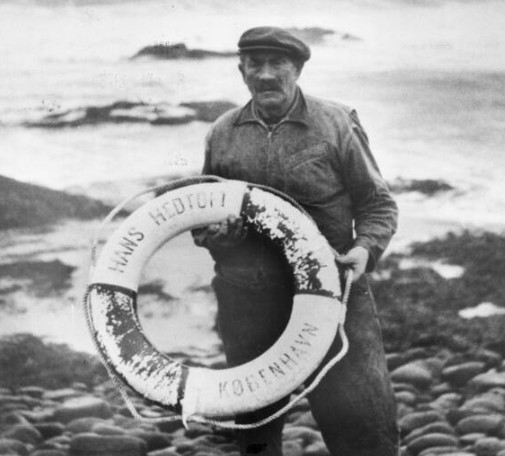
A man stands with the one lifebuoy that was recovered after the wreck of the Hans Hedtoft. (Photo via Facebook)
Everyone knows about the Titanic, the ship built to be unsinkable.
Great hype surrounded its launch and sea trials. When it was ready to begin its maiden voyage, it left Southampton, England, on April 10, 1912.
All went well until April 14, when it suddenly collided with an iceberg. The ship went to the bottom of the Atlantic. Of the 2,200 passengers aboard, almost 1,500 people died.
Greenland had its own version of the Titanic. It was not as large a ship, but the disaster, to the people of Greenland and Denmark, was as important as that of the Titanic.
The Hans Hedtoft was built in the Frederikshavn shipyard for the Royal Greenland Trade Department and launched on Aug. 13, 1958.
Named for a former prime minister of Denmark, the ship was small but sturdy with a double steel bottom. Its bow and stern were extra strengthened. It was diesel-powered, had seven watertight compartments, and was supposed to be able to stay afloat even if one was filled with water.
The vessel carried up-to-date instruments, including radio-equipped life rafts. Her 58-year-old captain, P. L. Rasmussen, said, “This ship means a revolution in Arctic navigation.”

In those days – not all that long ago – there were no airlines flying to Greenland, so the Hans Hedtoft was a passenger and cargo vessel.
The ship left Copenhagen on Jan. 7, 1959, for its maiden voyage. It travelled uneventfully to Greenland, where she called at Godthaab (now Nuuk), Sisimiut and Manitsoq. On the return leg of her voyage, it carried 40 crew, a cargo of frozen fish and 55 passengers.
Its route went from the capital, down the west coast of Greenland to Julianehaab (now Qaqortoq), and into the North Atlantic Ocean. There, about 56 kilometres south of Cape Farewell, she met strong winds and mountainous six-metre seas. In the morning, the wind from the northeast rose to storm level and the visibility was reduced to one mile.
Then, on Jan. 30, she struck an iceberg. Water poured in and flooded the engine room.
At 1:56 p.m., the ship transmitted a distress signal that was picked up at the weather station at Prins Christians Sund.
Two German fishing vessels and the U.S. Coast Guard Cutter Campbell altered their courses to attend the stricken ship. But the seas were littered with icebergs.

A little over an hour later, the captain sent a second message saying that the ship was in the ice and sinking. The engines were not working and there was no electricity. The only power was from a small emergency generator.
The German trawler Johannes Kruss reached the position where the collision had occurred. The Hans Hedtoft fired rockets into the air and the Kruss trained its searchlights on the sky, but neither vessel saw the other.
Another message at 5:41 p.m.: “We are sinking slowly.”
At 6:06 p.m., the German trawler picked up the beginning of an SOS message, but no more. There was no further contact with the stricken ship.
All ships in the area rushed to what they hoped would be a rescue effort. Sixteen ships from a number of countries participated. For instance, Canadian and American patrol planes flew from Keflavik, Iceland, and Newfoundland took part in the search. But no wreckage was found and there were no survivors.

The 95 passengers who died included Greenland’s two representatives in the Danish Parliament and six children.
In addition to her cargo of fish, the vessel was carrying archival material relating to Greenland’s history, transporting it to the National Archives in Denmark. The material amounted to 3.25 tons packed in 13 cargo crates and constituted about a third of all of Greenland’s archives, going back to the earliest days of Danish rule over Greenland — irreplaceable material.
Ironically, the material was being sent to Denmark to be conserved and properly organized. An archivist who surveyed Greenland’s local archives the previous year had found the material disorganized.
Some of it had been damaged by being stored in a leaky attic for years. He reported, “It is of absolutely critical importance that they are treated as soon as possible by a knowledgeable conservator.”
The plan was that they would be treated in Denmark, organized, and returned to Godthaab once a suitable archive building was constructed. Most of the material lost related to South Greenland. Among many other items, it included church records dating back to 1740 with records of baptisms, weddings, confirmations and burials.
And then the finger-pointing began. Greenland Minister Johannes Kjærbøl had pushed through a decision that the Hans Hedtoft should sail with goods and passengers year-round between Denmark and Greenland even though experienced captains had advised against carrying passengers during the winter months when sailing was more dangerous.
A private Danish shipowner, Knud Lauritzen, had said the steel plates on the ship should have been welded, not riveted; he thought that riveting did not provide enough resistance to the pressure of the ice.
A lifebuoy was found washed ashore in Iceland some months later. It is now on display in the church in Qaqortoq. A memorial plaque there gives the names of those who died.
The sinking of the Hans Hedtoft was one of the worst maritime disasters in Danish and Nordic history. For Greenland, the loss of lives at sea was unprecedented, and the archives lost were a tragedy from which the country has never recovered.
Taissumani is an occasional column that recalls events of historical interest. Kenn Harper is a historian and writer who lived in the Arctic for over 50 years. He is the author of Give Me Winter, Give Me Dogs: Knud Rasmussen and the Fifth Thule Expedition, and Thou Shalt Do No Murder, among other books. Feedback? Send your comments and questions to kennharper@hotmail.com.
(0) Comments