


Healing through harvesting: Therapeutic justice program expands to Pond Inlet
Fewer than 10 per cent of Inuit who complete program have re-offended, says program manager
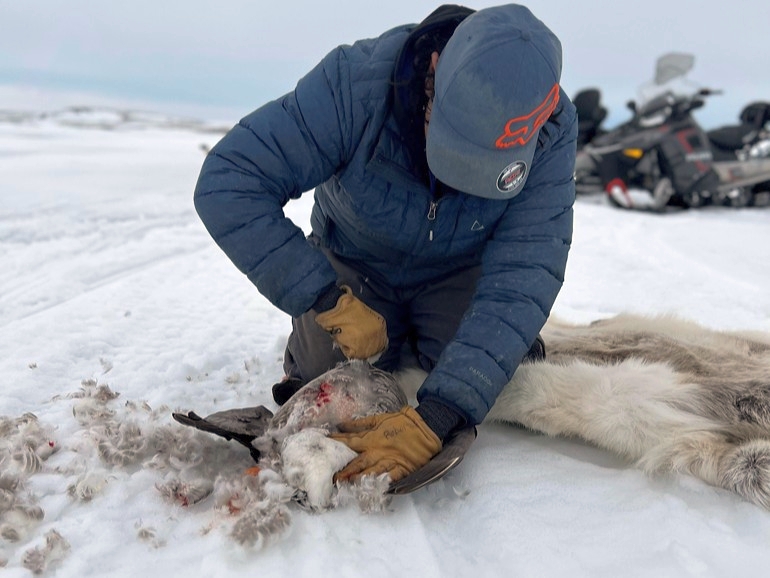
A Therapeutic Justice Program participant in Arviat practises harvesting skills he learned while participating in the program’s workshops. (Photo courtesy of Tracy May)
On top of being a father, a grandfather, a heavy equipment operator, a harmonica player, a hunter and a tool maker, Joseph Kablutsiak delivers cultural programming to Arviat residents going through the justice system.
“A few years ago, I was asked for help with our young people who are on probation,” Kablutsiak said from his home in Arviat.
“I’ve seen lots of troubled kids. I try to help them out, talk to them and find out what’s wrong. And I just try to be a good role model for them.”
He shares the lessons his father gave him as a boy, like how to fashion ulus, harpoon heads and qamutiks. He said he relishes the opportunity to teach such skills to men and boys who may not have had the same opportunities he did.
“I feel lucky that I am able to make tools,” Kablutsiak said, listing off the things he makes such as snow knives, harpoons, and harvesting hooks. “I try to keep that tradition alive with me, from my father, and pass it on to young people.”
His work is part of a larger initiative: the Government of Nunavut’s Therapeutic Justice Program, which began in 2019 in Cambridge Bay and now operates in Arviat too, with plans to expand to Pond Inlet.
The program is designed to give Nunavummiut going through the justice system an alternative route to healing. It’s also meant to reduce the chances of an offender re-entering the justice system after their release.
As of late June, about 160 Inuit have participated in the program, and less than 10 per cent of them, according to program manager Tracy May, have reoffended.
“It has that beautiful holistic approach for Inuit in Nunavut,” May said of the program in an interview from Cambridge Bay. “Looking at different programming that hasn’t worked … this is much needed.”
Referrals can come from two places. The RCMP can refer individuals “pre-charge” for lesser crimes, such as vandalism or theft under $5,000. If charges have been laid, the Crown or defence can refer individuals as well, said territorial Justice spokesperson Sierra LeBlanc in an email.
The program takes six months, give or take, according to LeBlanc. During that time, participants choose their own living situation and report to their case specialist. If they don’t show up to their appointments or can’t be contacted, they will go back through the court system.
The sessions — sewing, hunting, fishing, tool making, therapy — take place throughout the hamlets and involve elders, instructors and mental health specialists.
The program is tailored to each participant and community, May said. For example, participants in Arviat hunt caribou. If the program ran in Iqaluit, there might be more fishing.

“It’s not a cookie cutter approach,” May said. “It fits individual client needs, whether they need help in addiction, trauma or mental health issues.”
Participants have donated clothes they’ve sewed to schools. Others have built meat-drying racks and a qamutik that have ended up in the hands of elders as draw prizes run by the Hamlet of Arviat.
“It brings a sense of pride,” May said. “Like, ‘I’m helping; I’m giving back to the community.’”
The program is not mandatory, she said, but she has not yet had a referral decline to join. The GN spends time promoting the initiative, which has boosted its profile. Sometimes local radio stations will host phone-in shows with lawyers so community members can ask questions.
Others who are not dealing with the justice system have asked to participate, she said.
“We have to say: ‘I’m so sorry, you can’t,’” she said. “A big part of it is that engagement, maintaining that relationship with the community.”
Alessia Bongiovanni, a spokesperson for the Public Prosecution Service of Canada, said in an email that Crown lawyers refer people to the program often.
“We have seen many benefits including early access to mental health, addiction support, and life skills support,” she said.
May is excited to expand to Pond Inlet and looks forward to having the program in every Nunavut community one day. But she cautions against moving too fast.
“I see many programs starting up and going too fast, too big,” she said. “We want to start introducing [therapeutic justice] gradually into one community at a time, ensuring that it becomes successful, that everyone’s trained, then moving on to the next community.”
There is no timeline for the expansion to Pond Inlet, but the wheels are in motion, said Justice Minister George Hickes in June, during a news conference.
“We’ve got the funding and everything’s in place, we can start the hiring process,” Hickes said. “So that we can roll the program out and build on the momentum that’s already been achieved.”
They are lucky, being supported by hunters and all because where I am from, our local hunter only make fun of people who don’t have hunting gears.