


How Arctic Fresh grew from groceries to multimillion-dollar construction contracts in 5 years
Igloolik-based group of companies focuses on Inuit skills training
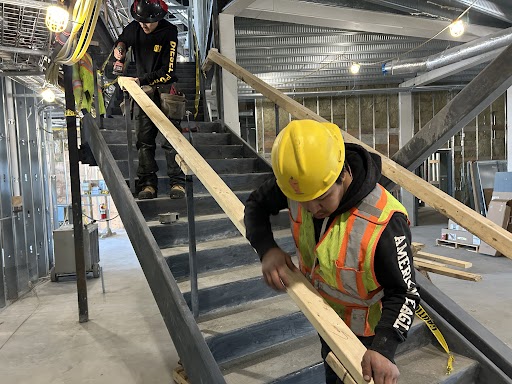
Patrick Evvik, left, and Nathan Veevee install a safety railing on the feature staircase at Aqqusariaq addiction and trauma centre in Iqaluit. (Photo courtesy of Mel Schellenberg)

Inuit-owned Arctic Fresh Projects is in the business of problem solving.
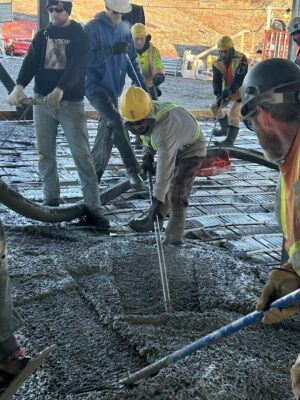
Scott Nakoolak, centre, spreads concrete at the Aqqusariaq Addiction and Trauma Center in Iqaluit, one of Arctic Fresh Projects’ ongoing builds. (Photo courtesy of Mel Schellenberg)
The five-year-old construction arm of the Igloolik-based Arctic Fresh Group of Companies currently manages $275 million in construction projects. The company’s biggest job to date is Aqqusariaq, the Nunavut recovery centre in Iqaluit, which boasted a 69 per cent Inuit workforce last month and 49 per cent in June, far surpassing the territorial standard of 20 per cent.
Month to month, the project averages a 25 per cent Inuit workforce while the company maintains 90 per cent Inuit among its permanent staff.
“We’re looking to bump up this percentage dramatically,” said Merlyn Recinos, chief operating officer of Arctic Fresh Group.
Now, Arctic Fresh is playing a role in helping to make Nunavut 3000 a reality. The $2.6-billion Nunavut government initiative aims to see 3,000 new housing units built across the territory by 2030.
The company announced June 13 that it will develop 56 new housing units in Igloolik, Coral Harbour and Sanirajak. The budget has yet to be assigned.

“When I think about everything that we have done and we started in 2020, it’s amazing,” Recinos said.
Originally from Guatemala, he and his wife, Arctic Fresh CEO Rhoda Recinos, stumbled into the construction business as a means of solving a problem they encountered following the launch of their Arctic Fresh food distribution business in 2015.
The couple started that business in response to high grocery prices in Igloolik. It began with the sale of four cases of Ottawa groceries to neighbours from their coffee table, soon shifting to doorstep delivery with online orders.
Their business model was flawed, however.
Customers needed access to a credit card to order and there was a three-to-five-day wait for delivery.
“It was great for us to have the online store, but we were still missing the point of food security in the community,” he said.

The couple sought to renovate an empty building to establish a walk-up storefront in Igloolik, but were gobsmacked by the contractors’ cost estimates, which surpassed $2 million.
Return airline flights and accommodation for southern workers took up a large chunk of the expense, they discovered.
“We’ve got to build a workforce that is able to maintain our buildings,” Recinos decided.
That’s when the Recinoses teamed up with Evan Schellenberg and his spouse Mel, who had experience building with non-profit organizations in the Democratic Republic of Congo.
“The approach that we’ve taken is, let’s train and also meet people where they are,” said Iqaluit-based Evan Schellenberg, the company’s general manager.
Using local Inuit skilled labour with some specialized southern assistance where needed, they completed the store renovation on a $640,000 budget, just over one-quarter of the original contractors’ estimates.
The store later included a sandwich shop to help funnel fresh vegetables into the community’s diet, once they secured Nutrition North funding.
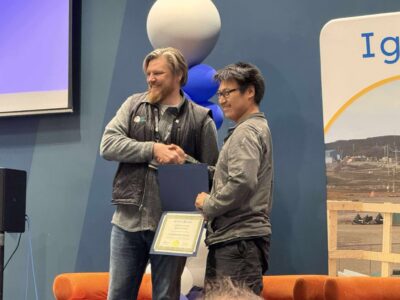
Terry Satuqsi of ZQ Heating, right, accepts the award for leadership in construction, presented by Arctic Fresh general manager Evan Schellenberg, at the 2025 Nunavut Housing Forum in June. Hiring Inuit managers is a priority for the company, says Schellenberg. (Photo courtesy of Mel Schellenberg)
The company also developed a solution to replace hotel and work camp accommodations for teams on the job sites in the communities where they’re working.
Workers identify abandoned or derelict buildings, renovate them, then use them as worker housing. At the end of the projects, the houses are freshened up and added to the hamlet’s housing stock.
The company’s approach to worker compensation is also novel.
Arctic Fresh pays them based on their experience and skills — not necessarily tied to their accreditation levels, which are always increasing through on-the-job experience and training.
“We will be working with participants to become a registered apprentice and continue working with participants to build their hours and work toward certification levels,” said Evan Schellenberg.
Building local capacity is the goal, he said.
“Many of our tradespeople have young families and they don’t want to leave their community to go to school in another community.”
These principles are echoed by Arctic Fresh employees like Adam Qanatsiaq, an Igloolik-based crew supervisor who has worked with the company for more than three years. He said he’s had the opportunity to develop work skills.
“I’ve seen how they are trying to help Nunavummiut,” Qanatsiaq said, adding he encourages the next generation to pursue careers in construction the way he did.
“You may fall, but get up and keep trying. Everybody has to learn at one point. The harder the fight is, you will realize that’s when you learn the most.”
In September, the company plans to fly instructors from Nunavut Arctic College into Igloolik for six weeks to train 30 workers in math, science and language.
Why is this an issue today?
Honestly people should just stop hating other people because they have different opinions, different beliefs, different skin colour, different language, different cultural, or different sexual preferences.
IT IS OKAY TO BE DIFFERENT!
Please stop trying to push your beliefs and opinions on others and respect each other for being different, weather right or wrong, just have some respect for each other.
Perhaps this wasn’t posted to the right article?
Kudos to the Arctic Fresh company for doing something different. Instead of just lining their pockets they appear to actually be assisting Inuit. Assisting them to enable themselves. A very good example to the rest of Nunavut.
I just hope that the growing pains is not too fast that they collapse. I wish them every success in their endeavours.
I think this is great…more members of the community helping to build the community can only make things better. Way to go, and pass it on to other Nunavut communities.
All companies are for profit. And that’s the same for Arctic Fresh.
Most companies that grow. As quickly as this one has. Usually run a cash deficit. I hope that all the subcontractors. Are covered. By construction bonds.
I salute the idea of getting local people on these job sites as long as it not only “Hype and PR “
On the other hand it is a perfect of the power of “ Inuit enterprises “ and the power of using the government polycies to deceive and acquire large contracts for Southern companies . A few tricks and a few lawyers and “ here it is “ another “Inuit Company“ They have become a dime a dozen
Thanks
If you were at the AWG yesterday (July 1) looking across at the sad state of the under construction future wellness centre, on the road that was recently named something like ‘path to wellness’ or a brighter future, something along those lines, you would be very sad and disappointed to see how that construction project looks abandoned, not being constructed very well, already falling apart and in state of disarray. Hopefully not a representation of the state of care and operations planned for that building, if it ever gets completed. So far looks like a dump.
Please share a picture that shows parts of the building that are falling apart . Back up your false statement
I gotta agree with you
It looks very unprofessionally done
The tube paper look so old and looks like kindergarten students put it together
It look so like it shot it pass inspection
Thanks for the inspiring article! It’s amazing to see how Arctic Fresh scaled from a grocery startup to major construction deals in just 5 years. Their growth model is impressive. What were the biggest challenges they faced during this rapid expansion, especially in remote communities?