


Kilikvak Kabloona joins National Council for Reconciliation
She joins Joseph Murdoch-Flowers, an Iqaluit lawyer who has sat on the board since 2025
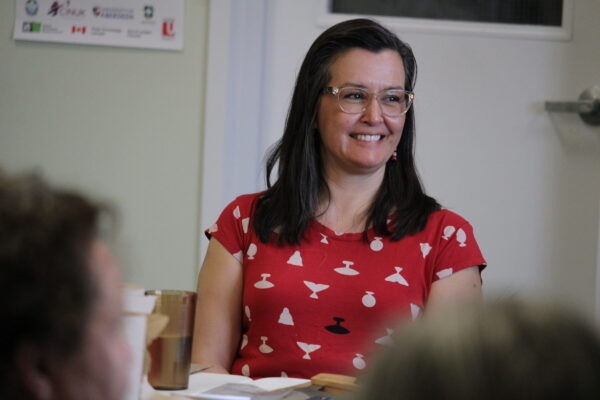
Kilikvak Kabloona, seen here in a file photo from 2025, has just been named to the National Council for Reconciliation, responsible for tracking reconciliation progress in Canada. (File photo by Arty Sarkisian)
A former CEO of Nunavut Tunngavik Inc. has been named to the group responsible for monitoring whether Canada is meeting its reconciliation commitments.
Kilikvak Kabloona is joining the National Council for Reconciliation.
“It’s a real honour,” Kabloona said in an interview Thursday.
Prior to working at the NTI, she was the Government of Nunavut’s associate deputy minister responsible for quality of life, a position focused on responding to the territory’s suicide crisis.
There, she helped secure funding for the Aqqusariaq Recovery Centre in Iqaluit, she said, a project that aligns with one of the Truth and Reconciliation Commission’s calls to action to improve Indigenous Peoples’ access to healing.
“Over my career, I’ve seen how progress can be made toward a healthier, more vibrant society through the implementation of these types of reports,” Kabloona said.
Health care in Nunavut still needs to get better, she said. More Inuit need to be working in that field and there needs to be more training available, which was also identified as a call to action, she said.
“These things will take time, it is a process and it’s important that we continually work on reconciliation. It is not a check box exercise,” she said.
Joseph Murdoch-Flowers, who joined the inaugural board in March 2025, says he has a deep respect for Kabloona, for whom he worked as a senior advisor on suicide prevention.
“She has immense competence and a deep commitment to the work that is required for reconciliation. She has the personal connections to the colonial history that gave rise to the need for this work,” said Murdoch-Flowers.
The national council exists to track Canada’s compliance with the 94 calls to action in the report of the Truth and Reconciliation Commission, which, in 2015, documented the history and impacts of residential schools.
The independent and Indigenous-led oversight body is required to publish reports on Canada’s progress on an annual basis. It formed in 2025 and released its first report earlier this summer.
That report concluded that Canada has made progress toward meeting many calls to action, through the introduction of rights-based legislation, child welfare discrimination settlements, increased investment and expanding distinctions-based partnerships.

However, inequities in child welfare, education, income, health and justice still persist, according to the report.
Murdoch-Flowers said many structural changes still need to be addressed. He mentioned a lack of consistent, long-term program funding from government as one example.
“We also know that there is a rising denialism in the country,” he added.
Kabloona is one of three new directors joining the board, which is now permanent, said chairperson Julie Ann Wriston in a news release.
“Establishing the first permanent Board of the National Council for Reconciliation is a meaningful step forward. We welcome this role with gratitude and a deep sense of responsibility,” Wriston said.

Also joining are Barbara Filion, a member of the Innu Nation of Mashteuiatsh in Saguenay–Lac-Saint-Jean and a member of the Canadian Commission for UNESCO, and Kluane Adamek–Aagé, a former Assembly of First Nations Yukon Regional Chief from Kluane First Nation.
Alright, congratulations!
Congratulations.
For those of us who unfortunately had to work under her this is not a good appointment, micromanaging, bottleneck everything and anything, again these places who make appointments to these important roles need to do their due diligence and actually conduct reference checks. Very disappointing.
For those of fortunate enough to work with her she provided strong leadership and trusted departmental leadership and helped improve government obligations to the Nunavut Agreement
The National Council for Reconciliation is a totally irrelevant piece of Federal window dressing.
It is entirely appropriate that Ms Kabloona and Mr Flowers were offered appointments.