


Modular home factory begins production in Arviat
$75-million, 64,500-square-foot facility will ramp up to 100 per cent in 18 months
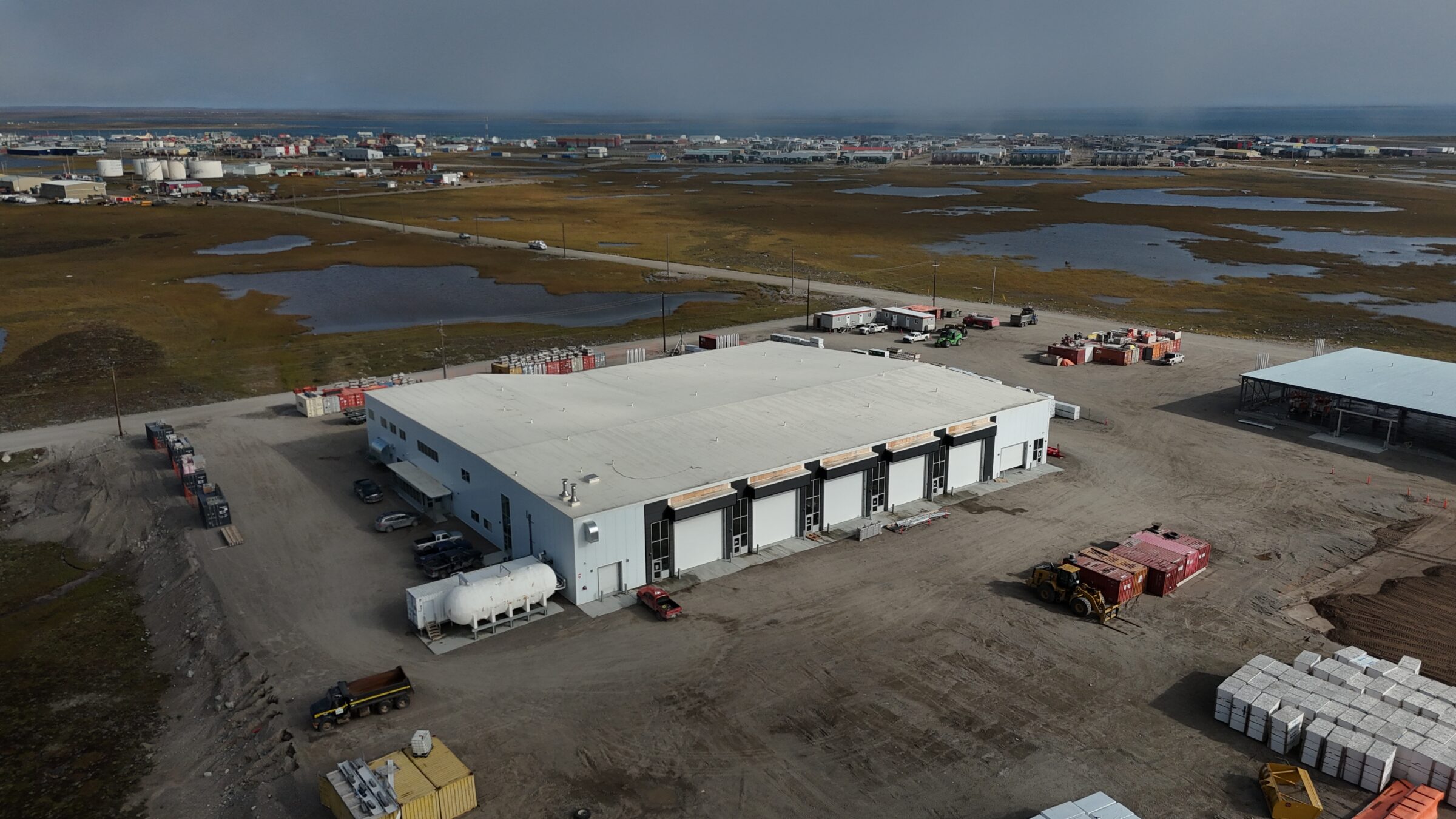
The Inuit-owned Sakku Innovative Building Solutions modular home factory in Arviat is a joint venture between Sakku Investments and Quebec-based modular manufacturer R.G. Solution. (Photo courtesy of Denise Kusugak/Sakku Investments Corporation)

With a ribbon-cutting ceremony, the modular home factory officially opened Tuesday.
The $75-million, 64,500-square-foot facility started production at 60 per cent capacity Sept. 23, said operations director Jason Gibbons in an interview. Within 18 months, the factory will achieve peak capacity, producing up to 40 single- and multi-family houses a year.
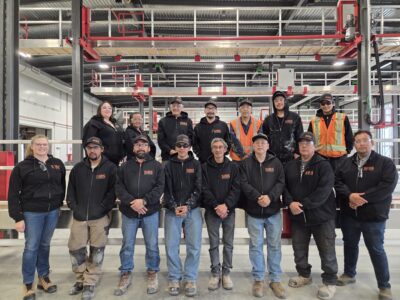
The Inuit-owned modular home factory in Arviat is operated under Sakku Innovative Building Solutions, a joint venture between Sakku Investments and Quebec-based modular manufacturer R.G. Solution. (Photo courtesy of Denise Kusugak/Sakku Investments Corporation)
The factory employs 15 staff, including 14 Inuit, said Caroline Nault, CEO of Sakku Innovative Building Solutions, a joint venture between Sakku Investments, the business arm of the Kivalliq Inuit Association, and Quebec-based modular manufacturer R.G. Solution, which operates the Inuit-owned facility. Of those workers, 10 work on the factory floor in non-administrative roles.
“There is only one non-Inuit employee, and it’s me,” Nault said in an interview.
By early 2028 the workforce will swell to 40 full-time staff, including journeypersons, carpenters, plumbers and electricians, Gibbons added.
To certify carpenters and other specialists, the company will provide in-house training and work with Nunavut Arctic College to certify its workers, Nault said.

Sakku estimates an additional 100 indirect jobs will be created in transportation, installation and finishing.
About one-third of the factory, which underwent construction in 2023 with an initial budget of $50 million, is occupied by a heated warehouse. A cold storage warehouse beside the factory is expected to be completed by November. It will have space to shelter a full-year’s production of raw materials.

This sixplex in Rankin Inlet was built as a pilot project by Sakku Innovative Building Solutions, a joint venture between Sakku and Quebec-based modular manufacturer R.G. Solutiona. (Photo courtesy of Denise Kusugak/Sakku Investments Corporation)
Sakku Investments Corp. funded the factory using Inuit equity and partnerships with Inuit organizations, the Northern Economic Development Agency, Next Generation Manufacturing Canada, Canada Mortgage and Housing Corp., National Research Council of Canada and the Government of Nunavut.
This month, the factory is producing components for nine three-bedroom houses, scheduled to be installed in the community next spring, Nault said. The company is also preparing to build two 12-plexes in Rankin Inlet.
Prior to factory completion, and with materials from Quebec, the company erected pilot projects that included two five-plexes in Arviat; a duplex in Coral Harbour; and four two-storey houses, a six-plex, and a duplex in Rankin Inlet.
The buildings are designed to incorporate aspects of Arctic living, with separate entrances for the multi-unit dwellings and cold porches on the front and back of single units, Nault said.
They ward off condensation and mould using ventilation and other preventative materials and systems, she said.
Tuesday’s ribbon-cutting ceremony was attended by Kivalliq Inuit Association president Kono Tattuinee, Nunavut Tunngavik Inc. president Gloria Uluqsi, Premier John Main and MP Lori Idlout.
Great, will provide local jobs. My question is the logistics, how are they going to transport the units to Rankin Inlet and other communities, the community dont have a port. Average cost of those unite will probably be around 1.5 to 2 million to build not including transportation..how is it affordable?
The reality is these are not going to be affordable units. You ship raw materials in via expensive shipping to Arviate, then you use expensive labour to assemble, then you again use expensive shipping to send them to another community.
The alternative being full assembly in the south, rail shipping to port then expensive sea shipping to whatever community its going to.
But that’s not the full story. If we get people off social assistance due to job creation perhaps the net benifit to the government in total is lower as in, yes NHC will be buying expensive units that will be more expensive than premades from the south, but the offset of decreased social assistance from job creation perhaps helps offset.
You would have to run the math I suppose and I’m guessing no one has.
I doubt the math is that hard. Order of magnitude –
A stick built single story 5 or six plex could likely be constructed for about 1,000 /sq ft. not the crazy number assumed by Nunavut 3000. Some activity would be generated in the communities where they were built.
Construction assemble and delivery of Arviat constructed modulars would be about twice as expensive (or more – power costs – delivery on dedicated ships or through backhaul is expensive plus other costs mentioned) with primary benefit to Arviat.
Modulars from the south – delivered and assembled – probably close to the same cost as stick built. little activity generated in communities. Maybe not practical for communities lacking appropriate equipment to move and place the units (applies to Arviat units as well).
If required to operate in a competitive commercial environment – the factory is not viable.
The same way modulars have been shipped around the north for decades usually to mines: load them on a flatbed from factory to the shore landing and load them on a barge, sail to wherever and unload them.
Can’t we just be happy Nunavut community now has modular home factory, and say congrats to Sakku and Arviat? QIA has been contracting out to southerners and not hiring Inuit to put up modular homes and multi-use facilities all around Baffin Island.
Let’s not forget the Arviat factory also had to be built, at a cost of $75M. Depending on where you stand, there are a number of ways to view this cost.
Assuming Sakku got a most of this amount as free government money to pay for this capital cost, they would still have millions on the books in start-up costs that they must recoup over time through modular home sales.
From the point of view of this factory acting as a business, the materials, labor, shipping and operating costs are not the only factors to consider in how much to charge for their product. Sakku would need to address their capital costs, and see a return on their investment too.
Now, again assuming most of the $75M construction cost was paid for by the taxpayer one way or another, from the public point of view, tens of millions have been spent already without a single new house being constructed.
How many new homes could have been built with public funds instead of building a factory?
Congrats to those who are making this happen in ARviat.
I hope it works out and is successful.
this is amazing,
I hope all the best for everyone
In the long run , perhaps when housing is caught up to times,
consumers can order cottages, cabins and shacks for delivery
cabins with renewable energy systems ,and once put in place a turn key operation !
living on the land is a passion for northerners .
Great work Caroline and team! This is a great project that will benefit generations to come.
The plant cost $75 million. It must have fancy saws and so forth. As one commenter mentioned, the logistics for shipping units to other communities will be challenging.
Wouldn’t it be simpler building a multi purpose building in each community and prefab the units right there. Mitre saws are readily available.
Back in the day I volunteered with Habitat for Humanity, we built 2×4 wall sections on a large wooden table, nailing them together with air nailers and attached the sheathing. The fabrication was very basic, it didn’t require a fancy building. You could also manufacture trusses that way although trusses require greater accuracy. Just saying.