


New cabin at Sirmilik National Park to support Inuit harvesters
Multipurpose structure to function as gathering place, emergency shelter
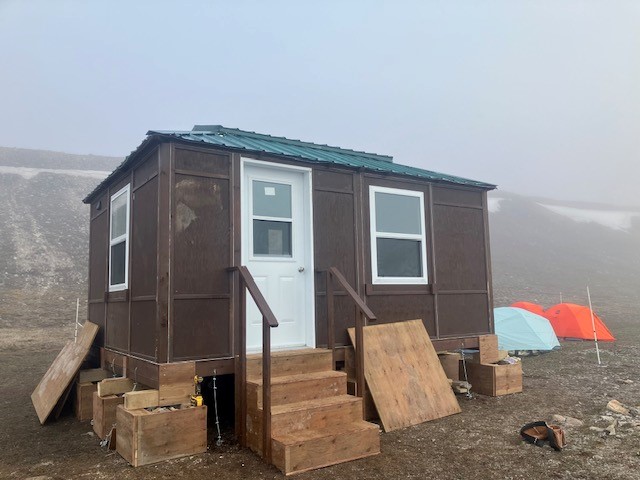
The multi-use cabin at Sinaasiurvik in Sirmilik National Park, northeast of Arctic Bay, was built in July after years of planning and construction delays due to the COVID-19 pandemic and rough travel conditions. The site, historically used by Inuit near the floe edge, will provide shelter for harvesters, elders, Parks Canada staff and researchers. (Photo by Clare Kines)

Updated on Aug. 27 at 3:50 p.m. ET
A new multi-use cabin is complete in the Sinaasiurvik area within Sirmilik National Park, providing a long-awaited gathering place at a site Inuit have used for generations.
The cabin, northeast of Arctic Bay on the shores of Elwin Inlet, will support harvesters, Inuit guardians, Parks Canada staff, researchers and visitors.
It will also serve as a base for cultural programs that connect elders and youth.
“This has been a very long-term project with the community of Arctic Bay,” said Darrell Makin, community relations and visitor experience manager for Sirmilik National Park.
“I believe it first started in Parks Canada records around 2003, and it was brought into the park management plan in 2016, which really allowed it to move forward,” he said.
The prefabricated structure was delivered to Arctic Bay in 2019, but the COVID-19 pandemic and other logistical setbacks stalled progress.
The work was further delayed in spring 2024 after a contracted helicopter being used in the project crashed while en route to Pangnirtung. There were no injuries and no supplies were on board.
Staff later tried to reach the cabin site last August but were held back in Arctic Bay for 10 days when weather conditions made it unsafe to fly the helicopter to the park.
“The project was put on hold again until July 2025,” said Makin.
Staff managed to reach the site in early July and completed the build on July 9.
Two Arctic Bay workers joined the construction, along with a Parks Canada staff member from the community. Colleagues from Pond Inlet and the Nunavut field unit’s cultural heritage team also joined to oversee work at the archeologically sensitive site.
“Considering how remote the location is, it was a significant achievement. I’m especially impressed by the skills of local Inuit, who have long built cabins in remote places. It’s quite an endeavour,” Makin said.

Sinaasiurvik has long been a place of importance to Inuit, as well as to Thule and Dorset cultures, he said.
The location is close to the floe edge, where families camp in spring to harvest narwhal and polar bear.
“The floe edge is also a unique biological area, rich with life, and has always been a place Inuit travel to from late April through mid-June,” he said.
Sirmilik National Park sees modest visitor numbers, with the most activity coming from Arctic Bay residents and one to four short Parks Canada trips each year, Makin said.
The cabin, which is not yet operational, will not be staffed year-round. It will provide a safe stopover for hunters and an operational base for monitoring cultural resources.

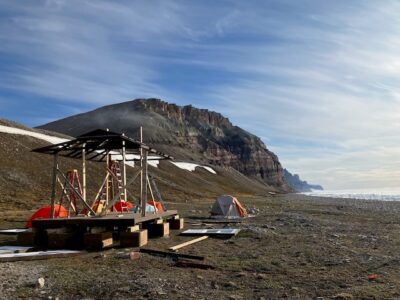
Parks Canada staff and local Arctic Bay workers assemble the prefabricated cabin at a place called Sinaasiurvik, located in Sirmilik National Park, in July. The project faced multiple delays. (Photo by Clare Kines)
Inside the cabin there is a small kitchen and table, a couch and two sleeping quarters that can sleep up to four people.
Makin said he was unsure of the total cost to build the cabin but was sure it cost a “pretty penny” as the process involved numerous helicopter flights and materials brought by sealift to Arctic Bay.
“The immediate next step is to develop a cabin-use plan,” he said.
“In the future, if the community decides [non-Inuit] visitors should also access the cabin, a cultural guide program will need to be developed.”
He said he expects the cabin’s land use plan will be completed next year.
“Sirmilik is a very important cultural and family place for Arctic Bay,” said Makin.
“Parks Canada is pleased to support this multi-purpose project and looks forward to continuing to work with the community on the future of its site.”
Note: This article has been updated to correct the description of the cabin’s interior and the circumstances of the helicopter crash
I wish we could have these. I look at the ones we have here, be it HTO or other that anyone can use and they are disgusting and half destroyed.
No one cleans up the garbage they bring in, everyone smokes in them both tobacco and weed, they just get destroyed and I don’t understand the mindset, we’re all out doing long distance travel in potentially bad weather or could all have an emergency, but no one seems to think about others.
No one ever replaces supplies either. They are happy to burn diesel or naphtha, but never bring a can with them to replace what they used the next time they come.
Courtesy is non-existent and unfortunately I think in the West that’s why we cant have more.
Hto have a cabin 101 mile away from kugluktuk for hunters. What they need is emergency cabins every 50 milrs to the most popular hunting grounds . Western hunter take care if far away cabins here out of Kugluktuk and never abuse the usage rules .too far away
Do you have to be only Inuk to stay in these? Cause I’m half and speak alittle…
If you’re feeding your mom, Granny and kids, it doesn’t matter. Please
❤️❤️😍🥳
So it took 23 years to build… that?! Great job Federal government
Says the first idea was submitted and recorded in Parks reports by 2003, and incorporated by 2016 to the plan, construction taking place over 3 years. It took less than five years once it was in the action list.
Yup, federal bureaucracy is slow as it always has to eventually get to the regional, then national levels and finally budgetary approval for the project. Most take longer due to the many environmental assessments needed inside a national park.
And that is why the people of Fort Good Hope, started building log homes for their people, cause the Gov’t is to busy doing nothing. Wish Nunavut had trees to build homes for our people.