


New weather station gives Grise Fiord real-time look at changing Arctic
Station is part of 3-year, $300,000 ArcticNet project studying storm-driven coastal erosion
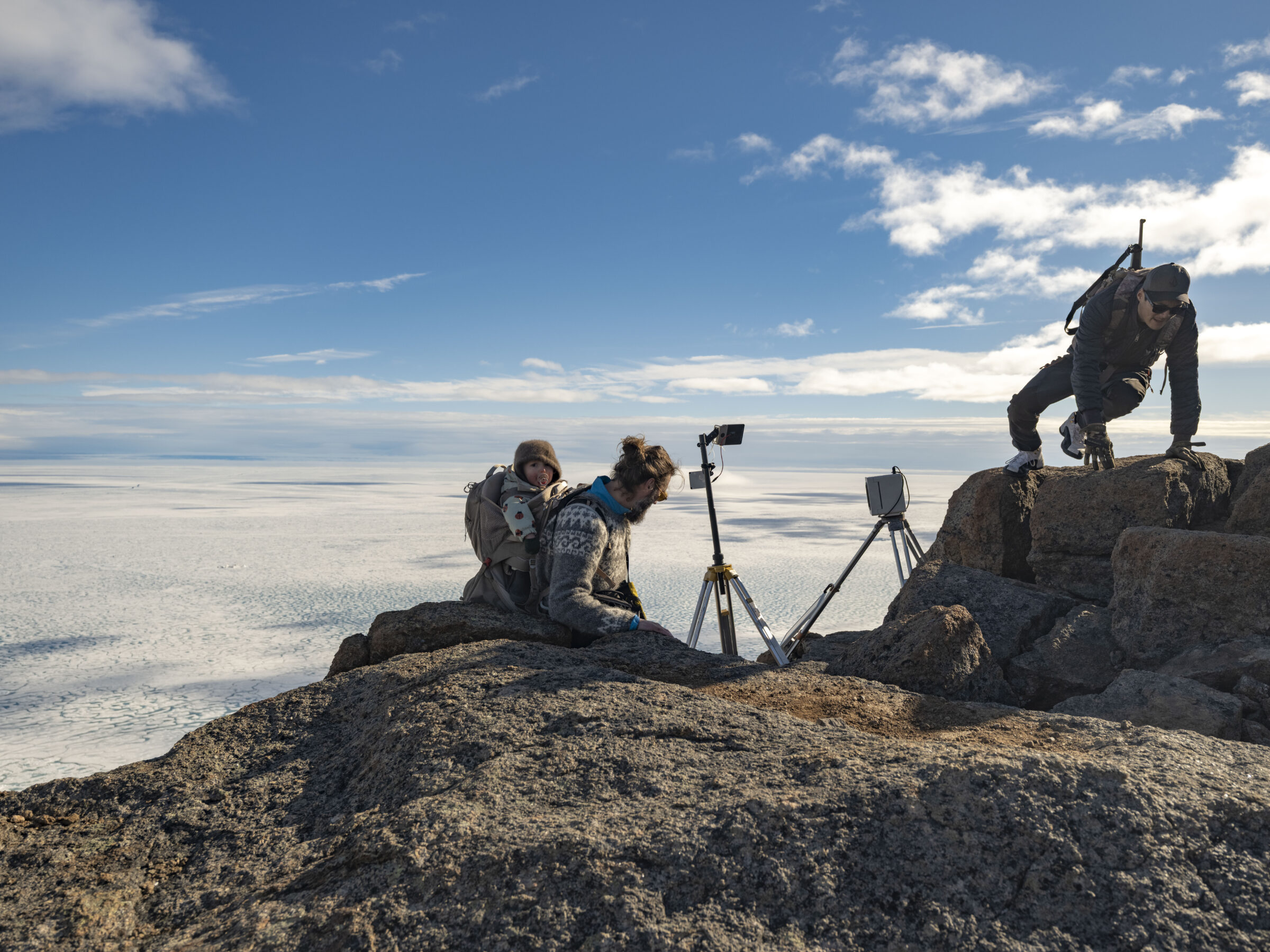
David Didier, left, a geography professor and director of the Northern and Arctic Coastal Research Lab, with his child strapped to his back, and Terry Noah, owner of Ausuittuq Adventures, install a live timelapse station near Grise Fiord on July 8. The automated camera system set up near the coastline helps researchers monitor the sea ice conditions. (Photo by Anne-Marie Dubé)

When fog settled over Grise Fiord last week, Marty Kuluguqtuq went online to see whether it was safe to travel.
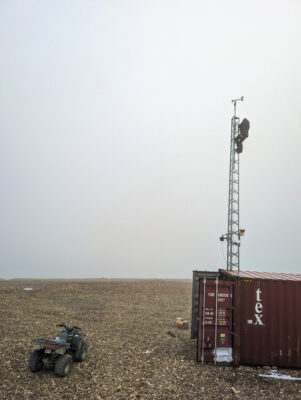
Francis Gauthier, a professor at the Université du Québec à Rimouski, fine-tunes the final steps of installing a 10-metre-high weather station near Grise Fiord on Aug. 15. The station supports research into storms, sea ice and coastal erosion. (Photo by David Didier)
Through the Northern and Arctic Coastal Research Lab’s website, he checked real-time images from a new weather station located about five kilometres east of the community.
The view showed the fog was mostly confined to town, while conditions farther out were clear.
“So we went ahead to clear skies,” said Kuluguqtuq, the hamlet’s assistant senior administrative officer.
“It helps a lot with actual, tangible assistance in real time,” he said.
The 10-metre-high station which was built last month is part of a larger research project led by Terry Noah, owner of local outfitting and guide company Ausuittuq Adventures.
The project is receiving $300,000 over three years from ArcticNet, a Canadian non-profit, to study storm-induced coastal erosion and ocean changes in Jones Sound, off the coast of Gjoa Haven.
ArcticNet announced the funding July 29, as part of a $9.3 million total that went to 13 Indigenous- and northern-led research projects across Inuit Nunangat and the broader Canadian North.
Noah’s weather station is also one of seven projects receiving a share of $1.6 million over three years through the Inuit Qaujisarnirmut Pilirijjutit program.
A beach in Grise Fiord that is used by hunters to park their boats is now much steeper because of coastal erosion over the past decade, Kuluguqtuq said.
“Because we have no small craft harbour or proper boating docks, we still park our boats on the beach at the mercy of high and low tides and weather,” he said.
A small craft harbour with floating docks, a boat ramp and a breakwater that could provide safer access to the water is in the works but the project is scheduled for completion in 2029, Kuluguqtuq said.

“We’ve certainly noticed some changes in our beaches and our coasts, and it coincides with our thinking of climate change,” he said.
David Didier, a geography professor at the Université du Québec à Rimouski and a director of the Northern and Arctic Coastal Research Lab, helped build the station with colleague Francis Gauthier and Noah after the equipment was shipped in August.
The station records wind and other conditions that can help researchers understand how storms generate waves and contribute to coastal erosion, he said, and has a live-streamed camera to track sea-ice conditions.
The weather station is connected to Silanga.ca, which shares weather information from community stations across Nunavut, including Igloolik, Arctic Bay and Pond Inlet.
“This program is just a small stone in the process to make sure they collect the data they need for climate adaptation, not just for coastal hazards, but also for travel safety, food security, and spatial planning in town,” Didier said.

The research project also extends into the ocean.
Erin Bertrand, a Dalhousie University marine microbial researcher, is studying whether storms help move nutrient-rich deep water toward the surface.
Noah is helping in Bertrand’s research by collecting water samples and sending them to her lab. Bertrand is also tracking the water using sensors deployed in the ocean that measure temperature, salinity and depth. The work is scheduled to happen from July through November, which is when sea ice is gone and storms can have a greater impact on the coast.
“We’re in our real first storm season for observations right now, so this is a really critical period,” Bertrand said, adding that research from Grise Fiord might present results at the ArcticNet meeting in Halifax this December.
“This project will also hopefully assist the political nature of things in the North, to assist us in what we need to survive and to represent Canada’s furthest community by keeping us informed,” Kuluguqtuq said.
(0) Comments