


Nunavut, federal ministers announce $35.6M health, elder-care deals
Funding to support nurse, paramedic training; will also pay for purchase of MRI, CT scanner for territory
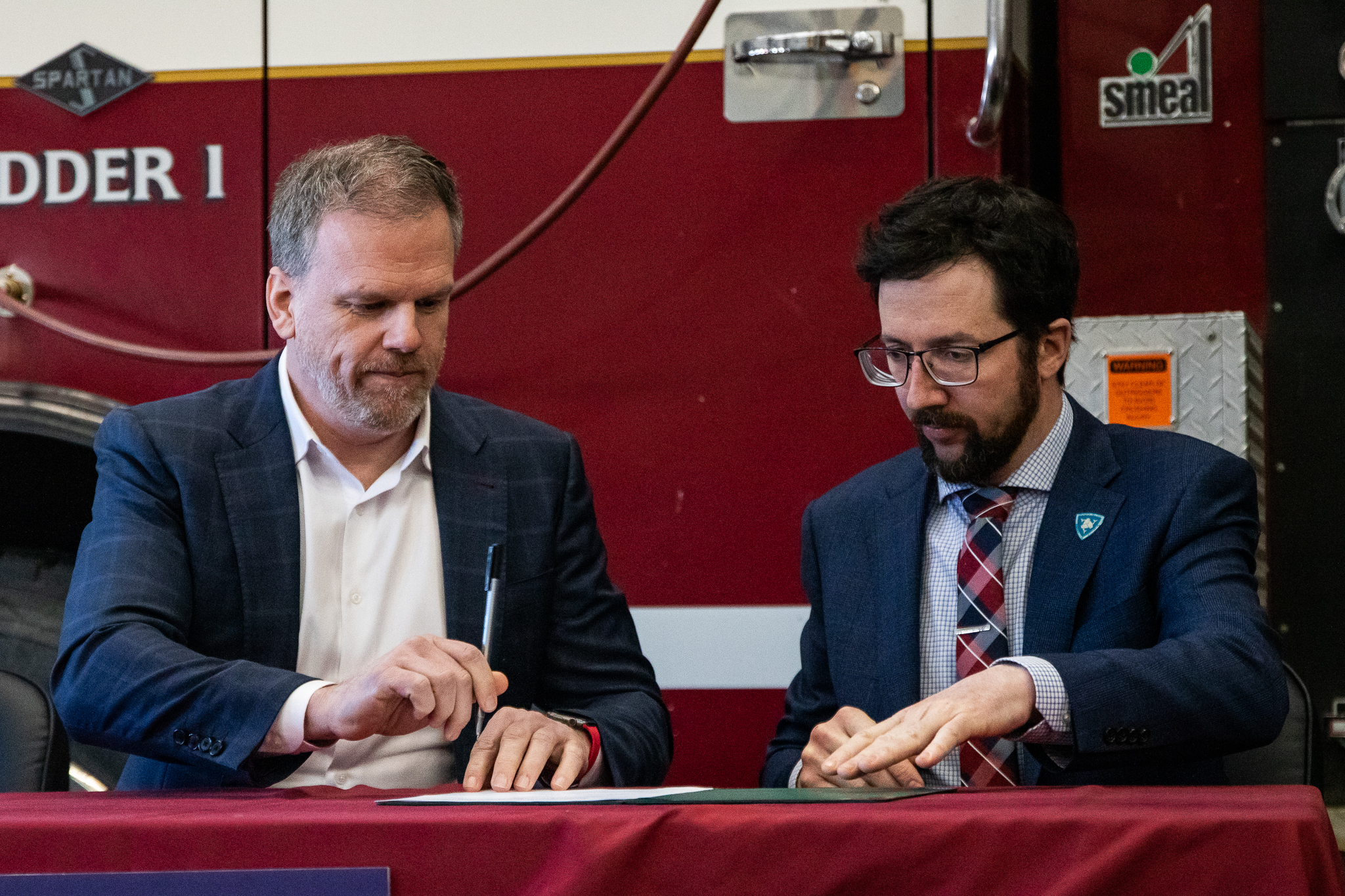
Federal Health Minister Mark Holland, left, and Nunavut Health Minister John Main signed two deals Tuesday, promising a wide-ranging list of health and elder care improvements. (Photo by Jeff Pelletier)

Agreements announced Tuesday by the federal and Nunavut health ministers promise a wide-ranging list of improvements to health and elder-care services in the territory.
Federal Health Minister Mark Holland and Nunavut Health Minister John Main signed the two agreements — which come with $35.6 million from the Government of Canada — during a media event at Iqaluit’s fire hall.
“Whether it’s additional staff, whether it’s additional equipment, whether it’s more supports for elders to be in their home communities [and] be more supported, it’s very useful to have this funding come into place and it will benefit Nunavummiut,” Main said.
“So for that I’m very thankful, and look forward to further partnerships.”
This first deal, which the ministers called the Working Together Agreement, includes $23.6 million to help Nunavut train and recruit health-care professionals including radiological technicians, paramedics in all 25 communities, and nurses.
The agreement emphasizes training Inuit from Nunavut for those positions.
It also promises to fund the purchase of several medical tools to be available in the territory, including a computerized tomography, or CT, scanner, a portable magnetic resonance imaging machine or MRI, and a C-Arm X-ray machine, which is a mobile imaging device.
“The path forward is, unquestionably, in empowering local communities, making sure that services are provided in people’s homes,” Holland said.
The second deal, titled the Aging with Dignity Agreement, includes $12 million over five years to improve in-community elder care.
It focuses on hiring and training Inuit elder-care workers, supporting nursing students and collaborating with Nunavut Arctic College to continue developing a personal support worker program.
Holland said the agreement will help ensure elders can have access to services in their community, but it won’t eliminate the issue of elders being sent south to Ottawa for long-term care.
“This, today, isn’t going to fix that problem in its totality, but it’s a really essential step forward and it builds on other investments that we’re making to help to make sure, here in Nunavut, that people can age at home and age in their own communities,” Holland said.
“Today is going to make an appreciable difference to that end, but it’s not going to eliminate the challenge in totality.”

Main said the agreement will help improve home-care services for elders. He said the Government of Nunavut will soon release an elders’ strategy which should provide greater detail.
“When that strategy is released, I think it will be apparent that our government has been taking a very holistic look at how we can make things better for elders in Nunavut,” Main said.
“Five years from now, we will have greatly increased our capacity to provide for elders in Nunavut in terms of long-term care.”
Should cover this quarters cancellation fees to Canadian North and Calm Air. I remember working for Health trying to convince them approve education and the answer was that unless you worked at Health HQ forget it, no training for front line health workers. Still
Nunatsiaq should report that these agreements are not specific to Nunavut. The Working Together Agreement is a $27.4 billion amount available over 10 years and the Aging With Dignity Agreement is a $5.4 billion amount available over 5 years, both Canada-wide (although not all provinces and territories have come to agreements as of yet).
It sounds like a lot of money but when the cost of doing anything in the North is so high it really isn’t.
Hope it helps though and that more funding agreements will be in place in the near future to make real positive improvements.