


Nunavut looks to learn from its false-positive COVID-19 case
With territory’s cases back to zero, health staff debriefing on response
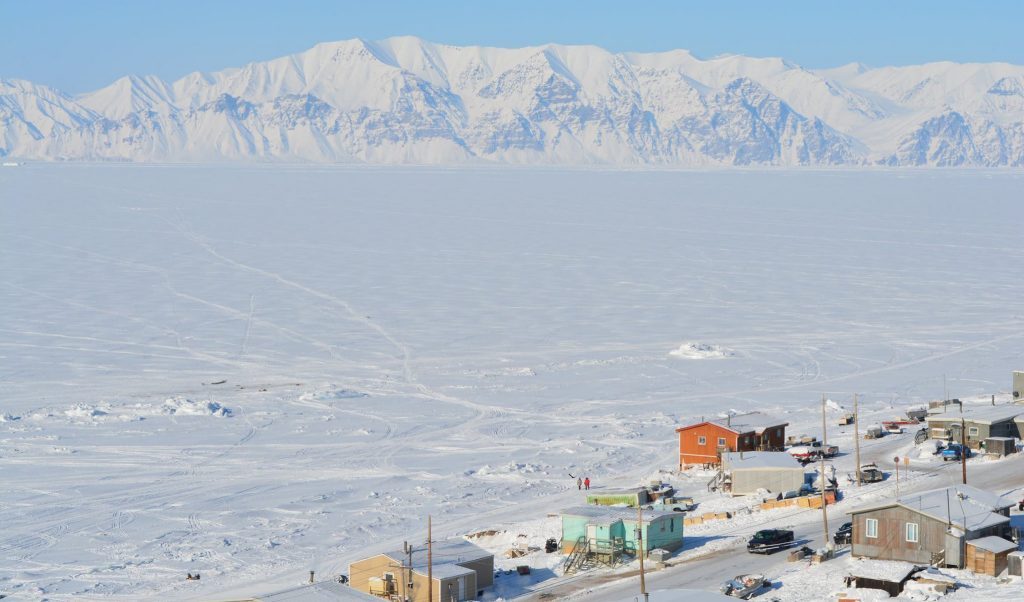
Pond Inlet, seen here, was the location of Nunavut’s first reported COVID-19 case, which turned out to be a false positive. Health officials are now debriefing on the territory’s response to the case in order to establish best practices. (File photo)
When it comes to testing for COVID-19, there are far worse problems to face than a false positive, says Nunavut’s chief public health officer.
Dr. Michael Patterson offered reflections on the finding that the territory’s only case of COVID-19, in Pond Inlet, had proven to be a false alarm during a news conference on Monday, May 4.
“The worst outcome would be to do nothing, wait a bit and see what happens, and let it spread if it was a true positive,” he said.
Patterson and his team are now debriefing with public health staff, those in the COVID-19 rapid response team and community members in Pond Inlet to figure out best practices for next time a test comes back positive.
The Government of Nunavut announced the false-positive finding on Monday, after the case, which initially came back positive last week, was re-tested on Friday, May 1, and both the original test and a new swab came back negative.
All of the test results came from labs in Ontario.
“No lab test is perfect,” said Patterson.

Before declaring the case to be a false positive, Patterson and his team considered other supporting evidence.
Before reaching a conclusion, doctors and health professionals consider more than just test results, Patterson said.
That includes the fact that the individual being tested had not left Pond Inlet “for some time,” Patterson said.
As well, no additional tests from Pond Inlet came back positive, and health workers didn’t notice any increase in respiratory infections in the community, Patterson said.
“For all of these reasons, we believe that the individual in Pond Inlet does not have and never did have COVID-19,” Patterson said.
The orders from the Government of Nunavut that restrict gatherings and require Nunavummiut to isolate for 14 days before returning to the territory remain in effect, Patterson said, as well as additional orders under the Public Health Emergency Act.

But additional measures put in place specific to Pond Inlet are now lifted.
“Effective immediately, travel between Pond Inlet and other Nunavut communities may resume, and the community-specific restrictions on businesses and services in Pond Inlet are also rescinded,” Patterson said.
“False positives are an issue that every jurisdiction has dealt with,” he said.
They depend on the machine used to conduct tests, and it’s hard to know the margin of error for each testing machine, he said.
False negatives occur up to 30 per cent of the time if the people swabbed are asymptomatic, or if they’re swabbed too soon after being exposed to the coronavirus, Patterson said.

That could result in an infected person being told they’re fine when they’re not.
“That’s why we don’t use swabs as an alternative to 14 days in isolation hubs,” Patterson said.
It’s too soon to say how effective the response was to the false-positive case in Pond Inlet, Patterson said.
The initial deployment worked well, with a team of health professionals on the ground and sending swab samples back to Iqaluit within 24 hours, he said.
And getting planes in and out of the community every day “enabled us to get information very quickly.”
If this was a false alarm for the virus in pond inlet, maybe it’s a false alarm for some qalunaaq’s back south? How can this be a false alarm?
You are correct, that’s why we must TEST, TEST, TEST, and have good tracing procedures. But don’t forget that some people have very few or no symptoms, so overall the “infected” count is lower than the actual count, by how much is anyone’s guess.
.
The federal government is working to support additional and improved testing and tracing. This will be one of the keys to “beating” the virus.
.
Efforts across the provinces are showing marked decreases in the number of daily infections. Ideally we would like to be able to see a number of days with zero infections in each province before they “reopen” for business. Some provinces could probably do this today but it is better to be safe than to see infections rates start to increase again.
.
The quicker we can get test results, and the more accurate they are, the safer for everyone. At this time the only defenses we have are social distancing, masks, gloves, and limited testing. Let’s hope that that is enough until we get a vaccine.