


Nunavut’s lower airline ticket prices are not the result of a subsidy, says transport minister
David Akeeagok says department is using purchasing power to make sure contracts don’t affect prices
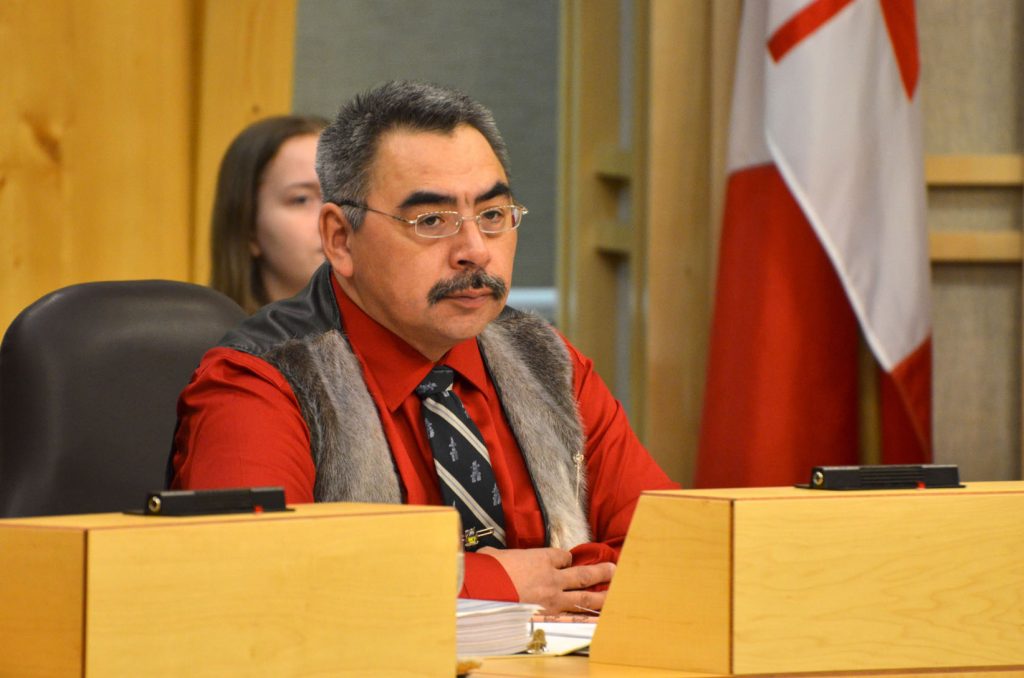
David Akeeagok, Nunavut’s minister of economic development and transportation, told the legislative assembly on March 5 that lower prices for economy airline tickets are not the result of a government subsidy. (File photo)
There was confusion in Nunavut’s legislative assembly on March 5 over whether a line in the Department of Economic Development and Transportation’s 2020-23 business plan meant it was subsidizing economy class airline tickets for travellers in Nunavut.
Arviat North–Whale Cove MLA John Main read a line from the business plan aloud during question period.
“By including the cost of scheduled air service available to the public (such as Economy Fares) in the procurement evaluation criteria, a significant reduction in the cost of air travel has been realized for much of Nunavut’s traveling public,” Main read from page 252 of the document.
“It appears to me that this government is now subsidizing the cost of certain types of airline travel for the general public. Can the minister … provide any kind of estimate today as to the magnitude of the subsidy?” Main said.
David Akeeagok, the minister of economic development and transportation, said that a report from Lufthansa, a German consulting firm contracted by the government in 2017 to help develop a new procurement policy ahead of the territory’s next medical and duty travel contracts, showed that the government’s previous contract for medical and duty travel was affecting seat prices for the public.
“What we are doing is using our purchasing power to ensure that Nunavummiut don’t get impacted by the government’s own contracts. I cannot give any exact dollar figures and I cannot call this a subsidy,” Akeeagok said.
Main said it sounded like a subsidy to him.
“There’s a saying in English that if it walks like a bird, sounds like a bird, and flies like a bird, then it’s a bird,” Main said.
“I’ll ask the minister again: can he give any estimate today as to the magnitude of the subsidy, which I should point out appears to flow to people who have enough money to buy tickets, which leaves out a huge chunk of the population who are on income assistance?” Main said.
Akeeagok told media that while the government is not subsidizing airline tickets, it is using its purchasing power to ensure prices are lower now that the medical and duty travel contracts have been negotiated.
“It’s not set. There’s room to have further discussions on this. We don’t know the operational costs of the airlines. We don’t know how much more medical or duty travel we’ll have…. But what we are doing is we are going to be monitoring this closely,” Akeeagok told media.
“It’s not putting money into it. It’s using the purchasing power to do that, which if you look at the Nunavut airline market, the majority of it is government travel, either through medical or duty travel,” he added.
“It is not a subsidy, we asked through a competitive process and one of the weights that put was on economic fares. The airlines came back and said we’re prepared to do this.”
In his replies to Main, Akeeagok stated again that the Lufthansa report showed that medical and duty travel contracts were affecting the prices of economy class airline tickets before the merger.
“When anybody needs to travel, these are rates that are being used for Nunavummiut. I personally was very proud that our government stepped in and helped Nunavummiut in ensuring that the fares that Nunavummiut have to pay should be lower and it was at the cost of our government to ensure that the medical travel and duty travel does not negatively impact Nunavummiut. It was through this contract that allowed us to do that,” Akeeagok said.
“I’m certainly not going to make an argument in favour of higher airplane prices, but every discussion we have in this house is in the context of limited budgets…. Budgets go towards things like housing, health care, and education. Those are called public goods,” Main said.
“I’m not sure when plane tickets from Iqaluit to Ottawa got added to the list of public goods for this territory,” Main said.
Akeeagok also noted that his department is in the process of hiring a contract manager through the Department of Community and Government Services to monitor “how well the new contract is going.”

Thank you Minister Akeeagok for using the power of purchase and thank you to Member Main for drawing attention to the good work of Minister Akeeagok.
Since Mr. Main doesn’t seem to understand how government procurement works with private businesses: The airlines bid for the GN’s lucrative business (medical travel, duty travel) by giving the GN their lowest/best prices. The successful bidder gets the contract for a fixed period of time. Because the bidder knows that they are guaranteed the GN’s business for the duration of the contract, they can also lower the prices for the general public, which encourages more ticket sales, and brings in more money overall for the company.
.
But “the GN is subsidizing airlines instead of housing!” gets you more votes, doesn’t it Mr. Main?
Polar bear roar.
Main has a point. The GN did not receive the lowest/best prices. For millions of dollars of tickets a discount could normally be expected of some sort.
But not in this case. Under the new contracts the lowest prices are for economy class. Next highest is duty travel class. And the highest is medical travel.
Whoever negotiated the new contract for the GN drank a bit too much Lufthansa koolaid and went much beyond protecting customers; they are now set up to be giving subsidy (indirectly mind you) to economy class travellers.
All airlines are governed under Federal jurisdiction, not Territorial or Provincial. Airlines must publish their tariff rates. But, the GN medical travel contracts that airlines vying for, usually go to the lowest bidder. So handing out lowball contracts, means airlines operating in Nunavut have to increase fares to make up for lost revenue, which costs regular customers more. GN not too smart despite all their chest thumping!
Both Mr. Main and Minister Akeeagok are correct and incorrect. The GN is indeed providing an indirect subsidy to regular economy class travelers by utilizing its existing duty travel and medical travel contracts as levers to enhance the price of publicly available fares. However what Mr. Main fails to grasp is that this does not translate into the GN providing any money directly to the airline to offset ticket costs. This is a form of financial persuasion often used in the negotiation of contracts to provide ancillary and indirect benefits and the GN (and Lufthansa) should be commended for identifying it and implementing it.
Is the GN paying more for duty travel and medical travel under this agreement than the last agreement? That is the real question. If they are then that is bad negotiations, if they are not then it is good negotiations. Sounds to me like the GN is paying more. Why would the GN want to pay more? So, if they are paying more, then it is indeed a “subsidy”.