


Out with the old: Iqaluit resident recalls history of Apex bridge as replacement work begins
New bridge will expand to two lanes and feature a pedestrian walkway on one side
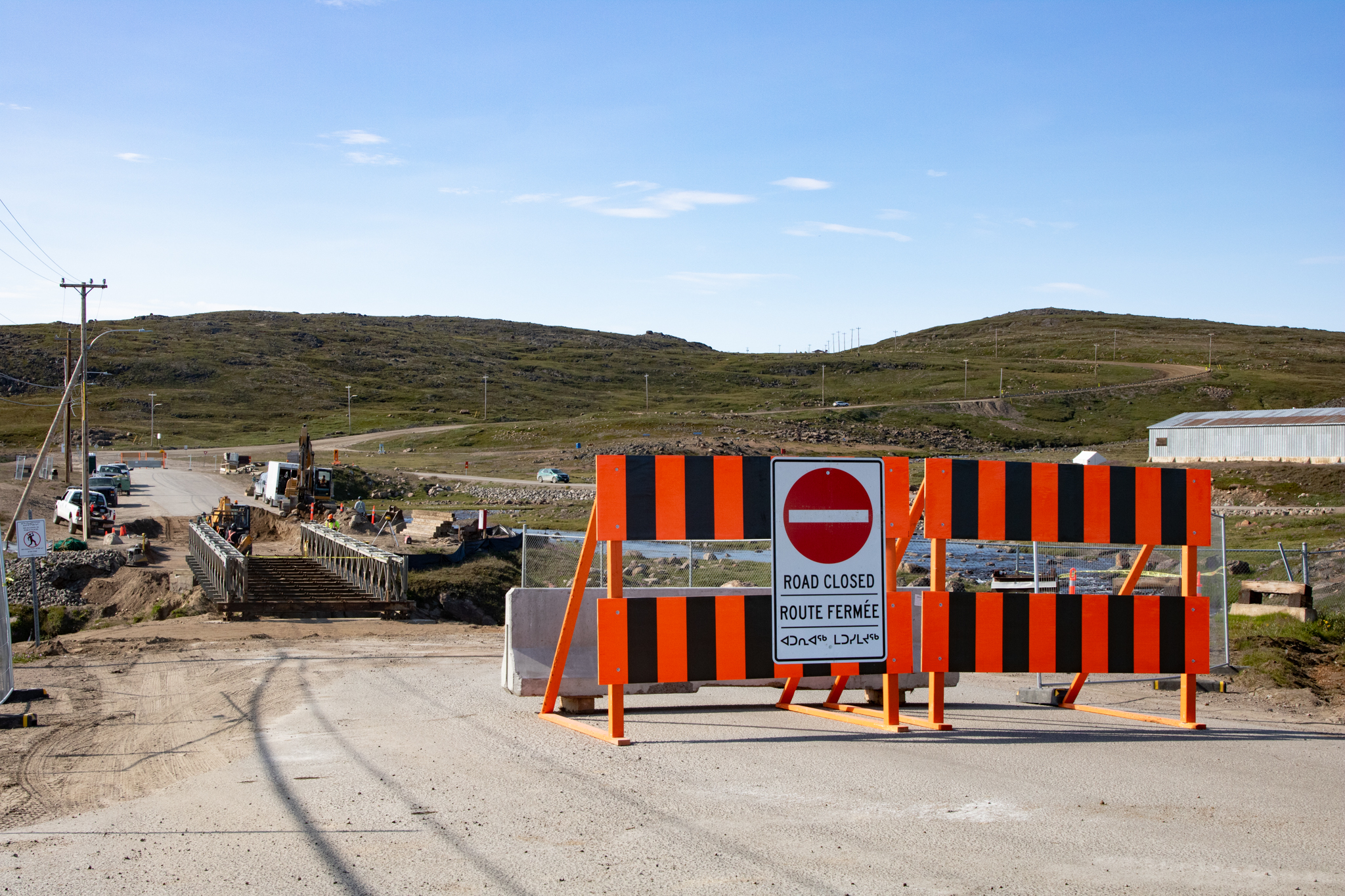
Work is underway to replace the bridge to Apex. (Photo by Jeff Pelletier)
The bridge that connects Iqaluit to Apex is being replaced after 69 years of use and one resident is here to watch the progress.
“Clearly the [new] bridge is needed,” said Anne Crawford, who lives in Apex and works as a lawyer.
Crawford has been keeping people updated on Facebook about developments to the project. The back deck of her home overlooks the bridge.
Old photographs she keeps of the original bridge show deep pits of rust on the structure that spans the Niaqunguk River.
“It was a World War 2 surplus, installed in the 1950s,” Crawford said.
The new bridge will have two lanes and trusses as well as a pedestrian walkway on one side, according to the City of Iqaluit.
Council awarded the $2.7-million project on June 11 to Tower Arctic for construction and Dillon Consulting for engineering, consulting and administrative work.

The old bridge had one lane, which pedestrians would walk in the middle of to cross, Crawford said, adding people have been really enthusiastic about this design.
“I think people will come just to see the pedestrian walkway,” she said.
Crawford has been following the history of the old Apex bridge for a long time. In 1988, she received a letter from Douglas Wilkinon, the site supervisor for the original bridge’s construction.
Wilkinson was also a director who made films about the Canadian Arctic and its people.
His letter to Crawford relates the history of the bridge’s construction. The old bridge was also a truss bridge, built in a design developed during the Second World War and used extensively during the conflict because it could be built quickly.
The old bridge was removed on Aug. 10 in one day, using a large crane, and the new bridge is expected to be completed by Oct. 20. In the meantime, people can get between Iqaluit and Apex using the causeway, a little north of the bridge near Nanook Elementary School.

Construction was supposed to start on July 21, but according to Crawford’s Facebook posts, crews began work on July 29, after the arrival of a recent sealift.
Crawford said she is “super impressed” by the speed of construction so far.
The original bridge was a Bailey Bridge. A WWII design with substantial historical significance, and one that remains in use worldwide. In Canada it is still widely used in remote access roads for logging and mining and such. Odd that not even the name Bailey Bridge was mentioned in the article.