


Police union slams parole decision for Nunavut man who killed officer
Pingoatuk Kolola shot 20-year-old police officer in Kimmirut; granting day parole ‘disrespectful,’ says union head
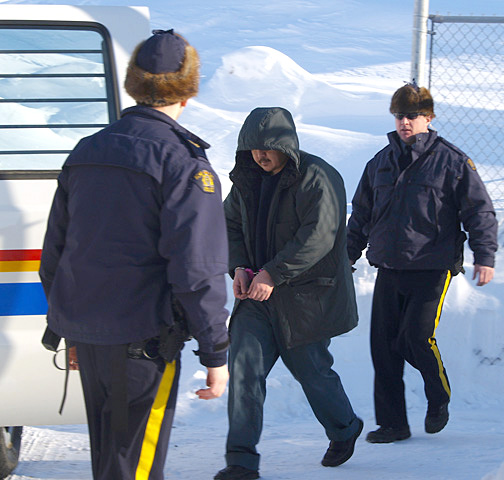
Pingoatuk Kolola, centre, leaves court in Iqaluit in March 2010 after being sentenced to life in prison with no chance of parole for 25 years for killing RCMP Const. Douglas Scott. Last month, the Parole Board of Canada granted Kolola day parole for a period of six months. (File photo by Chris Windeyer)

The president of the union representing RCMP officers says the early parole of a convicted cop killer is “disgusting.” Const. Douglas Scott, seen in this RCMP photo, was on the force for six months when he was fatally shot in Kimmirut in 2007.(Photo courtesy of the National Police Federation)
The president of a national police union says granting day parole to a Nunavut man convicted of killing a police officer is “disgusting.”
In a statement Tuesday, the National Police Federation condemned the Parole Board of Canada’s June 18 decision after Nunatsiaq News reported on Pingoatuk Kolola’s early release from prison.
“I think it is disrespectful,” Brian Sauvé, president and CEO of the union that represents nearly 20,000 RCMP members across Canada, said in an interview Thursday.
“It echoes what a lot of Canadians are seeing: An extremely liberal application of the interpretation of the law.”
Kolola was convicted in 2010 of first-degree murder in the 2007 shooting death of 20-year-old RCMP Const. Douglas Scott in Kimmirut. Kolola, who was 37 at the time, killed Scott when the officer responded to a report of a drunk driver. He had only been on the force for six months.
Though Kolola was sentenced to life in prison without possibility of parole for 25 years, he was granted day parole after applying for early release under the “faint hope clause.”

That Criminal Code clause allowed murderers to apply for parole after serving at least 15 years. The clause was repealed in 2011, but Kolola was eligible because he was convicted in 2010.
Kolola’s application for full parole was denied. Instead, the parole board granted him day parole for six months. During that time, Kolola will live at a community-based residential facility, the board’s decision said. It did not specify how long he would be able to leave the facility for each day or which community it is located in.
The board indicated Kolola does not intend to return to his home community.
Sauvé said considering the nature of the crime, making Kolola serve his full sentence “would be the appropriate approach.”
“It was an attack on a police officer. An attack on a police officer is an attack on the entire legal system, not just another person.”
Sauvé said, “So generally speaking, I think the decisions by the Parole Board of Canada are probably adequate and follow the rule of law as it is today. It respects the convicted person’s rights, in consideration of Canadian safety.”

Noting Canada’s legal system is built on the principle of rehabilitation, he said, “If Canadians want to change that as a collective, then Canadians can.
“However, I have heard from a lot of victims’ families, and I’ve seen the impact where they have to continually appear before a parole board to express” the impact of the loss of their loved one.
A prisoner can continue to apply for parole even after being rejected. Sauvé said that is “revictimizing those who have lost loved ones or been considerably impacted by a crime by allowing that system to continue, so perhaps improvements be made there.”
He hopes the parole board takes time to review Kolola’s case and does not grant full parole before the 25-year limit included in the sentence has ended.
“I am a big supporter of rehabilitation. I think people can change when given the right tools necessary,” Sauvé said.

Heard he going to Ilavut center in Kugluktuk
“It respects the convicted person’s rights, in consideration of Canadian safety.”
He should not have any rights! This is disgusting! He surrendered his rights when he took a life…..
Yes, and particularly when this guy killed a police officer – who was someone simply doing their job that they passionately loved. Agreed that this lowlife killer should have no rights – and what rights he did have, as Tory Smith says, he gave those up when he killed an officer and took his life. This is upsetting and disgusting.
I think the police union has a right to be upset about this one. It’s strangely coincidental that the NWT dealt with this “faint hope clause” just a few days ago in a case with very similar facts. In the NWT case, the person had also been convicted of murder for shooting a police officer. While in jail serving his sentence, the NWT person also had a checkered history like Mr Kolola but had been making progress too like Mr Kolola.
In the NWT case, the judge denied the faint hope application, and did not allow it to proceed on the basis that no reasonable jury would or should allow the possibility of early parole. That is what should have happened here and it is understandably frustrating for police that a different and inconsistent outcome occurred in Nunavut.
If Corrections did what they claim do by way of rehabilitation, and if he were ever ready for release, Kolola should by now have certified papers for some real trade. (Not bloody likely!)
He should be in a federal prison for life. Not the “vacation” jail in Nunavut or NWT.
Real jail.😈😈