


Quebec opens up dialogue in Kuujjuaq with aim to revitalize Inuktitut
Indigenous relations minister Ian Lafrenière visits community to hear people’s opinions

Quebec’s First Nations and Inuit Relations Minister Ian Lafrenière speaks to a crowd in Kuujjuaq June 16 on the revitalization of Inuktitut. (Photo by Cedric Gallant)

This story was updated June 20 at 3:15 p.m.
Zebedee Nungak is calling for an overhaul in Inuktitut language revitalization across Nunavik.
Nungak, director at Avataq Cultural Institute, was one of about 50 people who showed up at an open dialogue session June 16 between Ian Lafrenière, Quebec’s minister of First Nations and Inuit relations, and people in Kuujjuaq about how the Quebec government can help promote and support Indigenous languages and culture.
“The need is well beyond school, we need a total upgrade of language instruction and exposure,” said Nungak during the meeting.
Leaders of multiple organizations were present, ready to pick up a microphone and share their opinion on the matter. Lafrenière never intervened; he only listened and took notes.
“Our language is eroding very dramatically,” said Nungak. “We have to do serious work to stop that erosion.”
He estimated that in order to start a new project on language revitalization, the Avataq institute would need about $4.5 million.

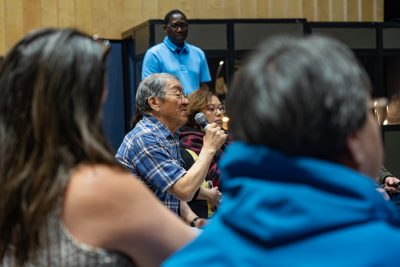
Avataq director Zebedee Nungak speaks in Inuktitut, talking about how infrastructure and resources are needed to revitalize use of his language. (Photo by Cedric Gallant)
Nungak also pointed out that although the percentage of Inuktitut speakers in Nunavik is high, the real data that needs to be looked at is how proficient individuals are.
“We have nothing to brag about,” he said, “because the language we are speaking now is about 30 per cent of our grandfathers’ total command of the language.”
That statement resonated with Lafrenière.
“Is the quality of the language diminishing with time, just like we are seeing with French?” he said in an interview during the lunch break. “Have our kids mastered the language well? I really liked that comment, because it is true.”
Attendees expressed gratitude that an open dialogue between the government of Quebec and the Inuit leaders was able to happen.

“I have been asking the Quebec government to meet us for this purpose,” said Sarah Aloupa, president of Kativik Ilisarniliriniq, Nunavik’s school board.
“When I was going to school, our language was still very strong,” she said. “Looking at the students today, some don’t even speak Inuktitut anymore.”
Alaku Kulula, the board’s assistant director of education services – first language (Inuktitut) curriculum, said if the Quebec government provided Inuktitut translation for its mandated primary and high school curriculums, courses like math and sciences could be offered in Inuktitut.
An official translation would go a long way, she said, because it is difficult to take curriculums for math or sciences and modify them into Inuktitut.
It would also help students learn the language beyond just the mandated class where it is taught, she said.

Another concern was brought up by Martha Grey, of the elders council. Official documentation and letters sent by the government of Quebec is always in French, sometimes in English. She said for a lot of elders, having Inuktitut documentation is crucial and would avoid a lot of those letters being thrown away.
The child fostering system was also a concern for attendees.
They said children taken by the Department of Youth Protection are often sent to foster homes down south, separating the children from their language and culture. This also contributes to deterioration of Inuktitut over time.
“Today in each community there is one child who has lost their language,” said Aloupa.
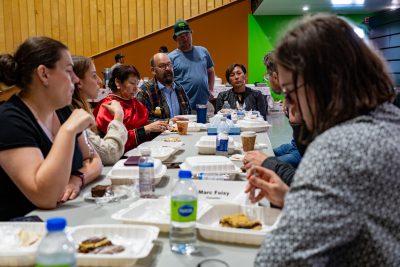
First Nations and Inuit Relations Minister Ian Lafrenière’s team and the attendees of the dialogue sit together at the table, eating lunch while continuing their discussions. (Photo by Cedric Gallant)
The dialogue remained respectful throughout the session, but numerous demands were made to Lafrenière.
He said while this exercise does not mean immediate action will take place, “We are not throwing promises for nothing to happen.
“There won’t be any miracles, and people understand that. It’s work that will take time.”
Note: This article was updated to include Alaku Kulula’s full job title
“Lets teach everyone english and inuktitut.”
Because, lets take away opportunities from our youth that we have so we can keep them in the north, isolated and less educated about the world around them. ~Real good idea~
The french language is strong and actually overpowers ours, even in our own region. Apply for jobs with the same qualifications but sub the french for the inuktitut and the one with the “x” on the french language wins.
Not sorry! Im an anglo/inuk with a ksb edjamacation. The struggles r real in the open world and not much easier within our own region.
Id suggest we start making french mandatory, as a second language. At least, at that, our kids have the option to leave nunavik if they chose to do so.
How can we not consider this as the modern form of colonization? The same people divided. The same people governed by different regions, provinces, cultures, and languages. The same people governed by different orientations. Some look towards Copenhagen, others towards Montréal. Many look towards Ottawa, but some look towards Calgary. The Inuit Arctic is, nonetheless, rich and increasingly strategic. The Inuit Arctic possesses all the resources (along with its brave and resilient people) for indigenous development and control of its territory, according to its own rules. Yet, this people is now divided, fragmented, and traumatized. Unity is strength!
Some people live in colonization their whole existence, even if only in their mind. Once the rule starts it never ends. I think that’s the unfortunate way of many indigenous people today. Even if the colonization is not a reality, it’s a perception, and a reality in the mind. It’s still their reality. Why not look at other societies in the world that have been colonized and see how they’re doing. Many many people have that problem, but many many come out of it as a stronger people. I don’t agree that Nunavik Inuit have to be consumed so much, and live so poor quality of life , with a belief, of being in a continuous colony of other peoples making. People need to wake out of that thinking and start living their full potential. You keep your culture , your language, your values, your in control of these parts of your life, it’s time the meetings and workshops embrace and teach people that they are free, the can think and contribute, not to be an inferiority complex.
I can only agree with you, but my point was:
How can a people (the Inuit people), who have a unity of language (with numerous dialects and variations, but the same root), culture, and cosmology, be strong and rule over their lands and resources when they are divided between Nunavut, Nunavik with Quebec as its center, the Northwest Territories, and another part, so geographically close, controlled by a tiny European country, Denmark?
Popular inertia is real, we agree.
But where are the Inuit elites?
In my response, I agree, that’s a good point. Inuit of this country Canada need unity within the Inuit societies. What I see even in small villages, divided groups for reasons that’s difficult to understand sometimes. As we can appreciate differences in any group, as sub groups , as by different beliefs and values in smaller groups. Kinship , family vs family too often also! rather than universal goal oriented. I once was on a committee, as much as I don’t think much of committee whirlwind nothingness, but my fellow committee members voted to hire outside the village, hiring non Inuit rather than their fellow Inuit with the qualifications. And it was said to me that Inuit should not get that job and pay, because it’s above other Inuit, now , we have Inuit saying that about Inuit. IT’s major impact towards going forward. There’s a lot of work needed done within as far as I’m concerned.
The idea that there is an underlying ‘sameness’ about Inuit, culturally, cosmologically, (politically?), is essentialist fiction for totalitarian thugs.
I hope you will still agree that there is a greater cultural, cosmological, linguistic, and physiological proximity among the Inuit people from different provinces of Canada and Greenland than between the Inuit of Nunavik and the average Quebecer in the city of Quebec, or between the Inuit of Nunavut and the average Ontarian.
Without falling into racialist delusions or totalitarian fantasies, there are distinct cultures, roots, and traditions, whether you like it or not.
Unless one considers that the Inuit do not exist and that there are only indistinguishable individuals across the world, devoid of history or identity, it is important to be able to calmly reflect on these topics without excessive caricature or misrepresentation of others’ thoughts.
Nothing do with sameness or individuality. There’s a need to cohesive cooperation if unity and strength are to optimized. All French are not the same either, difference in dialect, geography and expression. But enough commonality to unite. All Canadian Inuit are common enough to unite.
There is no more ‘unity’ to Inuit than there is to English speakers. A superficial commonality papering over deep ethnic and cultural differences.
Do we draw the line somewhere? What do categorical put one group of people there and other somewhere over there? Or do we do away with categorical placement and go with people only. That’s not going to work, it’s just going to be inclined to go into some group here and others there. It might even be innate to be that way, I’m not sure, but the human being appears to use groups , tribes and them vs us. It’s the feeling of belonging also. But there are people like your doctors , nurses judges, could even be your next door neighbor, they see beyond race and culture , but in a good way too. Groups and belong to one is real and will be infinite.
Nothing new here, the same stuff. Nungak is saying the need is well beyond school. That kind of thinking has a fair amount of concern. Yes, I think we can say that the language lacks in the life beyond school, but it’s school where the heart of it collaborates with learning at home and community, and the seeds and soul to get it into the place where it should be. If Inuit of Nunavik are thinking that an outside entity or other people will get Inuktitut language reviving, there’s a big disappointment coming. Over 40 plus year of opportunities and open doors and breaks and chances and subsidies and look at how educated or not Nunavik is today. How much opportunity, how many programs and work shops and made up certifications can be issued with such emptiness of results? Nothing seems to be discussed alongside the language debate about the deterioration of the society, no way. I’m concerned that Inuit are not doing what they need to do with the totality of living, language inclusion. There’s not one Inuit doctor , there may be a nurse , but I’m not sure, I mean living and working in Nunavik, that from Nunavik. No X-ray tech, no lab tech, and how many fully university grad teachers do Nunavik have! I don’t mean the ones taking workshops and quick courses here and there , with a grade 6 or 9 school bay, I mean fully university among the peers, in class grads. Inuit of Nunavik has a lot of work to do, but keep asking for waste millions of dollars with involvement is useless. Get the kids involved in their studies. It’s the way to embrace and win back the language.
Another problem we have in Nunavik today is elder involvement in education. The elders we have living today , are not the same cultural, traditional elders in language as , 40 years ago. The elders we have today are somewhere between the sadness of feeling victimized of the changes and a memory of glimpses from a better community when they were kids. In that we have the victim elder advocating for a tradition that they know little about! Except a few memories. What they think they know is actually loss in the progress of change, and they interfere with kids getting a modern education , which if the kids don’t get it, it’s backward to a false sense of traditional living. Elders should not have the opportunity to negatively impact education. They should be respected, but not involved that way.
A few comments,… Lafreniere says it is work that will take time But there is no time to lose as the degradation of the Inutituut worsens as time goes by; the devices we use are pretty addictive as much of the content is designed for the purpose to grab and hold our attention; no talking locking on to a screen is a big problem; at an outfitting camp where I spent some time the people who show say it is great to take a break from that, it can/would be a way to have Inutituut immersion taught in camps away from town…
There’s only one way to tackle this problem. Education is the answer. Until Nunavik becomes educated, it’s all in vain. Education is far away from the talks about language. You don’t get too many, even the Nungak’s , which you would believe would, but no body really addressing kids and school. And with that you’ll have uneducated elders trying to come up with new Inuktitut words. The uneducated elders , as too many believe is the way back to the language. But not realizing that the elders today , are the contributors to the loss of the language that started years ago. Loss of language cannot be reversed in a present day elder contribution , they don’t have it either. So become educated and take what you can from the few elders, but not worship a false hope through the elder, which is not there anymore. Embrace evolution of Inuktitut with what we have , but through education. Stop this going off to a tent somewhere , inviting elders to come up with words. It’s a waste of words to to speak. The common goal must be educating the population. Education doesn’t mean you become a non Inuk, it mean you become an educated Inuk.
Eat your smarties. It’s not as you say going out to a tent somewhere to discuss new words to add to the existing lexicon. You are purposely but I know not why arguing against the usefulness of taking the time to learn in a setting free of distractions that are found in the villages. Griping on elders is another matter not relevant to the point.
You can’t keeping using English and Inuktitut in the same sentence as your new version of language, and then realizing some day that you’re losing your language, then try to compensate and pay up , by forcing words in a quiet setting on some rock across the bay. You have to live your language and speak it everyday, and let it become what it may. But don’t expect someone else to do it in another culture for you.
One of the most common words in Inuktitut these days translates to money. One of the most commonly used sentences is give me more money. That the problem today, it’s not as much about the core issue as it’s about money and greed. I was at an Indigenous day, where cakes were displayed in beautiful colours and little kids were lined up to get a piece with eye wide excitement, only to be pushed away , as the cakes displayed, were a contest for the adults , top prize in the hundreds of dollar. That the way it is today, mislead away from real life by greed. Someone in that group again asking for more money. Now , I’m telling you: that attitude. If nothing else ! It’s makes the people guarding the purse sick , and tired, and not good for Inuit people , where there’s a few making unrealistic money demands.
Maybe that’s how we can get the kids to stay in school, un distracted from the noise that parents are making partying. School on the land in a tent. We all know about that one. The noise in the community is from the noise of those selfs. The noise you hear is your own noise. It’s amazingly noisy in small towns these days, but who makes it ? It’s all an indication that the problem , language loss included, exists within. What cost are involved to go out there, need money ?
The 4.5.million as Avataq’s CEO said in the discussion could be useful if well spent. There are many outfitting camps from the caribou hunt gold rush of a few years ago that are getting minimal use.
We change , we evolve, we gain , we lose. We must consider that nothing is constant. It’s always changing. It appears to me sometime that people that reject change are also expecting things just to be as is , and even long for the past as though it’s just a step away. I’m hoping the these groups of language hopefuls are not in belief that we can turn back to a time when language had no outside influence. I’m also concerned about the future of Inuktitut being driving further into non existence by groups that have unrealistic goals, without any consideration for change.
It’s going to be interesting to see what a meeting like this will look like 30 or 40 years from now. Meetings like this one occur every quarter of a century or so, as someone realizes the coppers are empty and meetings need agendas. Not that’s there’s any shortage of nag and grumbling in the daily round tables of popular get togetherness. Why don’t people learn to live and enjoy life, and love what they are, in its stead, it’s one beef after another, and kingdom come comes sore fully to those that live not.
Reality is to ask who’s reality. No doubt Europeans came to Canada, Nunavik, Quebec, all over from there to here. Mostly we reference that in relations to Inuit among other peoples of First Nations being on the property first. But just think in real terms of reality for a moment. Let’s say theres about 8 million Quebecers, seeded mostly from the influx of Europeans that come across the water. Now, for the reality, and I’m telling you now, it’s real: Most of those 8 million, or so, at least the ones of the ancestors that came at the time in question, were born here, and feel as much ownership here as any Inuit or other First Nation. This may not have a political corrective measure to it, but I’m telling it like it is. Entitlement is real. That’s the reality of what’s is , and try as you might! You will not tell someone born here that there are not from here, and are from Europe, if you don’t believe in what I’m saying , you need to wake , and rethink your reality. Not to put anyone on a spot here. So talking about language loss has a less of a emphasis on Inuktitut then you are lead to believe, due to many many other people that have their own interest as well, I do believe however that the mass number should help the lesser number to flourish, but , as I point out there’s more reasons to consider the whole picture, with its limitations to preserving this and that in our lives.
You got that right, they are not from Europe. They are native-born North Americans. They are no more European than Inuit are Asian.
Let us look at K.I. days in a year in which the students have no teacher! No school, no class, so many days in a year.
We’ll , if there no teachers from south, Nunavik kids are in big trouble. Now what sense does that make to language? I was looking at a photo of summer activities for kids in kuujjuaq. Ran by two or three man from the south. Not a local worker in sight last time I looked. Too busy travel to coop , not for food. Sleep all day , awake at night , 40 year olds drinking and driving. 4.5 million for language . Pathetic.
Why not have a language camp for the little children? That photo is of two baby sitters from outside the community taking care of kids while the parents go about their daily activities speaking half Inuktitut and English , drinking and driving and acting like kids themselves. And people wonder about what’s with the Inuit society.
As important as language is, it’s only part of the whole. Focus on language, and solely on language has its setbacks. What I mean by that is: we need to look at the bigger picture of what is. We need to address other issues in Nunavik society. Erosion of the language needs relevance to how the rest of society is also being loss. Like how culture is being loss with other traditions. The totality of Inuit life, not just language. We need to address why language is dependent on other aspects of loss. More then before, disconnection is more evident today. Poor communication among Inuit within Inuit , not just with other people. Let’s not get carried away with just language, and not addressing the why we are losing it all. Let connect Inuit together first.
Quebec has a special regard for language, that is a plus.