


Report highlights Nunavut’s low school-attendance rates
Overall attendance rate for Nunavut’s schools sat at 68.2 per cent last year
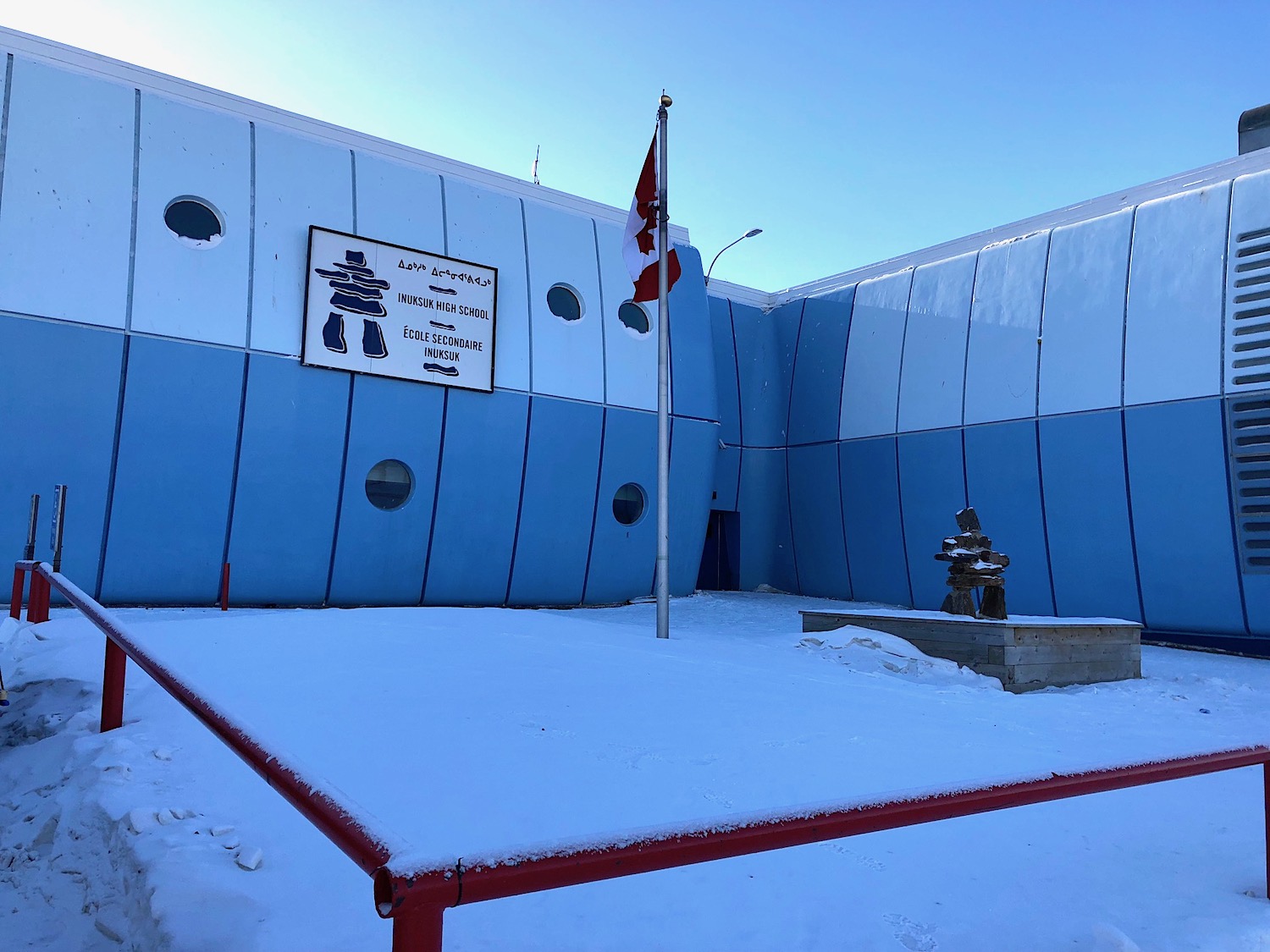
Inuksuk High School in Iqaluit is one of the schools in Nunavut that boasts good attendance. In 2017 it also produced the most graduates. (Photo by Jane George)

Fewer than seven in 10 Nunavut students attend school, according to the Department of Education’s annual report for 2016-17.
This report, tabled on Monday, March 4 in the Nunavut legislature, puts the territory’s overall attendance figure at 68.2 per cent, with higher levels found in elementary schools, among Inuit girls and among non-Inuit of both sexes.
In some communities, the attendance rates, as presented in the report, was dire. The phenomenon of non-attendance, most acute in high schools, could be found territory-wide, in all three regions, with the worst attendance found in the Qikiqtani region.
In Gjoa Haven and Pangnirtung fewer than one in two students attended high school, and the situation was not much better in Pond Inlet, Igloolik, Sanikiluaq and Whale Cove.
Better attendance could be seen in Kugaaruk, where eight in 10 attended school, but that figure also included elementary students.
You have to look at Iqaluit for some impressive attendance figures: with more than 90 per cent attending school at Joamie Elementary School and Nanook Elementary School in Apex.
Also up there were Rankin Inlet’s three schools, where more than eight in 10 attended the community’s schools.

Attendance was higher among Inuit girls (67.4 per cent) than Inuit boys (67.2 per cent) and among non-Inuit girls (79.1 per cent) and boys (79.5 per cent). Of the 268 graduates in the 2016-17 school year, nine in 10 were Inuit, 55 per cent girls, 44 per cent boys.
You can find the most grads in Iqaluit, at 59, followed by 36 in Arviat and 29 in Rankin Inlet.
The territory spent $170 million last year on its school system.
The report is not yet available on the Department of Education’s website. But you can see how your community stacks up in the attached document, scanned from the annual report.
Graduation rates, Nunavut, … by on Scribd

Quite a difference between Inuit and non-Inuit. I wonder why?
School attendances are very low because parents either give their children the choice to go to school, or don’t care to wake up to send them to school, or children don’t want to attend school because of being bullied.
Poverty is severe in Nunavut. If the parents don’t want their children to experience hunger, then they should send them to school, and not give them the choice. Otherwise, Nunavummiut will keep being poor for generations to come.
Education is key to success! Let’s stop the cycle of non-attending/don’t care about school, and give our children a brighter future. Teach them the importance of attending, because once they start working, they’ll always go to work on time.
Also, parents must talk to their children about being nice to other people, so the children will not pick on others. We need our children to go to school, and help them to be literate so they can pursue higher education, and obtain meaningful employment on our communities!
What is the strategy moving foward…years gone bye would see cuts to teachers positions. How many teacher positions will be cut?
Damn those numbers are abysmal.
Wait, some of our non attending students may have read that.
Those numbers suck eh.
Parents, please smarten up. If one child continues with those attendance numbers they will have missed three entire grades by the time they reach high school.
Not only do they have to attend every day but let them get proper sleep.
Welcome Nunavut to the club of jurisdictions with similar secondary school attainment:
Tanzania, Swaziland, Guatemala, Liberia, Burkina Faso, Yemen, Honduras and Cameroon.
I hope people realize how bad things are here.
We are truly in bad company.
We have similar attendance with countries experiencing civil, religious and narco wars, AIDS ravaged hermit Kingdoms, drought ravaged terrorism hotspots and places where the body parts of albino citizens are harvested for their supposed magical properties.
What is our excuse? Not waking up in the morning?
Thanks Putuguk. As is so often the case with sarcasm, you hit closer that you might think to insight.
People don’t realize how bad things are in NU, whether they live in NU or not. Outcomes in Nu are similar to those in many oppressive third-world jurisdictions because NU is one. One need only look around any hamlet in NU, look is prospering in the Hamlet, look further afield to see who from the Hamlet is sitting in the legislature and on one of many regional Boards – and then assess what good derives from those positions for the average Inuk. Not pretty.
Those same people call for more funding to combat suicide, addiction, crime, low-attendance, disease, unemployment, hunger, despair, homelessness and mold.
Fiscal funding has reached capacity and will start to decline. It is time for human capital in NU. Why is attendance low? Suicide by bullet or consumption is still suicide. Oppression from within or without is still oppression. Abuse inflicted on self or others is still abuse. Hunger for food or opportunity is still hunger. Disease of the body or soul is still disease.
The people of NU need go to work. The transformation must come from within.
I do not understand the reporting, you state Gjoa haven high school had less then 50% attendance and then you share a report that says the elementary school has that attendance and the high school has 60 %. What is the true numbers?
The Gjoa Haven Elementary had 60.3%, the High School had 48.9 (ie “less than 50%”) and when the schools are averaged out together they have a combined attendance of 58.4%
@Crystal Clarity, if you look at the item posted with the numbers, it say Qiqirtaq’s attendance is 60.3, that is the high school
I’ve watched this farce for 20 years, it’s not difficult to fix.
Step one. GN pass a truancy law requiring all children between the ages of 4 or 5 and 18 to attend school full time. You will want to cover exceptions for illness, or apprenticeship programs but that should be it.
Step two. Require hamlet council to enforce the law as part of their funding requirements.
Step three. Ensure that the Education Act require schools to report delinquent children to the Hamlet. Ensure social assistance requires specific attendance levels, I would suggest 90% excepting illness. Ensure hamlets enforce attendance, measures may differ from hamlet to hamlet.
Enforce steps one, two, and three.
Why are we still talking about this?
I have a suggestion. Tie funding and Federal transfer payments that go toward the education budget. So that monies are only spent on a attendance numbers per school.
Schools don’t get funding for staff or O&M for students who are non-attenders (ie attend less than 40% of the time)
Not sending your child to school is NEGLECT.
I’ve heard that that people wouldn’t receive what is now called Canada Child Benefit if their children didn’t attend school back in the good ol’ colonial days. It probably worked. Why can’t that practice be used again? Why are taxpayers paying for the Child Benefit when the majority of the students don’t even attend school let alone complete their post-secondary education? Uneducated kids are causing havoc in practically every community. They become a burden not only to governments but to society. They do not contribute to society whatsoever. Only good at procreating, collecting income support and so on. The children borne out of these losers have absolutely no place except crowding the already over-crowded homes. The communities can’t build houses fast enough to keep up with the demand. It’s getting out of control. Yet these newborns are welcomed by elders, community leaders and the sort. We need to come up with ways to curb the uncontrolled birth rate in this territory. We also need to ensure these kids will have a good future. They cannot and should not continue to rely on handouts. I say cut off the Canada Child benefit to people who don’t let their children attend school.
Interesting idea, but the Canada Child Benefit comes from the Government of Canada. Imagine if they tried to implement a change like that, people would be howling at them as oppressors and colonizers and the usual.
There is a direct correlation between achievement.
There are plenty of statistics which bear this out.
Why are so many children (of all ages) given the choice not to attend school? Parents need to be responsible for getting their children to school daily.
Approximately: the average Nunavut student has missed the equivalent of 2-3 years of school by age 18. How is this allowed to continue, year after year? It’s neglect. Previous Education Acts did have mandatory attendance (though I believe little was done to follow through with that –in this community at least). There was supposedly a daily fine. It was removed from the Act.
Perhaps allowances should be tied to attendance –might serve as an eye opener to parents who don’t act as parents.
Children have the right to education. Perhaps the Representative for Children and Youth office needs to become actively engaged in addressing this issue. The government hasn’t and continues to do little to address this.
Parents need to be held accountable. Truancy rates are astonishing.
Another thing that is important to mention relates to the type of student who comes to school.
There is all kinds of crap happening in homes, kids don’t want to be there, they are out wandering around into the night until their house quiets down and/or it’s safe for them to go back.
Children coming to school with 2, 3, 4 hours of sleep per night can’t learn –some are barely functional. Many fall asleep in class. The frequency of children complaining they are tired continues to increase.
Social media is another problem –younger & older students are up on social media 1/2 the night –parents be parents, and take away their devices.
These massive social issues are getting in the way of children both attending school and being successful.
I’m thankful for those parents who actively support their children & their education — one can appreciate that doing things differently from, what unfortunately is the norm, is a challenge.
To put that in perspective, I recently read an article which stated the Canadian standard was “if 10% of students are absent 10% of the time, you have a chronic absentee problem.”
Perhaps eighteen year-olds could begin to hire lawyers; better still, a law firm could initiate a class-action suit. It’d be feasible to name parents, community leaders, ministries, GN and the feds. Many in that list have a direct fiscal, moral and legal responsibility to minors.
One of the recurring themes among those in positions of influence in NU to those who have ideas to facilitate changes is that “… things are different here. You don’t understand the Inuit way…” as verbal rationalization for poor choices.
Another recurring theme (in direct contradiction to the former theme, contradiction being the standard tool of obfuscation by those in positions of influence in NU) is that those in positions of influence know best what is best for those that they oppress and marginalize and that if that just had more funding they could facilitate changes …
The value people place on education reflects culturally transmitted attitudes, which shape the norms within a society and even a home. So, when we say “it starts in the home” this is true to the extend that the experience for the child does start there, but social-cultural values shape what parents believe is acceptable within their environment as well. I believe these are changing, and improving, but slowly.
A child goes to school for about 12,000 hours. It works out to about 1,000 hours per year. People complain that upon graduation their children are not at a grade 12 level. The are correct. If a child is attending 70% of the time he or she have only done 8400 hours and are working at about a Grade 8 + level.
Simple math folks – if kids are not in school – how can they be working at grade level ?
It is like a hunter has gone hunting and stopped with 70% of the hunt finished – that hunter’s family is waiting forr the other 30% of the hunt to put food on the table.