


Researchers study oil-eating microbes off Hudson Bay coast
Genice II project staffed with Inuit and southern researchers
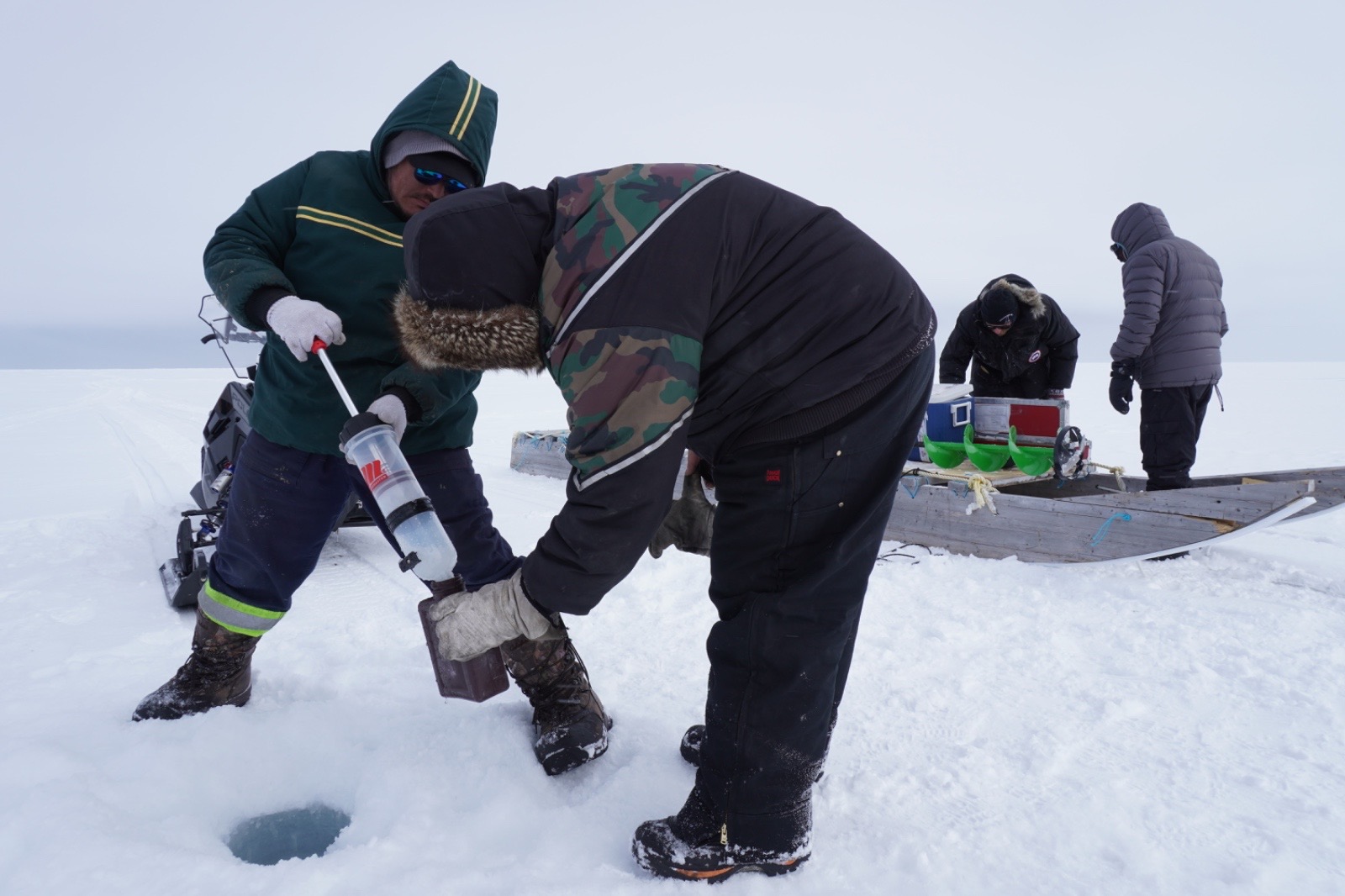
Field technician Simon Aggark of the Sapujiyiit Society, left, and Anulik Kadjuk fill a bottle with under-ice seawater during a sample-collecting trip near Chesterfield Inlet in April. (Photo courtesy of Masha Kardashevskaya)

A team of Inuit and southern researchers is using the water off Chesterfield Inlet as a living laboratory as they study naturally occurring microbes that feed on oil residue in the ocean.
Run out of the Centre for Observation Science at the University of Manitoba, in Winnipeg, since 2022, the Genice II project blends scientific method with Inuit Qaujimajatuqangit, or traditional Inuit knowledge. It builds on data from previous studies in Winnipeg and at the University of Calgary in 2015 and 2020.
The researchers are looking for microbial communities beneath the ice. These samples form baseline data with which subsequent samples may be compared, to identify any population changes, Collins said.
Microbes are the foundation of the marine food chain, ultimately supporting the species that make up country food.
Microbial activity is key for kiviaq (fermented seabirds) and mikigaq (fermented whale), by supplying the nutrients and vitamins necessary for fermentation.
Microbes can be harmful, in the form of algae blooms, which can choke out other aquatic life. These varieties are not evident in the region, Collins said.
The microbes pertinent to Genice II naturally maintain water quality in marine and freshwater environments by degrading and decontaminating human pollutants, which can include fossil fuels, the researchers have found. They can monitor these microbes to detect oil spills.

So far, researchers have not detected any disturbances that would indicate an oil spill occurred.
“If there were a spill, we would see indicator species that eat the oil,” Collins said.
A recent 50-litre oil spill 300 kilometres upstream, near Baker Lake, is not expected to affect findings, Collins added.
However, with increased shipping through the region, the risk of spills is ever present.
Chesterfield Inlet narrowly escaped environmental calamity in 2012 when the MV Nanny ran aground in the inlet carrying almost 3 million litres of oil.
The research reveals that the microbes behave differently in the North than they do in warmer climes, due to the low ocean temperature, Collins said.

It takes Arctic microbes one month to begin eating the same amount of oil that microbes in the Gulf of Mexico begin eating after two weeks, he said.
The scientists work with the Sapujiyiit Society, a grassroots group of Inuit knowledge-keepers that provides community-led environmental monitoring in the hamlet. They collect samples on the ice.
“That relationship has been very important to make our project work,” said microbiologist Eric Collins.
Some new microbial species have also been discovered along the way. Inuit of all ages will be asked to come up with Inuktitut names for these species in October, said Nicole Wilson, associate professor of environment and geography at the University of Manitoba.
(0) Comments