


Rhino discovery shows Arctic ‘big centre’ for mammal evolution: Researchers
Epiaceratherium itjilik, or Frosty, discovered in Devon Island crater
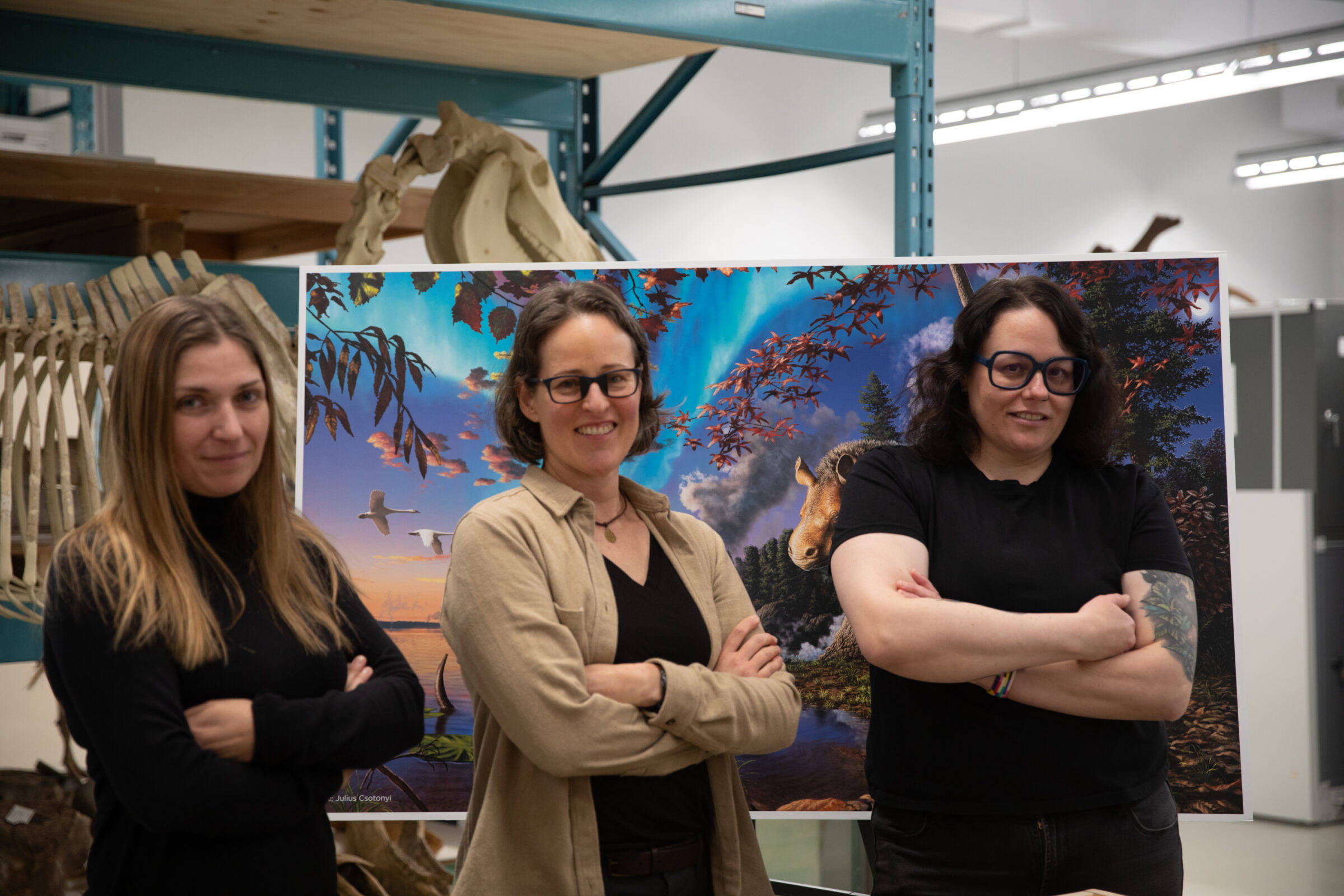
From left, Marisa Gilbert, Natalia Rybczynski, and Danielle Fraser are the researchers who confirmed the discovery of an Arctic rhino species that lived on Devon Island approximately 23 million years ago. They pose here with the rhino’s fossil at the Canadian Museum of Nature in Ottawa. (Photo by Jorge Antunes)
Updated on Monday, Nov. 3, 2025 at 3:45 p.m. ET

During the Early Miocene, about 23 million years ago, the environment of the Arctic was much more temperate with trees, hot summers and a climate similar to southern Ontario. Seen here: an artist’s rendition of the habitat in which Epiaceratherium itjilik (top right) lived. (Image by Julius Csotonyi courtesy Canadian Museum of Nature)
The fossil of an Arctic rhinoceros unlike anything discovered before sat buried below the Earth’s crust for roughly 23 million years, before permafrost heave brought it back to the surface of a High Arctic impact crater on Devon Island.
It was the 1980s, and Mary Dawson, a scientist with the Carnegie Museum of Natural History in Pittsburgh, Pa., was doing fieldwork in the Haughton Crater. She collected the specimens, but they ended up in a drawer where they sat for almost three decades.
Now, a team of scientists from the Canadian Museum of Nature in Ottawa say these fossils belong to a new species of rhinoceros, which they’ve named Epiaceratherium itjilik — or Arctic rhino.
It’s the most northerly species of rhino ever discovered.
The team published their findings Oct. 28 in the journal Nature Ecology and Evolution.

“[The] more we find in the Arctic, the more we’re discovering that it was a really big centre for mammal evolution,” said Marisa Gilbert, a senior research assistant with the Canadian Museum of Nature who has been studying these fossils since 2010, in an interview.
The rhino’s fossilized remains are about 75 per cent intact, which is “incredibly complete,” Gilbert said in a Canadian Museum of Nature news release about the discovery.
Canadian Museum of Nature research scientists Danielle Fraser, Natalia Rybczynski and Gilbert authored the study, along with Dawson, who is listed posthumously. Dawson died in 2020 at the age of 89.
Fraser, Gilbert and Rybczynski started work on the specimen in 2010 at the invitation of Dawson, who at the time was nearing retirement.
“By 2023 was when we were really like, ‘It is in this genus,’ and gave it a species name,” Fraser said.
The team invited former Grise Fiord mayor Jarloo Kiguktak, who participated in multiple research trips to the crater, to do the honours. He chose itjilik — which means “frosty” in Inuktitut.

E. itjilik — roughly the size of a muskox — would have likely eaten things like the trees and bushes that thrived in the area during the Early Miocene epoch, like birch, larch and pine, said Fraser.
The High Arctic at the time hosted a temperate climate filled with a variety of plants and animals. In fact, while researching the Arctic rhino, researchers found the fossilized remains of another previously undiscovered species — Puijila darwini, an ancient otter-like seal — on the rim of the crater.
The researchers say they believe the animal’s body fell to the bottom of a lake that had formed in the Devon Island crater, which contributed to its remarkable preservation.

The 75 per cent complete skeleton of the Epiaceratherium itjilik rests on a table at the Canadian Museum of Nature in Ottawa. (Photo by Jorge Antunes)
Now, Epiaceratherium itjilik joins 57 other known taxa, or classifications, of rhinocerotids, almost all of which are extinct today, said the news release from the Canadian Museum of Nature.

The discovery also provides evidence the species migrated to North America from Africa and Asia across a land bridge that may have provided a route between the continents for millions of years longer than previously thought, the release said.
The researchers say they hope to put Epiaceratherium itjilik’s fossils on display, but there is no timeline for when that could happen.
Correction: The caption beneath the main picture in this story was updated from its originally published version to correct the order of the names to correspond with the people in the picture.
It seems that the meteor hit this place on Devon Island around 30 million years ago when the area was in a temperate climate. I suppose that means the land mass was a lot further south. Then it would have filled in eith erosion as well as become a lake which would have gathered silt and perhaps dried up as the land drifted northward to the arctic desert land. Or not. The study of the history of the Earth’s crust is intriguing and complicated and beyond my scope.
Thirty million years ago Devon Island was pretty much where it is now in terms of latitude. North America has generally moved westward for the last 70 million years or so as the Atlantic Ocean has opened without a lot movement toward the north. The dinosaurs who lived during the Late Cretaceous in what is now Nunavut would have experienced a day-night cycle the same as what we experience right now. The difference is that it was a lot warmer.
Thanks Keith. That makes sense. Especially since the Mid-Atlantic Trench keeps widening from way back when, it’s stands to reason the continent would be drifting mostly westward, not much to the north
“I suppose that means the land mass was a lot further south.” Yes, S, maybe near the equator if want to look down an interesting rabbit hole.
Einstein, Charles Hapgood and many others tried to calculate how it happens with a pole shift. Ken White led Project Nanook 1940 mission to study military arctic survival and the North Pole. Ken let the cat out of the bag about the mission in his 1992 book, World in Peril.
Finding the North Pole moves, and what was found when they dug down. It was polar, tropical, sedimentation happening about every 12,000 years each.
Recall the past news reports over the decades about tropical trees and crocodile fossils found in Yukon/NWT/Nunavut.
Fast forward to today. The overdue 90-degree polar tilt is on many minds. And how the elite billionaires are building bunkers at high elevations in the Rockies and Alps. Building a bunker just for the view?
Because it’s the heavy ice that wants to get to the equator. Think spinning globe. And if tilts? Will put Devon Island close or directly on the equator. South America becomes the South Pole and India the North Pole.
Unlocks the thin crust? A solar storm. Such as a solar micronova or other strong solar storm, when the Earth’s magnetic field is extremely low. Allowing the electric current to travel through the crust, liquefying the low-velocity zone. Like glue coming off a heated floor tile, and bingo, the 90-degree tilt happens. Takes only 12 to 24 hours with massive tsunamis moving up and then down when the earth’s tilt stops. Bingo… new tropic location. The poles keep on staying cold.
It was nowhere near the equator