

‘Spicy’ times call for big increase in Arctic investments, Obed says
ITK president focuses on marine infrastructure, threats to Arctic waters in Iqaluit speech
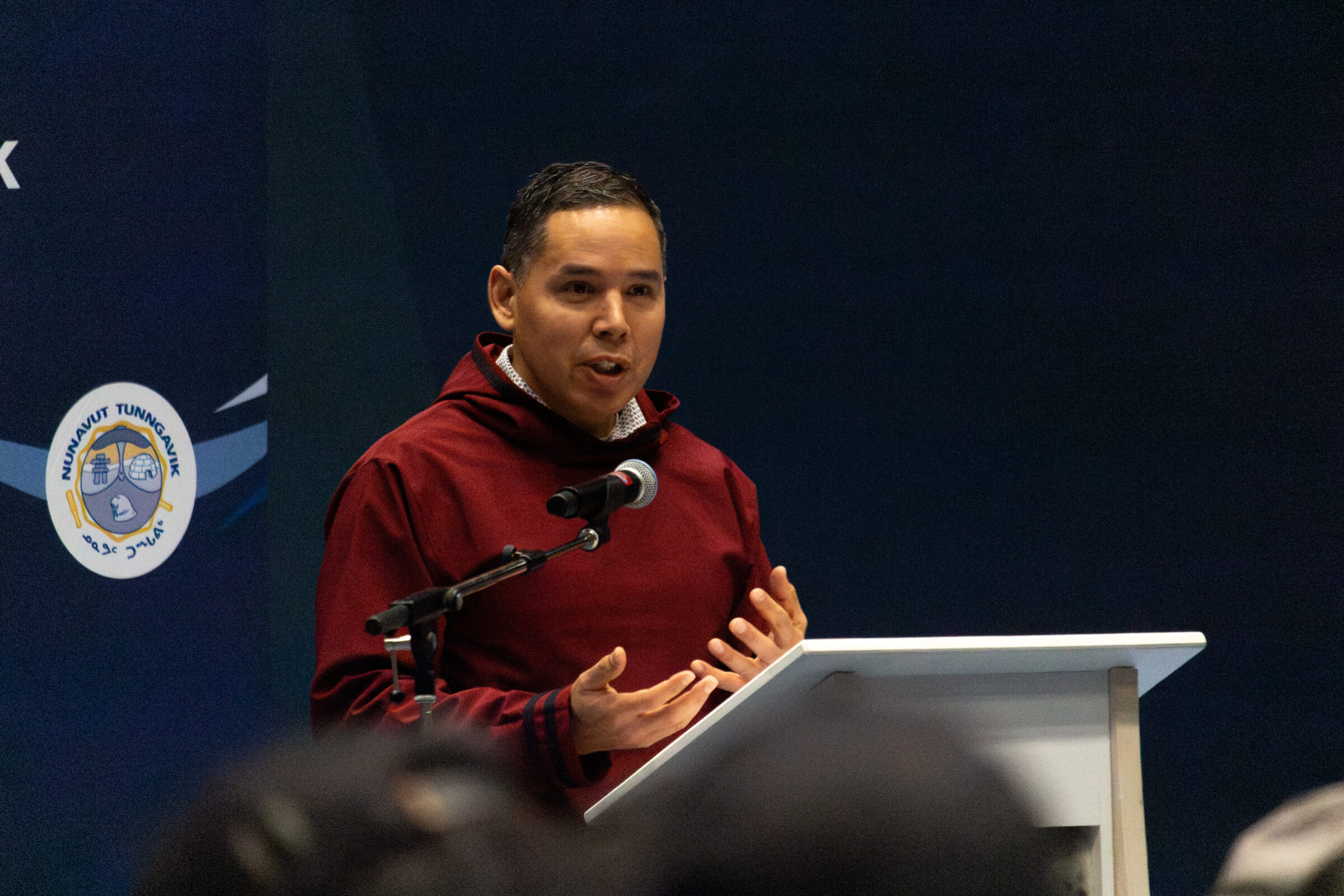
Inuit Tapiriit Kanatami president Natan Obed speaks at the Ingiulik Nunavut Shipping Symposium in Iqaluit on Tuesday. (Photo by Jeff Pelletier)

“Spicy” times in the world call for “generational” investments in Canada’s Arctic, says Inuit Tapiriit Kanatami president Natan Obed.
Obed made the remarks while attending the Ingiulik Nunavut Shipping Summit at the Aqsarniit hotel in Iqaluit Tuesday.
The ITK president was keynote speaker on the second day of the four-day Nunavut Tunngavik Inc.-led event, which attracted delegates from across the Canadian Arctic, Alaska and Greenland.
“It is an unacceptable reality that our 51 [Inuit Nunangat] communities are so underserviced from a marine infrastructure end,” Obed said in his speech, noting Canadian Rangers require facilities to launch their patrols and sealift companies need better options to unload cargo.
“We need to do better, and hopefully, we can work with the Government of Canada and jurisdictions to do that.”
Obed addressed ongoing concerns around the United States and other countries interested in gaining greater access to Arctic waters.
Rather than focusing on recent escalating threats by U.S. President Donald Trump and other American officials to annex Greenland, Obed addressed the longstanding U.S. position which views the Northwest Passage as international waters.
Obed said ITK’s opinion is that the Northwest Passage belongs to both Canada and the Inuit whose land claims it passes through. The Canadian government considers the passage to be within Canadian jurisdiction as well.
“We may be in the crosshairs of other nation states’ interests in a way that we just have not had to consider,” he said.
“Our shipping policies, our marine policies, and the ability to develop them here in the present — before all of this other noise that comes into the picture — is something that we really shouldn’t let pass by.”
After his speech, Obed told reporters that Trump’s threats and comments regarding Greenland are cause for concern.
“If you hear President Trump, one of the accusations he cast against Greenland is their lack of investment within Greenland. And if that is going to be a measure of another nation state’s justification for taking over space that they feel is underutilized, then I do worry about that case being made against Inuit Nunangat in Canada,” Obed said.
“This is the time to focus on strengthening our communities, to strengthen our sovereignty, and also … to ensure co-operation and partnership between Inuit and Canada and then Canada and the world.”
Obed said these are “spicy” and “uncertain” times, but also a time where Inuit in Canada and beyond are finding solidarity with each other. He said he hopes to connect with international delegates this week to reaffirm that.
“We have to just try as best as we can to mobilize with our existing allies,” Obed said, “to ensure that democracy is strengthened, that our allies are not going to annex or forcefully take over their allies’ lands and resources.”
Since his half American how about he go down to DC and ‘spice’ things up ?
What happened to the $90 million ICC got for Arctic shipping pathways? Can these not-for-profits be trusted to manage large investments?
Spicy? These are HORRIFIC times.
“Spicy Times”. That is way the President of ITK chose to define the times we currently find ourselves in. Seriously? That was the word he used to describe the current dystopian times we are living in. Words like unprecedented, dangerous, tumultuous, alarming or countless other words that could have lent more weight to the challenges the world is currently facing did not seem adequate. So, he went for that incredibly omnipotent word “Spicy”!
No wonder no one takes us seriously. That type of talk, followed by some generalization about Trump talking about “underutilized space” being justification to want to forcibly (if necessary) seize Greenland. Is Obed actually serious? Trump gives a rat’s butt about “underutilized space”. For Trump, Greenland is about grandeur, domination, kingdom building and self-aggrandizing (and equally importantly deflecting from the Epstein files). It’s about carving up the globe and splitting it between the Russian’s, Chinese and now the United States. Whoever would have thought we would be here at this moment in time just 10 or 15 years ago. Then Obed goes on about everything everyone else needs to do to shore up and improve Northern strength. Question? What is ITK doing exactly to achieve this. Has it spent any of the tens of millions they are sitting on to achieve that goal? No need to answer. Nunavummiut know in their communities the amount ITK has invested to improve the status of each community. Nothing!
So go on describing it as “spicy”. Maybe head over to TikTok and dance that word around while everyone else tries to figure out what exactly needs to be done to circumvent this unparalleled power grab and Orwellian times we are living in.
Inuit Tapiriit Kanatami president Natan Obed is right.
Canadian Arctic Rangers do require facilities to launch their patrols and snow machines, ATVs, boats and new war security training.
Gee whiz, the Hunters and Trappers Org over in Rankin Inlet are totally skilled in the flying of drones. And not just the tiny ones. It’s as if the Canadian Arctic Rangers are an afterthought to arctic security.
Even NATO Secretary General Mark Rutte says it was Trump 45 in his first presidency who “alerted us” about the Arctic sea lanes opening up. China and Russia are currently active up there and increasing. Made it clear that the lack of security in the Arctic is next to nothing.
Mr. Rutte talks not just about Greenland but about how arctic security is urgency needed for all arctic countries. Noting that Denmark has over the last year invested in Boeing P8s, Long range drones, Air to Air refueling. Plus, they have a recent $45 million AGM-114R Hellfire missile from the USA. Though what part of this investment is for Greenland is unclear.
The NATO Arctic Light 2025 exercise was held this fall in Greenland, but the USA was not invited. And if Greenland is taken by the USA, Ukraine must come and defend Denmark because of their 2023 agreement between the two countries.
It would also mean the end of NATO. Who then fills the USA’s shoes?
So, this stand with Greenland… is it to keep the USA out? But welcome Greenland to be taken by a communist country?
At least now people are paying attention to Gteenland. When I was in some communities a couple of years ago, the majority of home still relied on honey buckets. Greenland is miles away from Denmark in location and priority. Trump’s outburst may help Greenland and least place them in their thoughts and help provide the needed resources.
Investing in profitable and potentially profitable businesses in the Inuit homeland is, obviously, a desirable objective. Evidently, however, that objective eludes the management of the billions of dollars in the Nunavut Trust slush fund.
Bureaucratic investment managers and supervisors have no skin in the game and no incentive to improve their miserable performance. They’re happy just to sit back and draw their rocking-chair money. Same thing for the Inuit trustees. They have no expertise to bring to the table. But presumably they get the NTI slush fund to pay them for the oversight that they don’t do.
The NTI annual report is wretchedly inadequate for what it says about where they put beneficiaries’ money. Why is there no breakdown showing, for example, how many shares in Agnico Eagle the fund holds? Instead, almost half the fund is invested in its own secret slush sub-fund of mostly unmarketable investments.
Since the purchasing power of the capital is falling far short of cost increases for food, housing or anything else, Inuit beneficiaries should demand a forensic audit. And a strategic review of the fund’s performance and objectives.
Beyond that, I suggest division of the trust into separate funds, by beneficiary, like Justin Trudeau’s trust fund. Different beneficiaries have different needs. The now-dead money could, for example, buy housing or pay for medical school.