


Taissumani, April 1
William Scoresby Junior (1789-1857)
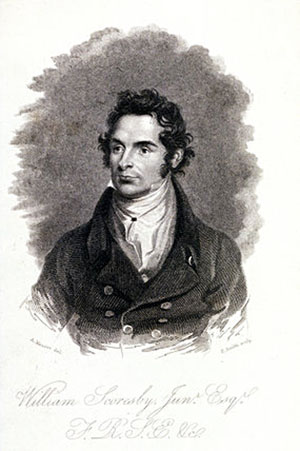
William Scoresby, the British natural scientists, amassed an immense body of knowledge on his voyages to the eastern Arctic in the early 19th century.
KENN HARPER
A scientist who met William Scoresby Junior when the latter was 52 years of age described him succinctly as “eminent for qualities seldom united in one man.”
That scientist, James Joule, went on to describe Scoresby more fully in these words, “At once an experienced seaman, a successful geographical discoverer, a hard working and eloquent clergyman, he was also a zealous student of nature and a scientific investigator.”
William Scoresby Junior was for twelve years the most successful captain and the most skilled navigator in the entire Greenland whaling fleet. Others followed where he led.
Born in 1789 near Whitby, England, he went regularly to the whale fishery with his father from the age of 10, attended the University of Edinburgh for two winters while in his teens, studying natural philosophy and chemistry, was first mate under his father at the age of 17, and became captain in his own right at 22.
While whaling was his reason for being in the Arctic, he used the opportunities his profession afforded him to study geology, meteorology, glaciology, terrestrial magnetism and natural history.

Scoresby’s correspondence with Sir Joseph Banks, President of the Royal Society, during the winter of 1817-1818, helped to rekindle the British government’s interest in the Northwest Passage and influenced the decision to send out the expeditions of 1818 in search of the passage.
And our first real knowledge of the east coast of Greenland comes from Scoresby who, in 1822, surveyed and mapped 400 miles of that coast. One of the two main communities in East Greenland, the artificially created Scoresbysund, was names in his honour on its establishment by Ejnar Mikkelsen in 1925. (It is now known by its Greenlandic name of Ittoqqortoormiit.)
In addition to all his scientific accomplishments coupled with his career as a successful whaler, Scoresby was a prolific writer. A member of the British Association for the Advancement of Science, Scoresby authored over 60 scientific papers.
At the age of 31 he wrote a popular northern classic, “Account of the Arctic Regions and Description of the Northern Whale Fishery” and three years later, in 1823, followed it with “Journal of a Voyage to the Northern Whale Fishery.”
That same year, following the death of his wife, he gave up his life at sea to become a clergyman in England, and served a number of parishes. The next year he was elected a Fellow of the Royal Society. In 1827 he was made an honorary member of the Paris Academy of Science. In 1839 he earned the degree of Doctor of Divinity.
Few men have amassed as great a knowledge of the physical and natural sciences in the Arctic in so short a time, or shared it so eloquently, as did William Scoresby.
To Scoresby’s many other accomplishments can be added the role of inventor. He developed an instrument that he called the marine diver, an instrument for obtaining deep sea temperatures. Using it, he established that in the Arctic seas the bottom temperatures are warmer than those of the surface.
Always curious, even in retirement, at the age of 67 William Scoresby made one last major journey. He travelled to Australia to obtain data for his theories on magnetism. In the following year, 1857, he died at his home in Torquay, after a lifetime of diverse accomplishments.
Next week, I will tell how William Scoresby made fire form ice.
Taissumani recounts a specific event of historic interest. Kenn Harper is a historian, writer and linguist who lives in Iqaluit. Feedback? Send your comments and questions to kennharper@hotmail.com.
(0) Comments