


The Canadian roots of Donald Trump’s wealth
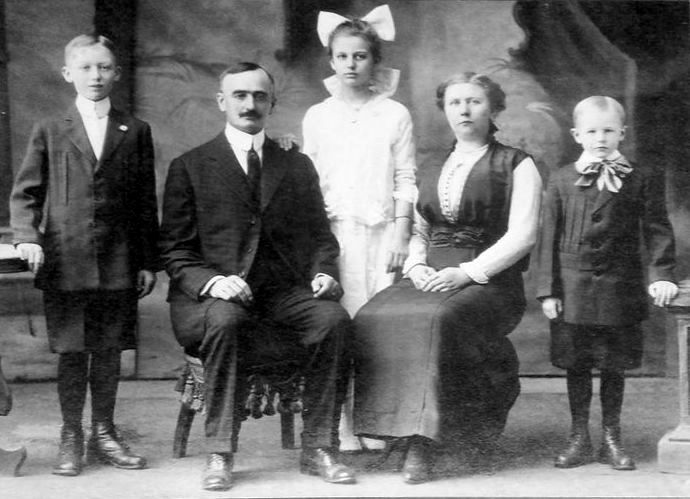
Friedrich and Elisabeth Trump pose with their children, from left to right, Fred, Elizabeth and John, in 1915. (Photo courtesy of Wikimedia Commons)
Canadians are well aware that America’s boorish and vulgar president is wealthy.
Donald Trump received a head start in life with money from his father, a real estate developer in New York who bent the rules and skirted legalities while amassing the wealth that he left to his children.
Fred Trump set up trust accounts for his five children, of which Donald Trump was the fourth. By the age of three, he was earning the equivalent of US$200,000 per year in today’s dollars, or about C$276,000. At the time he graduated from college, he was receiving about US$1 million annually (C$1.38 million). By some estimates, he received over US$400 million (C$553 million) from his father.
Most of this is well known. Less well-known are the northern Canadian roots to the family’s fortune.
In Kallstadt, Germany, in 1885, Donald Trump’s grandfather, Friederich Trump, was 16 years old and didn’t like the thought of working in the family vineyard or as a barber, a job for which he was being trained. So he left a note for his widowed mother and left home one night. He wanted to be rich and headed for Manhattan, eventually becoming an American citizen.
He moved on to Seattle, where he changed his first name to the more American-sounding Frederick and where he thought the easiest money would be made in the red-light district, known as the Lava Beds. He leased a restaurant, the Poodle Dog, and renamed it the Dairy Restaurant. It had a dining area and a bar, and it advertised “private rooms for ladies.” This was thinly-disguised code for the availability of prostitutes.
In 1894, he was attracted to an area north of the city named Monte Cristo. He filed a bogus mining claim there and built a cheap hotel that offered food, drink and women.
Three years later, in 1897, he saw newspaper headlines claiming that gold had been discovered in the far North.
He sold his eatery and headed there. The following year, in Bennett, B.C., just south of the Yukon border, he opened a business called the Arctic Restaurant and Hotel. It was a two-story, shoddily-built structure with an impressive façade, where customers could pay their bills with gold dust.
Following the same recipe for success that he had used in the south, Frederick Trump’s business was little more than a brothel.
A reporter for the Yukon Sun wrote, “I would not advise respectable women to go there to sleep as they are liable to hear that which would be repugnant to their feelings and uttered, too, by the depraved of their own sex.”
His stay there was short. Greener pastures beckoned in Yukon.
Frederick Trump dismantled his flimsily-built hotel in Bennett, loaded it onto a barge, and floated it downriver to Whitehorse. There the Arctic Restaurant occupied a prime location right across from the railway depot. It offered booze and gambling, and of course the company of what were euphemistically called “sporting ladies” in an area curtained off by dark velvet.

The elder Trump made a lot of money in a short time. Whitehorse author Pat Ellis, who wrote Financial Sourdough Starter Stories, said, “He made quick money on booze, and he was a good cook.”
But in 1901 the North-West Mounted Police wanted to curtail gambling and liquor sales, and the business of the “scarlet ladies.”
Frederick Trump left town.
He returned to Germany where he visited his mother and married the girl next door, Elizabeth Christ, in 1902. Shortly thereafter, they immigrated to New York. But Elizabeth became homesick and they returned to Germany. Frederick Trump tried to regain his German citizenship, but was ordered deported.
The couple returned to New York. They had three children.

When Frederick Trump left Whitehorse, he reportedly had $16,000 in U.S. currency, a sum worth over $600,000 today. He was always careful with money and, in 1910, he began to invest in real estate in Queen’s, a borough of New York City.
He died eight years later, leaving his properties to his wife, who proved to be a capable manager and grew the business.
Eventually his son Fred, who had been only 12 when his father died, took over the enterprise. When he died in 1999, he left a property empire valued in the hundreds of millions of dollars.
This is the source of Donald Trump’s fortune. It grew from his grandfather’s nest egg, earned through a restaurant, bar and brothel in Whitehorse.
Taissumani is an occasional column that recalls events of historical interest. Kenn Harper is a historian and writer who lived in the Arctic for over 50 years. He is the author of Give Me Winter, Give Me Dogs: Knud Rasmussen and the Fifth Thule Expedition, and Thou Shalt Do No Murder, among other books. Feedback? Send your comments and questions to kennharper@hotmail.com.
No little islands , epstein .
CRAZY TRUMP , 2 MORE YRS OF THIS LUNATIC !!!!!
The last prime minister Canada had was Harper. Would prefer trump over the two pm wannabes we have had since 2015.
Okay, sounds like a convicted felon, rapist, pdf file is the conservative style? Is that right?
Please explain to me how having a trained economist, who has governed 2 major central banks and without a criminal record is somehow worse than a real estate tycoon with many failed business (including a casino that lost money) and 34 felony convictions?
Because he is. He plagarized any degree he has, as per various news reports. Was disaterous in Britain (as per britons). Tells falsehoods, has a sense of self importance and an overall con. You have been conned just like all the other xx’s who voted for him and his predecessor.
I suggest you read some of the material available out there.
Firstly, here’s a link to a Snopes article regarding the plagiarism allegations: https://www.snopes.com/news/2025/03/31/mark-carney-plagiarism-allegations/ . It seems there are 10 short passages from a 300-page thesis that are similar to previously published works without attribution. However, his thesis advisor has defended him (and no, that’s not just out of some sense of loyalty or self-preservation). As well, it’s not even clear if the passages meet the definition of plagiarism at Oxford (be it now or in 1995). It seems Carney attributed the authors in his bibliography and footnotes and the context of the passages, except perhaps 1, show attribution to the appropriate authors.
Secondly, here’s a BBC article to Carney’s time as the Governor of the Bank of England: https://www.bbc.com/news/business-51851150 . Far from being “disastrous”, his time at the Bank of England was mixed, though I will grant you it was not an unmitigated success. You have to remember the Bank of England is a policy-making body, NOT a political body. If the government has a particular policy it wishes to follow, the Bank of England has no power to stop it. In Carney’s case, there were 2 large shocks outside the BofE’s control: Brexit and the COVID-19 Pandemic. As Carney explained, the BofE’s guidance is based on an “expectation not a promise.” Like any central bank, the BofE looks at data and comes up with a plan but unexpected things can happen which puts a crink in plans.
I didn’t think that NN was going to allow comments on this article. What ever you think of the Donald, NN has better things going on to publish then this trash. As a business person Mr Harper should realize that not everyone will think you are a good person. I would like to see if you could find a handful of people who were in Iqaluit in the 90’s and find out their opinions of Harper with Ventures or his multiple real estate holdings.
NN focus on Nunavut and it’s people. Stay out of the TDS mudslinging.
BAH HUMBUG !!!!!!!!!!!!!!!!
People who accuse others of TDS are usually those unable to defend against Trumps countless lies, corruption, criminal behaviors and on and on and on. Thie sweeping term erases all the problems they can’t account for, and probably are not even aware of as they seem to intentionally ignore what is happening and live inside their own little deranged information bubble.
@Think about it… maybe you should take your own advice and do exactly that. Think a little. NN reports news and publishes stories. News and stories that affects Nunavummiut and people throughout the North. News relevant today and sometimes stories that tell the incredible history of the North. Stories and news that actually includes the current clown south of the border who is and has turned the world into chaos and who has target Canada (ALL OF IT). What he does, is having a direct impact on Nunavummiut’s and all Canadians. If the story that was told in this article is not relevant or an interesting story, I am not sure what is.
The article provided details and information I was not previously aware of. The Norths history is long, significant and the people who call it home are proud of that. It has played a major role in Canadian and world history. To read something that speaks to this as it correlates to existing ongoing world news is rather interesting to read.
I don’t always agree with the angle or contents of articles, and stories written by this newspaper. That however does not make them irrelevant, unnecessary or imply any type of bias (i.e. TDS). And certainly, does not distract from covering the important ongoings throughout the North.
Not everyone who writes a story that does not please you has TDS.
PSC
Yeah so good talking all Trump and not Canada becoming an associate member of the EU. With no say, just follow EU rules.
Wonder if EU open borders means Canada borders will be wide open for Canada’s EU quota to reach 100 million population licky-split. Isn’t the 100 million population man just been put in place?
Gotta thump down those wages.
And no worries a deal in works for China’s military to be working along side Canada’s stripped down woke military across Canada.
Now snap. Back to Canada out of mind and all Trump, no 51 state but hip hooray Canada 28th member EU.
Mass Formation: what planet are you on? Apparently your planet is cut off from news from earth. PM has said explicitly that Canada is NOT interested in becoming a member of the EU. As for the impending deal with the Chinese military, it only exists in the minds of the paranoid.
As said… an associate position. Something that isn’t even created and if it would be hard-nosed to obey all of EU laws and rules. Makes it easy to soundbite say, not joining the EU.
China’s Ministry of National Defense publicly announced Canada and China’s resumed military to military communications talks, army and air force, which were held in Ottawa on September 4, 2026. Also look back to 2020, 2023 Chinese troop Canada approved training in Canada.
Wow Ken Harper, you must be reaching the bottom of your barrel to be pulling out garbage like this story on the authentic Orange Turd. That American is nothing but crap and I’m disappointed I have to read about this loser in NN. Very disappointing. If I want to hear anything about that racist’s garbage, I’ll read merican news.
I have some awesome news for you, you don’t HAVE TO READ anything
The fact that none of Kenn Harper’s detractors can’t manage to spell his name correctly says a lot.
Looking at the picture into a very different time in some respects, how straight the group poses for the camera with the very patriarch tone, the man at the head. But the love of money within the family and by the most wealthy class of people as is known and relayed to us by wise men thru the centuries has culminated in the Orange Mobster in this year of the Lord 2026.