


The lost discovery of Keenan Land
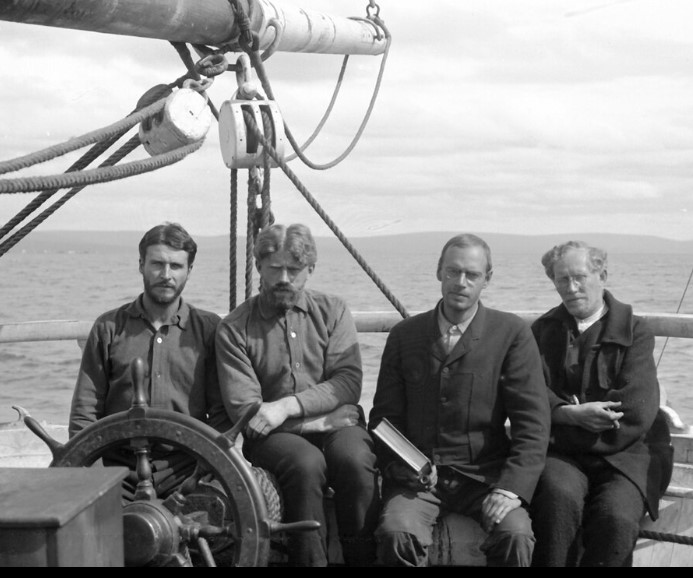
Members of the British-American Arctic Expedition with Ernest De Koven Leffingwell at left and Ejnar Mikkelsen second from left. (Photo from US Geographical Survey Photo Library, via Wikimedia Commons)

This German map from 1906 shows Keenan Land. (Photo courtesy of Wikimedia Commons)
I’ve always liked reading books about geography. When I was a young man, I had a book called No Longer on the Map.
It was about places that were once thought to exist and therefore showed up on various maps but turned out, in fact, not to exist at all or to have been badly misplaced.
The great American geographer Samuel Eliot Morison in his marvellous history The European Discovery of America: The Northern Voyages, called such places “flyaway islands and false discoveries.”
One place that is not in either book is Keenan Land.
Don’t feel surprised if you’ve never heard of it. It would be surprising if you had. That’s because it doesn’t exist, and yet it featured prominently on some maps in the early 1900s.
It’s named after its discoverer, John Keenan, an Arctic whaler. He went to sea at the age of 14 and spent many years on whalers in the North Pacific and the Arctic Ocean.
It was a tough life and he survived at least one shipwreck, that of the James Allen near Point Barrow, Alaska.
The captain’s obituary in 1910 tells of his discovery of the non-existent island:
“There is a tract of land off Point Barrow named after the worthy old sea captain. It is known as Keenan’s Land. The land was discovered by accident. It was after a very long and perilous voyage when the vessel was caught in a terrific gale, which at the first blow dashed to pieces the rudder, and the main mast went by the board.
“The small craft drifted helplessly before the wind and at top speed was beached on a strip of land which now bears the captain’s name. The party was safely landed, and references to maps and observations made proved that the land had never before been touched by man.
“The flag of the United States was fastened to a staff made from parts of the wreckage and placed on the highest point of land that could be reached. The discovery was reported at Washington, and the land was officially named after Captain Keenan.”
In 1907, a polar projection map was published in Germany showing Keenan Land north of Alaska in the Arctic Ocean. Scientists at the time believed tidal fluctuations north of Alaska must result from the presence of a land mass near the North Pole. They had only to find it.

In 1905, British adventurer Alfred Harrison embarked on a private expedition, the British Exploring Expedition, with the grandiose plan to find a previously undiscovered polar continent in the Arctic Ocean, and ultimately to proceed to the North Pole.
He and his team surveyed the coast between Herschel Island and Baillie Island and attempted to reach Banks Island. But they did not venture far offshore and never made a serious search for land to the north. He wrote a book about what can only be considered his failure: In Search of a Polar Continent, 1905-1907.
In 1906, an American scientist, Ernest De Koven Leffingwell, and Ejnar Mikkelsen, a Dane, embarked on a private expedition, the strangely named British-American Arctic Expedition.
They were both experienced Arctic explorers and veterans of the Baldwin-Ziegler Polar Expedition to Franz Josef Land north of Russia. This time, they decided to search for Keenan Land or whatever land mass lay north of North America. They were joined by a Norwegian, Storker Storkerson.
They purchased an old sealing vessel, the Beatrice, and renamed her the Duchess of Bedford. She was a sailing ship with no auxiliary engine.

The City of Victoria, B.C., was a financial sponsor of the expedition but even with that backing they operated on a shoestring.
In short order, the vessel was crushed by pack ice off the north coast of Alaska, where the expedition members wintered at Flaxman Island in a hut they built from wood salvaged from the ship. Vilhjalmur Stefansson, who went on to fame as an Arctic explorer in his own right, was to join the expedition at Herschel Island, but the ship never made it that far.
The explorers persevered, despite the loss of their ship. They travelled by dogsled over the frozen sea and bored holes to take soundings. They found that the farther north they went, the water became deeper. Farther out, they located a continental shelf in the Arctic Ocean about 100 kilometres offshore. But no land.
Mikkelsen left in 1907, but Leffingwell remained on the Arctic coast for another year.
Three decades later, in 1937, George Hubert Wilkins flew over the area and proved there was no land there.

This plaque commemorates the sealing ship Duchess of Bedford, which explorers used in an attempt to find Keenan Land. (Photo by Paul Stubbing)
Leffingwell was a geologist and a competent mapmaker. He returned twice to the North Slope of Alaska. He was the first to scientifically describe permafrost and he identified the oil potential of the North Slope region. He died in 1971 at the age of 96, the last of the old-time polar explorers.
The British-American Arctic Expedition left its own mark on the northern map with place names that have remained.
In Alaska, there is Duchess Island, Leffingwell Glacier, Leffingwell Creek and Mikkelsen Bay. In the Northwest Territories, there is Leffingwell Crags.
But there is no Keenan Land on any recent maps.
Taissumani is an occasional column that recalls events of historical interest. Kenn Harper is a historian and writer who lived in the Arctic for over 50 years. He is the author of Give Me Winter, Give Me Dogs: Knud Rasmussen and the Fifth Thule Expedition, and Thou Shalt Do No Murder, among other books. Feedback? Send your comments and questions to kennharper@hotmail.com.
(0) Comments