


The Moravian mission to Ungava: The aftermath
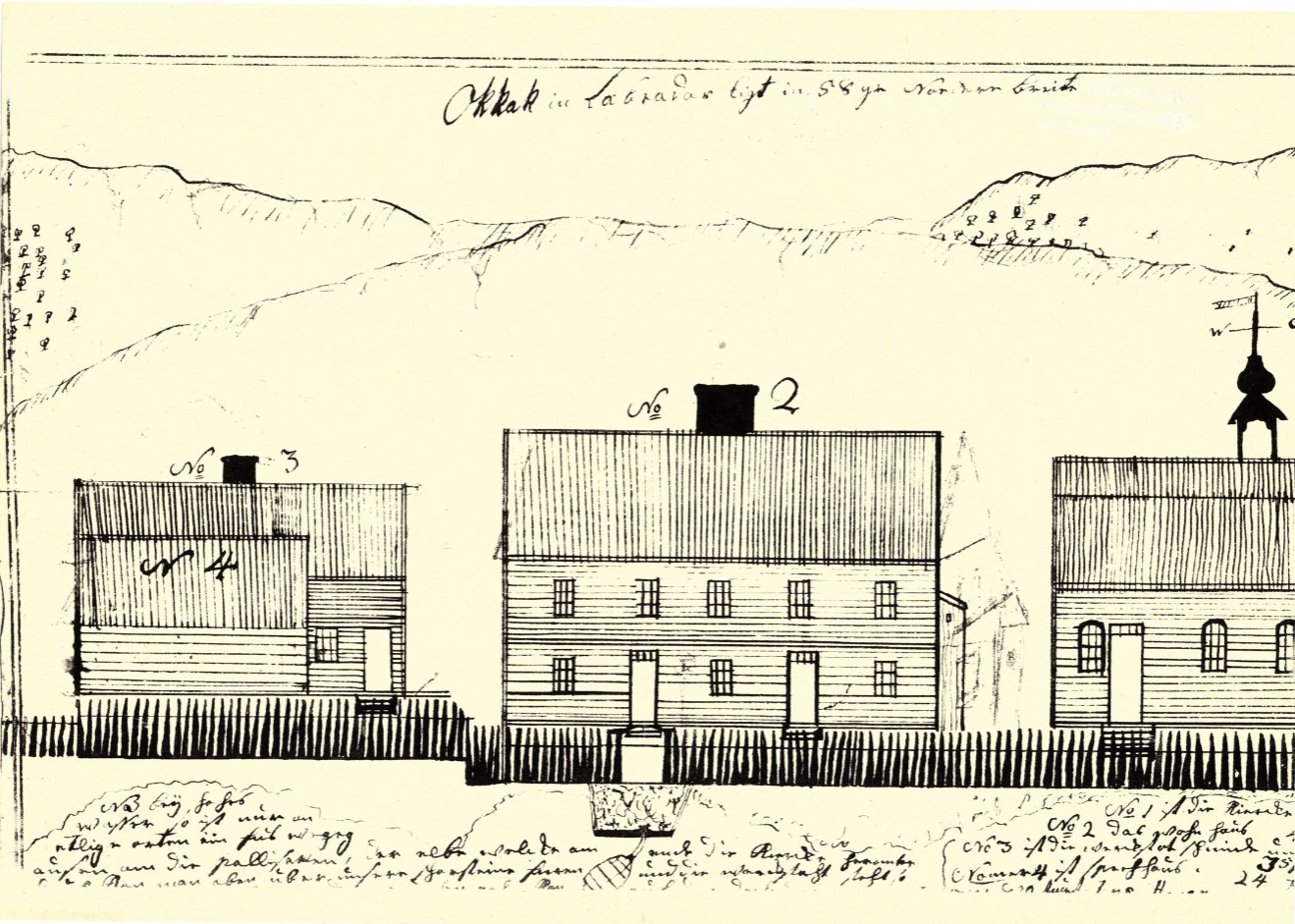
This pencil sketch of Okkak, Labrador, in the late 1700s, is titled “Labrador Inuit Through Moravian Eyes.” (Image courtesy of Memorial University, Archives and Special Collections, Digital Archives Initiative)
Benjamin Kohlmeister and George Kmoch returned to their mission at Okkak on the Labrador coast in the fall of 1811 after a trip with Inuit guides along the shores of Ungava Bay.
They liked what they had seen there — the land and its resources seemed likely to be able to support a mission, and the Inuit they spoke with were receptive to the idea.
The Inuit welcomed the idea of the Moravians returning and settling permanently among them, not so much because they wanted to be Christianized — they had very little idea of what that would entail — but because they knew the Moravians were traders as well as missionaries.
Many Inuit in Ungava were tired of being at the mercy of the influential Inuit middlemen who had set themselves up as itinerant traders, taking produce from Ungava Bay to Okkak to exchange there for European goods which were in high demand in Ungava.
In 1812, rumours spread throughout Ungava and beyond that the Moravians would shortly return and build a mission. The following summer, Inuit flocked to the Koksoak River. Twenty-one boats full of people came, with their goods, and spent the winter there.
Inuit at the time had no writing system. So how do we know what happened in Ungava Bay in those years? It is because two Inuit, Atsugarsuk and Aveinik, arrived in Okkak in 1815 and reported the activities to Kohlmeister.
He recounted what he learned from them in a detailed letter to the Society for the Furtherance of the Gospel. That letter, long ignored, should be considered a foundational document in our knowledge of the history of Ungava.
Kohlmeister wrote that the people were “anxiously waiting for our return.”
He continued: “Now, if we reckon 20 persons at an average to one boat, and the larger ones will hold 30, we may allow that nearly 300 Esquimaux have been waiting for us on the Koksoak, and that the Ungava country is not so destitute of inhabitants as one might be led to suppose.”
By my math, the number would be at least 400.
All but one of the boats were from various locations in Ungava Bay.
The largest was from Igluarsuk, that mysterious place reputed to be across Hudson Strait on the Baffin coast. That boat “was full of people, several of them old men and women, who had never seen a tree grow, and were exceedingly astonished when they saw wood for the first time,” wrote Kohlmeister.
“They construct their boats and implements of drift-wood… The said island has a great many inhabitants, and that, for want of wood, many of the old grey-headed people there, had never been in possession of a kayak.”

In 1811, Kohlmeister had thought Igluarsuk was near Resolution Island at the northeastern entrance to Hudson Strait, but four years later he was of the opinion that it might be Nottingham Island. In fact, Kohlmeister had no real idea where Igluarsuk was located, nor does it really matter.
Atsugarsuk and Aveinek reported the Inuit at Koksoak were preparing for the arrival of the Moravians. They knew the missionaries would need quantities of wood to construct buildings so, Kohlmeister wrote, “the men had resolved in their council that they would cut no timber for the repairs of their kayaks and boats in the Koksoak, that the woods might not be injured.”
In the meantime, Uttakiyok, their guide on the trip into Ungava Bay, was waiting — as his name suggests — in the eastern part of the bay, in readiness to guide them again as pilot whenever they might arrive.
He and other Inuit had “taken care to preserve the boards and other signals we had set up near the shore, that we might not seek the former places in vain.”
But, in fact, it was all in vain.

In 1813, the two missionaries and four others of their colleagues at Okkak acknowledged in a letter to Society for the Furtherance of the Gospel that, because of the Napoleonic wars which engulfed Europe, “it is not well possible just now to begin a new establishment in the Ungava country, but we hope and pray, that soon opportunity may be afforded to preach the gospel to the Esquimaux dwelling in that region.”
But that letter identified a possible obstacle: “As the Ungava country seems to lie within the boundaries of the district granted by charter to the Hudsons’ [sic] Bay company, leave ought to be obtained from that body to make a missionary settlement upon it, that we may not be treated as intruders, but as friends.”
In other words, the Moravians knew the Hudson’s Bay Co. had prior and exclusive rights to trade in Ungava Bay because of the charter it had received from the British Crown in 1670.
In 1814, when the Moravians published Kohlmeister and Kmoch’s report on their trip to Ungava, it was widely read. The Hudson’s Bay Co. took notice. It had long harboured its own interest in Ungava, but knew little about it.
Unwittingly, Kohlmeister and Kmoch had done the Hudson’s Bay Co. a favour — they had described Ungava Bay and its access and even published a detailed map.
The following year, the Society for the Furtherance of the Gospel secretary met with Hudson’s Bay Co.’s Lord Selkirk in London and asked for the company’s permission to establish a mission in Ungava.
Selkirk supported the idea of converting the Inuit to Christianity but, when told the mission would also be trading with the Inuit, he declined to give permission. There would be no Moravian mission in Ungava.
In 1817, a final letter from the missionaries at Okkak put the nail in the coffin of the Ungava mission: “We are sorry that, by circumstances, our ardent wish to bring the Gospel to the Ungava country, cannot be fulfilled for the present.”
The Moravians renewed their focus on northern Labrador, opening a mission at Hebron in 1830. That same year the Hudson’s Bay Co. opened its first trading post in Ungava, at Fort Chimo.
Taissumani is an occasional column that recalls events of historical interest. Kenn Harper is a historian and writer who lived in the Arctic for over 50 years. He is the author of Give Me Winter, Give Me Dogs: Knud Rasmussen and the Fifth Thule Expedition, and Thou Shalt Do No Murder, among other books. Feedback? Send your comments and questions to kennharper@hotmail.com.
Love reading history about ungava peoples.
No doubt the churches and the HBC kept a close eye on one another during the early days of development and expansion, a natural competition for the hearts and souls you could say.