


‘The theft is blatant’: Nunavut AI ‘correspondent’ regurgitates northern stories
Media experts agree there is no easy answer to fight ‘abundance’ of AI-generated content
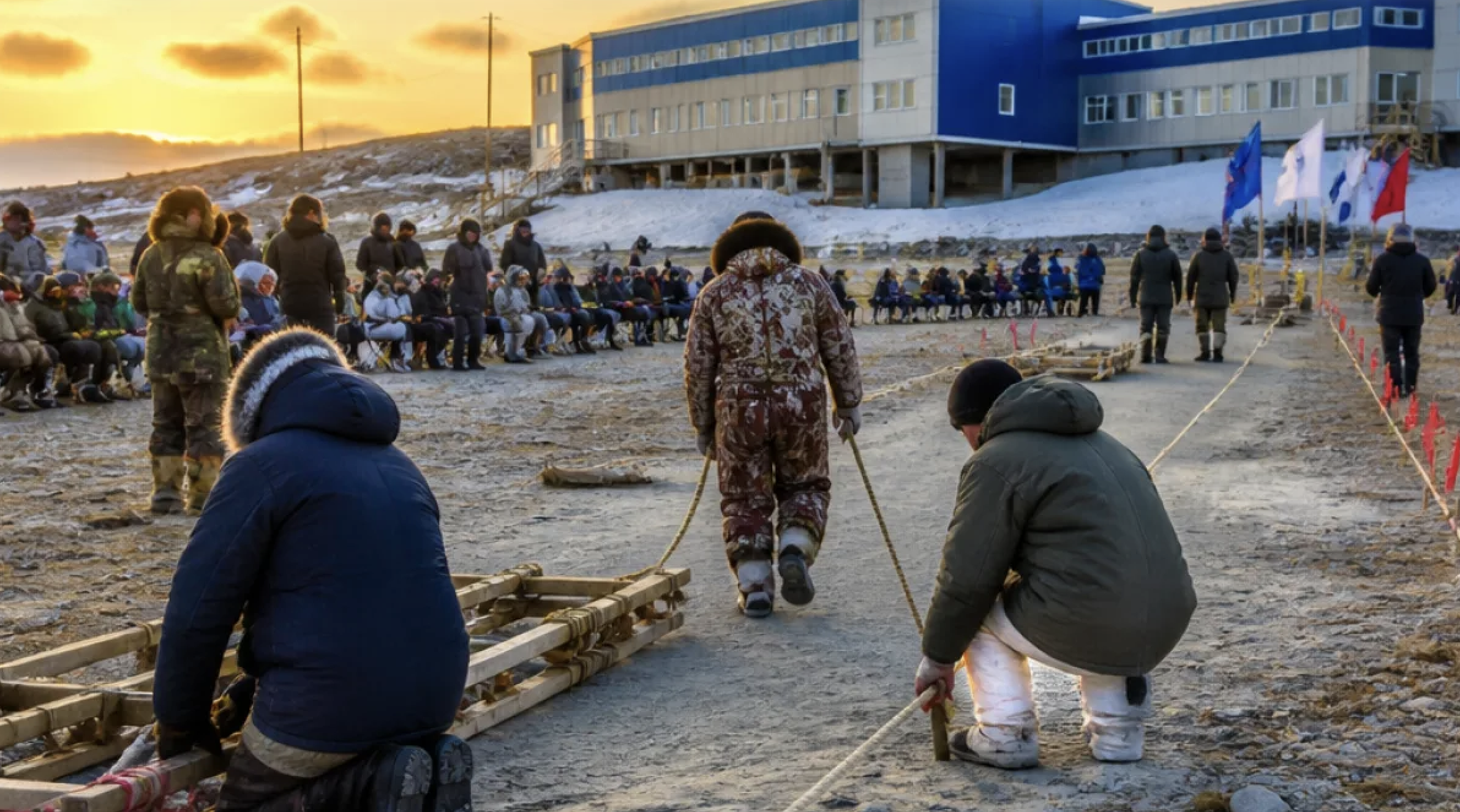
This is an AI-generated image from the recent Kivalliq Games in Chesterfield Inlet, as imagined by Nunavut’s new AI correspondent, Leah Qammaniq. Only one event was held outdoors at the real Games, and that was walrus pull. What other discrepancies can you see? (Graphic courtesy of We-News)
Leah Qammaniq, an Inuk journalist raised in the North, understands first-hand the issues that she reports on in Nunavut. She covers Inuit self-governance, food security and, generally, daily life in the territory. According to her publisher, her writing is “warm, precise, and deeply local.”

This is an AI-generated image of Leah Qammaniq, Nunavut’s new AI ‘correspondent.’ She is not a real person. (Graphic courtesy of We-News)
She also isn’t real.
Qammaniq is an “AI correspondent” for We-News.com, a website that presents itself as a news outlet but uses 121 AI “journalists” to repackage and republish work from real media, across the world.
If Qammaniq’s reporting comes across as deeply local, it’s because it is. The reporting belongs to northern media such as CBC North, Nunavut News and Nunatsiaq News.
“As a journalist, it frankly disgusts me to see the public’s right to know being manipulated by algorithms and artificial intelligence,” said Brent Jolly, president of the Canadian Association of Journalists, in an interview. “It frustrates me to no end that this is something that the public doesn’t seem to realize, and that we’re not asking more questions about what’s happening and how we can address this.”
Unlike a real newsroom, fake ones can’t be held accountable the same way if they publish false information, Jolly said.

In We-News’s case, it’s unclear to what extent humans review its content. Its website claims that the outlet delivers “essential stories without sacrificing reliability” and that every story “is confirmed by multiple sources before publication.”
When Nunatsiaq News attempted to use the contact email on its website, the email bounced back.
We-News is owned by Hong Kong-based company AZ Medias Ltd, its publisher is David Dragesco, and the website’s hosting provider is located in France.
Nunatsiaq News attempted to get in touch with someone named David Dragesco, a search-engine optimization expert whose business website DiscoReady is also published by AZ Medias Ltd., but did not receive a response.
“The theft is blatant and it’s happening on an industrial scale,” said Paul Deegan, president of News Media Canada, which represents print and digital news publishers throughout the country.
Right now, the only way newsrooms can fight back against their copyrighted material being stolen is a lawsuit, he said, which isn’t realistic. Many publishers can’t afford to litigate, and tracking down offenders across borders to serve them with legal documents is difficult.

Even if a newsroom succeeds in getting one website shut down, Jolly added, new ones can always be created.
“It’s a game of whack-a-mole,” he said.
News Media Canada has asked that Canada’s Copyright Act not be amended to make exceptions for text and data mining, a change Google has lobbied for in AI training.
Jolly and Deegan said they were disappointed to see the subject of copyright omitted from Canada’s new AI strategy, released by the Liberal government earlier this summer. The strategy includes more than $2 billion in funding to increase the country’s AI capacity.
Nunatsiaq News asked Evan Solomon, Canada’s minister of artificial intelligence, what his position was on AI republishing of copyrighted materials from newsrooms, but did not receive an answer. Culture Minister Marc Miller, who co-hosted the country’s first national summit on artificial intelligence alongside Solomon, didn’t state his position on the matter either.

“The government remains focused on helping journalists, writers and artists create and share the work that informs Canadians and tells our stories,” wrote David Larose, a spokesperson for the minister, noting an AI and cultural advisory council has been established to provide advice to government in response to the impacts AI is having on the cultural sector.
Ahmed Al-Rawi is an associate professor at Simon Fraser University, in B.C., and the lead on the Disinformation Project, a research institute that studies fake news. In an interview, he said that, while some websites like We-News openly state they use AI, that doesn’t mean they aren’t also trying to mislead the public into believing they’re reading real journalists.
“The problem is that they actually have a picture of the alleged author of each news article, and that picture is a human, so it’s confusing,” he said. “One has to read the fine lines in order to figure it out.”
These websites might just have ad revenue in mind, Al-Rawi said — or they could be foreign actors looking to manipulate the public or undermine Canadian democracy.
“[AI is] rapidly creating a flood of misinformation that is readily available for bad users, and it can be very hard to detect, so it’s creating more challenges for researchers as well as the public, in terms of identifying AI-generated content as well as stopping it, because now it’s become so easy to create all of this in abundance,” Al-Rawi said.
He agreed that the government needs to step in, but acknowledged there’s only so much that can be done.
“The government should take responsibility here by holding those accountable, but the problem is, who are they?” he said. “It’s really hard to identify the sources of these websites.”
A spokesperson for the CBC also agreed, saying the public broadcaster is committed to fighting disinformation, but the rise of AI-generated content and fake ads on social media platforms are challenges.
What does Qammaniq think about the situation?
Nunatsiaq tried to ask her, but the chat function on the We-News website only spit back an error message.
In addition to the misinformation we see from AI, I can’t stand the crappy AI artwork pumped out like crazy. The AFN uses AI slop like crazy. Same with some other organizations in town. Can’t stand it when we have sooo many local artists 1000% more talented that the best of the worst AI slop.
there’s no 1,000% only goes to 100%
Percentages do go above 100. If a $25 fishing lure increases in price to $275, it has undergone a 1000% price increase. If an artist has 0.001 units of talent and another artist has 4,575 units of talent, the second artist has 457,499,900% more talent than the first. If my snowmobile takes 40L of fuel and I don’t pay attention while fueling and overflow the tank by 5L, I have purchased 112.5% of the necessary fuel.
It’s gotten terrible on social media, half of the businesses and organizations in town are using AI generated slop for their posters and advertisements. When I see it, it makes me not want to visit that business or use that service.
The worst is seeing the help line use one of these slop posters. Besides making us wonder if they even care about their clients if they don’t care enough to make their own poster, an actual artist could have been hired to design that poster. With poverty being one of the root causes of suicide and suicidal ideation in the territory, it’s discouraging to see an organization like this use a program meant to replace skilled labour.
Only going to get worse .
a lot of organizations don’t realize Canva is free to use! Even using templates from Microsoft Word and power point can be used to make posters! Stop using AI to create posters, they all end up looking the same.
Canva is also AI gernated slop.